
Image by Priyanga Ravihansa
Words by Jo Leask
Dancing Sri Lanka: Myth, Memory and Feminine Voices is a new platform curated by London-based choreographer and artistic director Sithumini Amarasingha, which seeks to preserve, celebrate and reimagine Sri Lankan dance within contemporary and international contexts. I attended its inaugural launch at the Bharatiya Vidya Bhavan Theatre, where the centrepiece was two contemporary works by Amarasingha, performed by her dancers in Ceylon Dance Company. The evening also included a performed, insightful, historical overview of Sri Lankan dance, a panel discussion and the launch of her new book, Dancing Beyond Boundaries. Two themes ran through the evening: safeguarding the heritage of Sri Lankan dance for younger generations and diasporic communities and making traditional forms accessible to international audiences and different communities. Amarasingha’s choreography offered an indication of what such an evolution might look like.
The historical overview mapped out the beliefs and traditions central to Sri Lankan dance, including its rich folklore and storytelling. Sri Lankan drummer Asela Rangadewa demonstrated how dancer and drummer work together in drum-driven sequences, followed by short extracts danced by members of the company. These revealed the distinct features of the form: grounded, open-legged stances, rhythmic footwork and expressive hand gestures. Wearing highly ornate headdresses, jewellery and saris, the dancers performed fast, repetitive turns, and angled foot taps that coordinated with the drumbeats.
In Amarasingha’s contemporary choreography, the dancers wore minimalist black leotards and sarongs, revealing the unadorned body and allowing for the athletic floor work and leaps intrinsic to her style. The first work, Kuweni, reimagines the story of Sri Lanka’s first mythical queen. Developed in 2024 for ten dancers from Amarasingha’s Master’s research, it reconceptualises the queen, danced by Amarasingha herself, as resilient and empowered through a contemporary feminist lens building a critique of patriarchy and inequality. Early on, Kuweni falls in love with a dashing but egotistical lover, whose macho leaps, over-expansive gestures and aggressive behaviour hint at his true colours. He cruelly rejects and abandons her, leaving the dignified queen devastated and powerless by his betrayal – a crumpled heap on stage. From this nadir, Amarasingha transforms the queen from a tragic figure into a determined warrior. Slowly Kuweni is resuscitated by the other women, who gather around her to form a healing matriarchy. Her timid, hurt gestures become more expansive and her steps more grounded; lyrical, soft, gendered movements grow stronger and more determined, and through them she establishes agency and voice. Amarasingha performs with an intensity and feeling that reflects her own experience of being a woman. Flanked by the other dancers, with their assertive movements and defiant gazes, she asks us to think about the lived experiences of women in patriarchal societies today and their ongoing struggles.
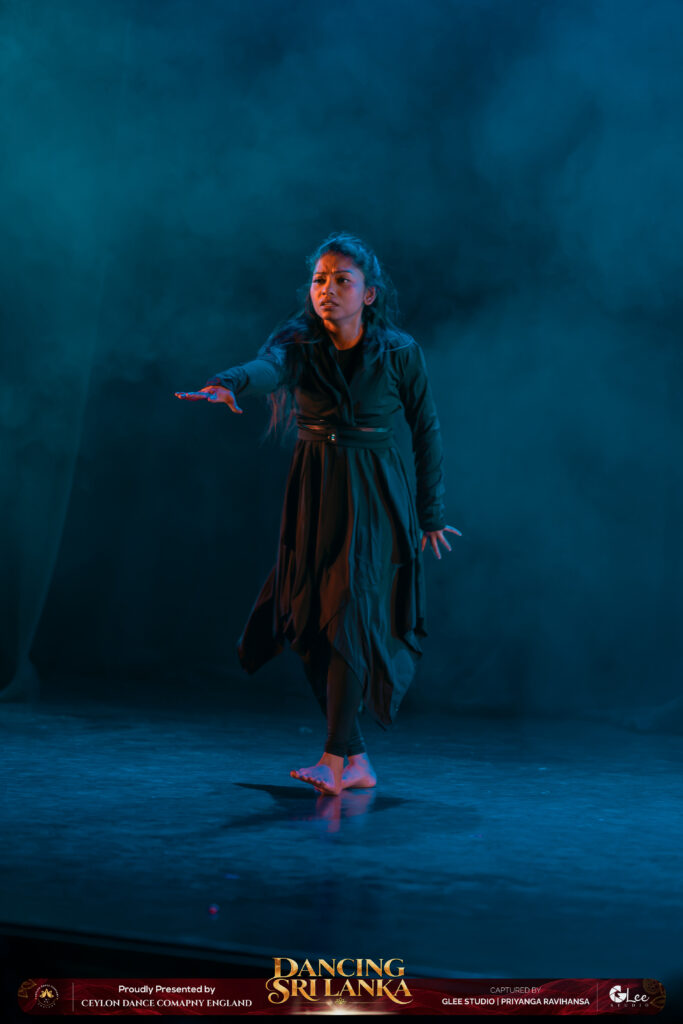
Amarasingha’s new work Kalu also draws on Sri Lankan folklore through repetitive movement, highly expressive gestures and spoken text. More abstract than Kuweni, Kalu questions fear and how patriarchal culture insidiously cultivates it in order to undermine women. Amarasingha performs with a smaller ensemble of five dancers, all in black tunics – a symbol of authority, resistance, danger and grief. Movement is based on tension and release to convey struggle: hands are held behind the back as if restrained, and gestures are direct and literal, such as pointing at another person, reaching out, holding one’s head or covering the face. Unison sections which articulate strength in numbers are powerful to watch when the women walk slowly in circles, or purposefully in a line downstage towards the audience. The whole body engages in the struggle, and sequences segue between fast turns, floor work and jumps. The dancers frequently collapse to the floor, roll across it or writhe in fear and anguish. Amarasingha creates a dark world and, rather than showing us glimmers of hope, asks us to question how fear can be gendered, who the perpetrators are and who are the victims. In both performances she pushes her body to the limit, always present and focused. Her passion for dance becomes an expressive tool but is always tempered by a sense of critical enquiry.
Amarasingha’s multi-faceted role as curator, writer, scholar and choreographer is impressive. Although her work is at an early stage of development, the evening revealed how it already traces the evolution of dance from traditional to contemporary form and questions the roles of women, from mythology to present-day societies. Together with the riveting performances, the closing discussion with scholars and artists made the evening an inspiring occasion for intercultural exchange, dialogue and learning.