
Image by Alena Egorkina
Berlin based dancer, artist and writer Alice Heyward talks to Polina Fenko and Daria Iuriichuk (the artistic duo ‘Girls in Scores’) about their work Traces and Exposures, premiered with Tanzfabrik Berlin BÜHNE at Uferstudios, October 1–4, 2026.
Girls in Scores is a collaborative artistic research project by Polina Fenko and Daria Iuriichuk at the intersection of expanded choreography and media studies. Through multiple formats such as performances and workshops, they examine movement scores, forms of body capture and the infrastructures of control embedded within them. Their work has been developed in Berlin and internationally (Tanzfabrik Berlin BÜHNE, ITI-Germany, affair gallery).
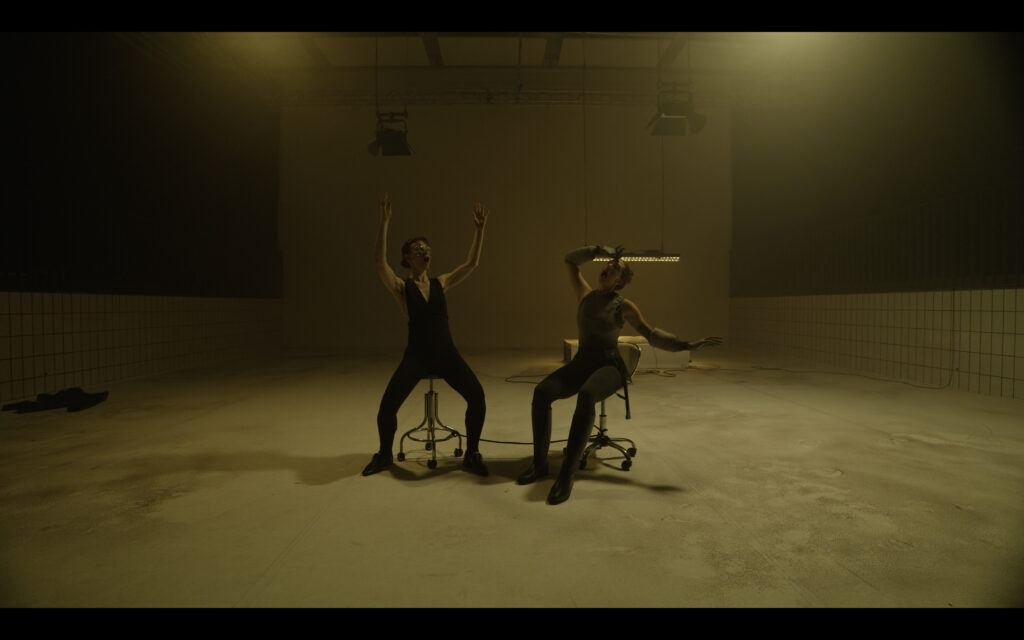
In Traces and Exposures, Polina Fenko and Daria Iuriichuk move through a dim, murky landscape built from their embodiments of historical images: the architecture of the anatomical theatre, Baroque automatons, the labour manuals of Aleksei Gastev’s Soviet Central Institute of Labour, and the photographs of patients taken at neurologist Jean-Martin Charcot’s Salpêtrière hospital in Paris, among others.
I find myself caught in a peculiar, ominous suspension. The situation is fraught, engulfing me in ambiguous textures and tones as it unfolds, pushing, cracking, seeping, and flicking through a maze of time. Small details appear within the changing landscape, drawing my attention to the angle of a forefinger or the parcours of small electronic beetles released onto the dusty, or maybe slimy, floor, tracing infinite markings. Time stretches and glitches. Space expands and shrinks through and between the performers’ bodies as they carve shapes that emanate forces. The show demands that I surrender to its breadth, weight, and intensity, like driving through the curving path of an underground tunnel, pressure bearing in from all sides. Dense, voluminous space beyond the walls that divide us presses ever closer.
There’s a cautious specificity to their bodies’ movement, like figurines being moved and held through and against resistance. Weight rarely drops or flies; they incrementally shape forms that represent somethings. I sense their significance but can’t recognise what they point back at. Weaving obscure matter and meaning, choreography in Traces and Exposures works like a puzzle that paints a picture it doesn’t know. The tunnel becomes a desert, becomes a cloud, becomes a disused industrial laboratory.
We spoke a few weeks after the performances about investigation as method, images that haunt and desire through embodiment, and how a viewer might meet these images as they inhabit and pass through the performers.
ALICE: I’ve been thinking about the relationship between investigation and research since the performance. Both are general (and opaque) terms for working in art today, but they come from fields outside artistic practice and can serve different purposes. There’s clearly a lot of research behind this piece, which moves through constructions of specific images pulled from diverse histories. The work has the air of an investigation itself, while strangely opening a mysterious, floating space where purpose dissolves into something felt.
How do you understand your own research process, and the aesthetics of investigation so present in the work?
POLINA: Daria and I have talked about how we travel through different times and documents. When does an investigation end? What keeps it going? Artistically, these images, displaced and out of time, haunt us. And they find their agency through us, the investigators. We’re captivated by them, embody them, and they enact what they want. Without living bodies, they are just images: a photograph separated from a body, a sculpture separated from its model. Through us, they get a space to re-enact a possible future.
ALICE: The work opens as an aftermath. The show begins with you actually telling us something violent has happened, and that you experience this somatically. You then embark, ostensibly as affected investigators, on a search for traces, scientific and sensorial, of allusive, elusive mysteries. Theatre may not be where we necessarily investigate bodies, but it’s certainly where we look at them. I found myself encountering my own gaze, hunting for clues.
DARIA: This reminds me of the book Investigative Aesthetics: Conflicts and Commons in the Politics of Truth (Verso, 2021) by media theorist Matthew Fuller and architect Eyal Weizman, founder of Forensic Architecture. They trace investigative aesthetics back to filmmaker Harun Farocki and his description of making a video essay. Farocki approached investigation by weaving together separate found media elements, like a bird collecting different sticks to build a nest. Fuller and Weizman talk about collecting affective evidence from people so that truth isn’t only from a hegemonic point of view but becomes common, communal, and collaborative. For me, research and investigation connect to that line of thought. In our case, however, we are not working with literal evidence. Instead, we use embodiment to explore what else might be discovered through the materials we are working with.
I think the urge to make the work ‘investigative’ came from wondering whether dance, so abstract, could really speak about reality. We both love media studies, and we wanted to bring research from this field together with the body, with its affective knowledge, outside textual, discursive knowledge.
POLINA: Investigation mostly deals with material evidence. At the very beginning of the process, we discussed how evidence is organised in criminology, for example: material objects linked by a narrative that is mostly created through text, a discourse that connects parts of reality that evidence itself doesn’t connect. Then we discussed this in relation to art exhibitions and re-enactments. A performance represented in a museum works the same way: physical props once used by artists, archival materials (drawings, written concepts, scores), and photo and video documentation of the past event are used to connect bodies across different times and spaces. And there’s often a text that frames it. In our discussions and experiments, we asked: what if the material evidence exists in this world, but the narrative that unites it isn’t imposed by a text that guides your thinking and perception about these images? What if it emerges from the materiality and the situatedness of an image within that world?
ALICE: Evidence is used in a courtroom as clues and traces to prove something. But you weren’t trying to prove anything. You were committed to emergent truth rather than to solving a case. I felt a strong devotion to the abstract. Andrei Tarkovsky’s film Stalker (1979) came to mind: dense with literary, philosophical, religious and historical references that not every viewer needs to recognise, working through poetic metaphor rather than rigid symbols. While the plot is clear, the meaning is deeply abstract, metaphysical, and open to interpretation. How did you think about what to reveal?
POLINA: I talked a lot with people who came to see the work, and many of them asked: what are the images? What are the references? Daria and I had an ongoing conversation about whether to specify our source materials: how to situate certain references in the work, how many clues the audience needs, and whether they should have to guess at all. Yet these images already circulate in culture. The photographs of patients diagnosed with hysteria at Charcot’s hospital, for example, were co-created and co-constructed[1], and they keep reappearing in other contexts and other bodies. It would be interesting to talk with the audience about how they feel these images in their body, rather than about where these images might come from. For me, that’s how I can understand if the images really arrived somewhere through our embodiments of them: less about guessing the historical references and more about the affect and perceptual intensity they carry. We tried to create a slow, viscous time that gives the images space to breathe, and the audience space to perceive them and co-imagine them with us. This slowness also runs counter to the genre of investigation, which is usually associated with events unfolding rapidly and evidence piling up. For me, it creates a more intimate way of questioning the very being of the image and how it can be perceived.
ALICE: A scene that stood out among the slowness was you both sitting on chairs downstage, your arms carving quick gestures: manual, mechanical, repetitive actions. This produced a strong image that wasn’t still or slowly moving, but played out rapidly through task and process, although the situation produced didn’t necessarily change: like a GIF.
How did you work with your different source materials? Were they mostly static images that you transformed into movement within landscapes and scenes? How did you move from image into action through time?
POLINA: We worked with very specific images: from the anatomical theatre, including architectural plans that show how the audience’s gaze is directed toward the uncovering of the body. Another reference, maybe not an image as such, was the Baroque automatons, the first robots: three-dimensional automated puppets connected to clock mechanisms. They played musical instruments and evolved into all kinds of animated figures, like a Cleopatra endlessly killed by a snake.
The automaton scene grew together with the labour manuals of Gastev’s Central Institute of Labour. It wasn’t something we set out to include. But as we repeated gestures following the logic of the automatons, we started asking: what is the repetition of a gesture? What is the repetition of a functional gesture, and what is the repetition of a decorative one? That brought us to the Industrial Revolution and the search for efficiency in movement.
The photographs of Charcot’s patients were different: these images have a past and a future. A photograph captures one slice of reality, but there’s a history before it was taken, and an after. So investigating it meant imagining what happened before the photograph was taken and what could have happened afterwards. Some of these images have an almost violent quality in how they were constructed. The anima is taken out, whether by drawing or by photographing. So what is this animation? What is the anima in relation to an image, and how do you meet it?
ALICE: What’s next? How might a new space change the work?
POLINA: There are so many different spaces it could go. In Uferstudios Studio 1, the former tram and bus depot of the BVG, Berlin’s public transport company, the tiles refer to many industrial sites, as well as clinical spaces and hospitals, and the rise of fascism in Germany in the 1930s. The work really found its home there for those four evenings. Our stage and light designers, Pire Sova and Emilio Cordero Checa, did a great job transforming Studio 1 into a liminal space. And Andrea D’Arsié’s music supported the haunting feeling in the room. For me, the question is where these images meet, and what world they meet in. So it will be fascinating to see what happens when the piece takes place in a completely new space, with its own history and scenery. It would cast the images differently.
[1] Fenko and Iuriichuk worked with Georges Didi-Huberman’s Invention of Hysteria: Charcot and the Photographic Iconography of the Salpêtrière (Macula, 1982; English translation MIT Press, 2003), a study of how 19th-century psychiatry and photography “invented” the medical diagnosis of hysteria.