
Toussaint To Move. Image by Beth MacInnes
Words by Isabelle Enquist
Living Image Chapter 2 demonstrates the archive not as a fixed record of past artistic achievement, but as something active, mutable and embodied. By inviting five practitioners to reinterpret Siobhan Davies’ 1977 choreography Sphinx through their own experiences and movement languages, the programme explores how we engage with archives and, ultimately, how time and context morph, inform, and reform movement.
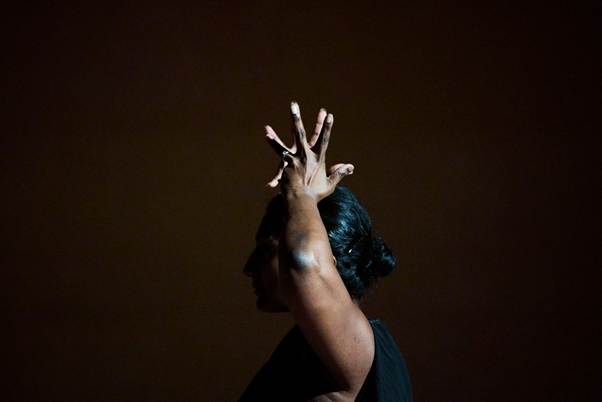
Subathra Subramaniam performing Keeping Our Heads Above Water as part of Living Image at Siobhan Davies Studios, 2026. Image: Beth MacInnes.
This comes in time for Siobhan Davies Studios’ 20th birthday celebrations, which marks two decades of pushing boundaries, redefining who a dancer is and can be through radical inclusivity. Living Image – a choreographic programme that invites contemporary practitioners to engage with and reinterpret works from the company’s archive – is a natural continuation of this mission and ethos.
Jules Cunningham, Sheri King, Charlie Morrissey, Toussaint To Move, and Subathra Subramaniam were given five days to develop their interpretations, without ever having seen the original work. Rather than simply replicating the original, Davies explains the process to the artists.
Davies’ seemingly relentless curiosity is central to this process: trusting others to receive and reshape your legacy is an exercise in relinquishing ownership. And in doing so, one recognises the archive not as something static to be preserved, but as something living. Our bodies are particular archives; they carry histories, experiences and knowledge that can be easily revealed, remembered, translated, reclaimed and made anew through movement.
FIRST IMPRESSIONS
It was interesting to first see the iterations before the archival film and imagery, and understand how each body and each person interprets ideas surrounding ferality, primal instinct and embodied knowledge, and the (dis)connection between body, nature, ground, and self. This reverses the usual relationship between source and reproduction, but perhaps this helped erase assumptions around language and expression, with the focus shifting to the individual understanding of each piece, each feeling, and their intention. It encouraged the audience to look for familiar, relevant elements, which were expressed with a heartfelt intention and honesty in each performance.
THE PROGRAMME
The five-day timeframe seemingly encourages a particular kind of creative urgency. This restriction produces structured improvisation instead of a rigid, finite, resolved work, leading the practitioners to find a different anchor — water, another body, spatial boundaries, repetition — through which to establish a framework for movement. This allows them to explore and develop ideas without necessarily having to arrive at a fixed or definitive piece.
Toussaint To Move and Subathra Subramaniam use water as a point of departure, expanding into different inquiries through narrative methodologies, using gestures and varying degrees of force and softness – from stomping to swaying – to determine intensity.
For Sheri King and Jules Cunningham, the idea of (self)discovery is particularly pertinent. In this collaborative performance, joy and curiosity shape movement. Charley Morissey uses a similar logic to see how space correlates to the self, and how imagination entangles with reality to create perceptual limits.
Touissant To Move – Coming Home
Water, both physically embodied by To Move and in audio form recorded on his visit to Jamaica, becomes the central organizing thread of Coming Home. Sounds of the sea, spoken word and live vocalisation move in conversation with the choreography, the narration informing the body as much as the body gives physical form to the words – poetry in motion. Beginning with smaller, deliberate gestures – palms and arms gently unfurling – the movement gradually expands, shifting between softness and force, fluidity and decisiveness. It investigates how the contemporary body is commodified for gain – exploited and used to propagate a certain bourgeoisie fantasy about the distribution of resources – and how this is reconciled with its role as a natural form, inseparable from its surroundings, from water and soil, as carrier of emotion, memory, knowledge and history. A particular idea which comes to mind from the audio is ‘diaphragmatic euphoria’: breathing, a basic act necessary for survival also undoubtedly forms the very molecular level of our being – the particles we inhale depending on place, the city smog or the salt in coastal areas – and the body the only space which restrains, liberates, stores, metabolizes, carries, and regenerates our personal, cultural, and migrational experiences.
Sheri King & Jules Cunningham — Elonging
A conversation, a game, a frolicking, a discovery and a chase, Elonging unfolds with an infectious sense of joy. The closest comparison would be the association game – where one term or gesture prompts a spontaneous response, completely dependent on the players’ subjective experiences. Beginning with a mirroring technique, perhaps a bit apprehensive at first, Sheri King and Jules Cunningham gradually develop increasingly individual and, at times, dissonant physical languages. There is something creature-like about their exploration, as though discovering the possibilities of having a body for the first time: how does a gesture develop as it travels through the body and what might happen if movement is allowed to follow instinct rather than intention? The playful, organic quality of the accompanying sound evokes crickets, insects and the imagined rhythms of an evolving ecosystem. What begins as an exercise in connection becomes an exploration of individuality, demonstrating how two bodies can share a space, playfully untangling the constraints or possibilities which this creates.
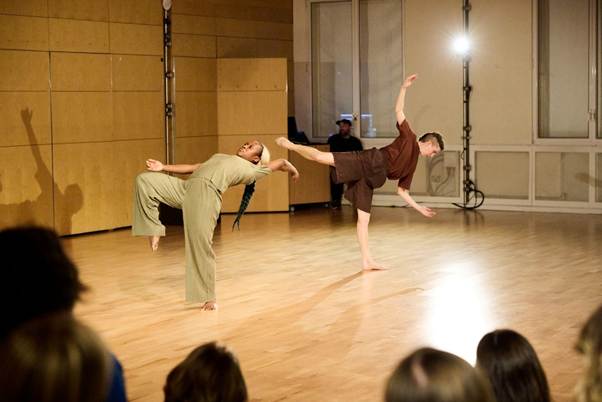
Charlie Morrissey — What moves gets taken by the wind
Clad in white and framed by a bright projection, Charlie Morrissey’s What moves gets taken by the wind establishes a strict relationship between the body and the space it occupies. Exploring weight and weightlessness, gravity and propulsion, the work considers how the ground defines and restricts movement, and how the body might find ways to become unshackled. The projected boundaries appear initially definitive, yet the interplay between light and shadow gradually complicates them, with the expansion of Morrissey’s shadow seemingly extending the space. Is he trapped by the boundaries of the projection, or does his presence redefine them? With the soundtrack being just sounds of the wind, movement becomes tempered by visual perception and the performer’s own, gradually developing, movement and speed, as he finds his footing, seemingly, and starts to understand that direction can be defined by gestures such as push and pull or pointing, but will necessarily inform the rest of the attached body.
Subathra Subramaniam — Keeping Our Heads Above Water
A really energising and gripping conclusion to the evening, Subathra Subramaniam’s Keeping Our Heads Above Water is both inquisitive and commanding. Drawing on Bharatanatyam’s dramatic storytelling, a vocabulary of precise gestures – washing, kneading, soothing, scooping, and reaching – develops through repetition, rhythm and an increasingly forceful physicality. The repetition serves as a way of building intensity and meaning, like how the mundane and routine give way to increasing conviction, to expertise. It’s directional, specific, and deliberate. An ode to grit and perhaps ferality of womanhood, where softness and vulnerability are not at odds with strength, but are themselves its source. To be enduring is to become relentless and unyielding. In a moment which felt serendipitous, the lighting in the space caused Subramaniam’s shadow to split into 3 afterimages, creating multiple versions of her and almost suggesting the generational and ancestral knowledge carried within. The entire performance encompassed this knowledge as something precious and tense, which we hope to hold onto and honor, which can be trapping, but also freeing and empowering. The accompanying poem by Chris Fogg puts it well: ‘she carries what her body remembers and she keeps going – every drop is precious’.
Traditional archival practices often prioritise preservation, documentation and historical accuracy, yet fail to recognise the inherent bias – decisions about preservation practices and methods, what is ‘worth’ archiving, and how material was acquired. The importance of a programme like Living Image is that it sits somewhere between archival research, artistic collaboration, choreographic experimentation and performance. It proposes a different relationship with the archive: one that values interpretation, process and invention – an archive entirely subjective and in its subjectivity honest, where meaning can change as it passes between bodies, generations and artistic practices.
Rather than presenting the archive as something to be looked at, it asks what happens when we allow ourselves to move through it. We are always incredibly concerned with preserving the original condition of things, but that preservation could be a form of interference. What if allowing something to change, decay or be used might be a more honest way of honouring its existence?