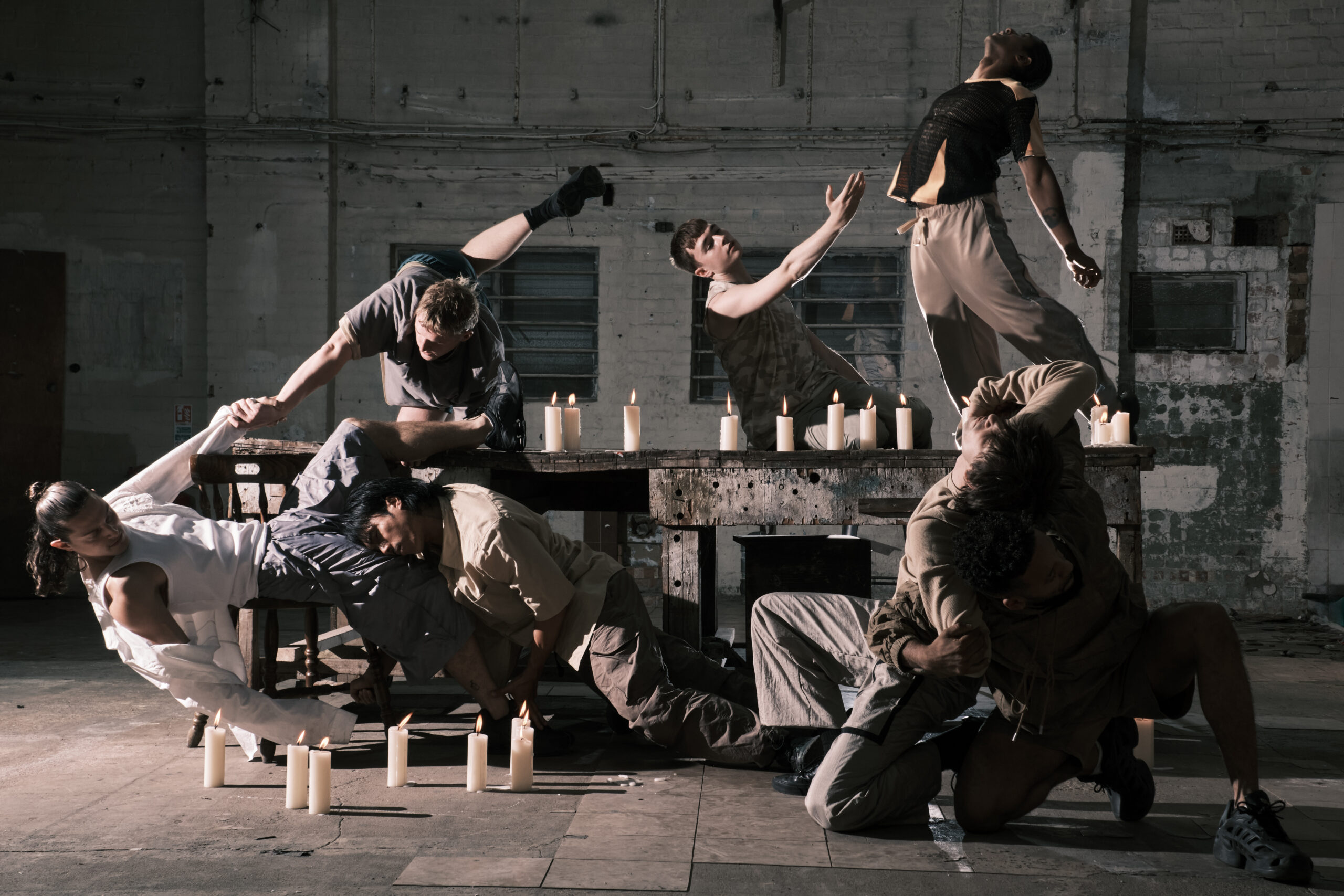
Image by Ralf Hersborg
Words by luella Rebbeck
Twas the night of Halloween, and not a creature was stirring, except a lonesome chair, holding space for all that had been lost.
There was something quietly ceremonial about the opening of Hang Time. A meditative, almost ritualistic soundscape accompanied the slow unfolding of the performance, creating the sensation of watching something at once impossibly ordinary and strangely sacred. I found myself waiting for an act to reveal itself, as though I had entered a room just before a magic trick, a confession, or a private ceremony was about to begin.
But what happens when the horror is not something lurking in the darkness, but something we carry within us?
Through questions of violence, masculinity, diaspora, grief and loss, Malik Nashad Sharpe brings bodies together in a shared language of breath, rhythm and collapse. The dancers begin to form a landscape rather than a collection of individuals. Whether two or three bodies occupy the stage becomes almost irrelevant; what matters is the sensation of something continuing to happen, of people attempting to remain together as something else falls apart. There is something profoundly outward-facing about the work, a sense of performance as an act of showing, of making something visible for an audience. Yet I found myself wondering about the distance between displaying grief and actually feeling it. At times, the emotional language felt startlingly clear, almost binary, as though grief could be separated into recognisable states and presented for our understanding. I wanted more uncertainty, more mess, more of the contradictions that make grief so difficult to articulate in the first place.
How do you choreograph something that refuses to remain still?
The bodies repeatedly stamp their feet, gathering rhythm through breath and repetition. Grief becomes a shared space that people enter and exit at different points, rather than a linear passage with a clear beginning or end. There is something almost joyful in this collective physicality, a suggestion that even when loss cannot be resolved, its weight might be momentarily redistributed.
Grief, here, is not a destination. It is a condition of being together.
Curiously, it was the quieter images that stayed with me most. The backs of bodies turned away from us against a stark, almost cinematic white backdrop. Figures struggling without offering us the reassurance of their faces. No obvious invitation to understand, just the back of a body carrying something we cannot entirely see. How much can we read in someone’s back? How much trauma lives in the shoulders, the spine, the small collapse of the head? Sometimes, I think, we feel more than we see. Perhaps we see something more honestly when we are not given a face to interpret. These images possessed the grain of an old film, like fragments of memory recovered from a damaged recording. I found myself more interested in these moments of apparent breakdown than in the dancers’ most technically accomplished movements. Less interested in the greatest trick or the most impressive step, more interested in the instant when the body could no longer maintain its composure.
What happens when the performance of strength gives way?
The shadows offered another answer. Depending on the light, they grew larger than the bodies themselves, stretching beyond their physical limits. Grief seemed to follow the dancers, becoming something that could not be contained within an individual. Something that changed shape according to the light, that remained present even when nobody was looking. On Halloween, this felt particularly resonant. The work hovered between horror and reality, between the supernatural and the painfully familiar. A red spotlight briefly transformed the stage into something almost frightening, yet the image felt less like a theatrical fantasy than an insistence on the present. This is happening now. This is not a story about somebody else. Grief does not always announce itself dramatically. Sometimes it arrives through an unfamiliar sound, a radio playing in another room, the sudden recognition that you have been carried somewhere you did not intend to go. I thought about the experience of losing oneself in a sound, of longing for something that is no longer there, of inhabiting a reality that has become almost unrecognisable. The soundscape moved between contrasting textures, punctuated by pauses that offered brief opportunities to breathe. Yet the movement often felt relentlessly compressed. There was so much repetition and physical information that I occasionally became overwhelmed, until the movement itself seemed to disappear from view. I wondered what might happen if the work trusted stillness a little more, allowing a single gesture to remain long enough to become uncomfortable. Perhaps this insistence was itself an expression of grief: the compulsion to repeat, the body’s attempt to find a rhythm capable of holding what language cannot. Still, I found myself wanting something more unguarded, less like a demonstration of feeling and more like the experience of being caught inside it.
Is grief contagious? And if it is, what exactly passes between us?
Through stamping feet, synchronised breath and repeated gestures, the individual experience begins to acquire a collective pulse. Something private becomes momentarily communal. There is even a kind of joy in this togetherness, not as an escape from grief but as the relief of recognising oneself in another person. These questions feel particularly resonant alongside the work’s concerns with masculinity, violence and diaspora. What kinds of grief are permitted to become visible? What happens when the expectation of masculine endurance collides with the body’s need to collapse? And how might displacement, inherited trauma or the loss of belonging shape the ways in which we carry sorrow?
I was interested in grief as something embodied, inherited and shared: a feeling that moves between people, sometimes consciously, sometimes without their knowledge. Yet I was not always convinced that the performance fully trusted these questions to speak for themselves. At times, I wanted less of the feeling to be presented so clearly, and more room for its contradictions to remain unresolved. I smiled quite often while watching. There was something recognisable in the physicality, something human in the awkwardness of bodies trying to make sense of what has happened to them. I felt, at moments, as though I could smell the performance before I could fully see it. Its physicality seemed to travel through the room, through breath and sweat, resisting the limits of the visual. Perhaps this returns us to the body as an archive. We often look for grief in the face: the tear, the grimace, the unmistakable expression of sadness. But what if grief is equally present in the back, in the feet, in the breath, in the repeated effort to continue?
What if the most truthful image of grief is not the moment someone breaks down, but the effort required to stand up again?
I left thinking about the relationship between endurance and collapse, and the possibility that these are not opposites at all. To endure is not necessarily to remain intact. Sometimes it is the willingness to be seen struggling. Sometimes it is simply the decision to remain in the room with another person.
Hang Time did not always give me the realism I was searching for. At times, the accumulation of movement overwhelmed the intimacy of its subject, and the representation of grief felt more immediate than the experience itself. But its quieter images stayed with me: the solitary chair, the white floor, the backs of struggling figures, the shadows growing beyond the limits of their bodies.
On a cold Halloween night, in a small room of people watching other people struggle, there was something quietly radical about this gathering. A group of strangers sharing time with bodies attempting to articulate what it means to lose, to remember, to fracture and to continue. Perhaps connection begins somewhere before understanding, in the recognition of a familiar rhythm, a familiar hesitation, a body that falters in a way we recognise without knowing why. What if we allowed our small, imperfect stories to exist between us without demanding that they become anything more? What if the act of witnessing another person’s grief were enough? And what if, in the midst of all that we cannot repair, the simple fact of being together were itself a form of endurance?