Words by Isabelle Enquist.
Sound, or rather the perception of sound, is dependent on time and distance both in its physicality and its retention. Memory, as an archive of sound, behaves in similar ways. To record a sound is to take it out of context, away from the circumstances in which it was first heard, apart from the bodies and spaces that created it, never to be faithfully reproduced. We should be at peace with this inaccuracy; memories and sound morph, skew, succumb to bias and acquire meanings as they age.
Iskendriya Al Qahira: Visitations One is a sonic performance, part of an ongoing project, by Muhammad Muhammad, in which the artist gathers recordings of (and between) Cairo and Alexandria — traffic, trains, street conversations, domestic noise, radio announcements, Ramadan music — and abstracts them into an almost-recognizable ambient soundscape. Cities breathe and shake, streets chatter, cars whisper, and the speed and the flow of traffic unmistakably form the city’s identity. Have you listened to the sound a pedestrian light makes to signal go? It is different in one city and another. It has cadence and rhythm and breath. What does prayer sound like, and what key is it in? What note does an electric bus make? How does the pitch of a car tell you something about its make, its maker, its owner? The recordings do not restore a clear image of Cairo and Alexandria. Instead, they allow something of those places, their character, to visit the present in a venue more than 3000 kilometres away, arriving through fragments and associations.
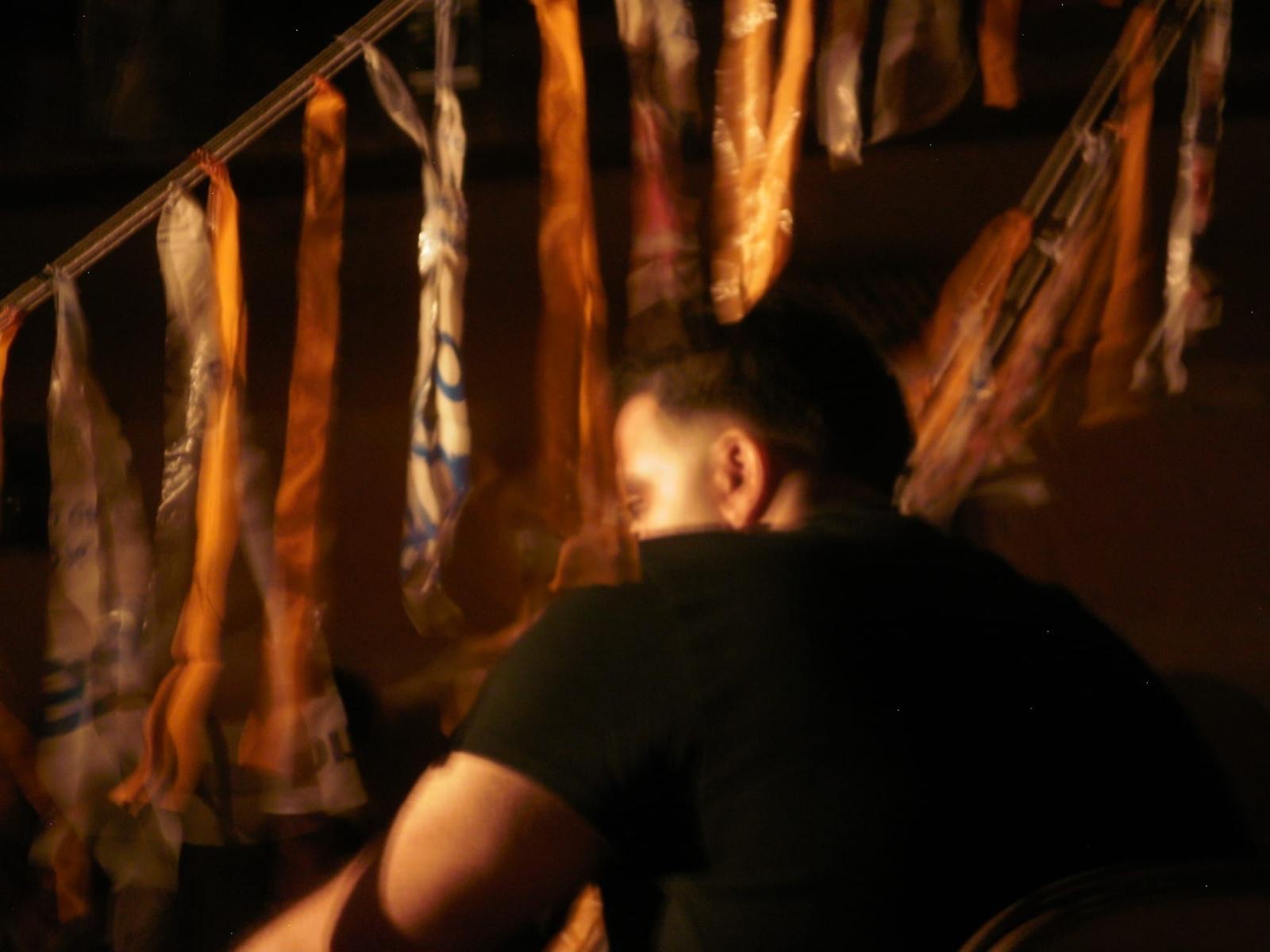
This particular iteration of the performance took place in an intimate room in Palestine House, London, against the backdrop of rugs, ornate tiling, plastered walls, and wooden banisters. Egged on by two fans, pieces of plastic fluttered like flags, like wind, like clothes being dried on strings, and kites. A lot of the recordings are of the domestic and the everyday, but their use in the performance echoes what Muhammad’s grandmother refers to as ghurba – with her explanation of the word marking the end of the performance, it is most closely translated as loneliness, longing, estrangement and alienation which often come with leaving home. This retelling comes with a certain intimacy, like sitting in someone’s living room, having coffee, a story unfolding slowly, with many details, some drawn out goodbyes in the doorway. But without immediate proximity, we are liable to forget the precise texture of things. Visitations here are brief arrivals within familiar spaces, close enough to a homecoming, but with the knowledge that they are short-lived.
Muhammad’s vocal improvisation – responding to a particular lyric from a Ramadan song, speaking of the wait to return – makes the dimension of the performance suddenly shift to that inevitable proximity, activating the listener. Even to a non-Arabic speaker, this intention comes across perfectly clear, slowly enveloped by a certain longing. Their voice becomes both part of the soundscape and an interruption of it, something living entering and altering a collection of recorded traces. To notice these sounds and engage with their presence is to understand the unique DNA of every city, of every neighbourhood, every household. We can uniquely identify a locality based on the ambient, the collective noise, if you will, and our development within it.
You can tell the age of the population, what political rhetoric is dominant, when schooldays come to an end, which areas are commercial, which residential, which densely populated. Muhammad describes the work as an act of active remembrance, rather than an attempt to reconstruct a fixed past. This restraint is important. The ambient noises — chatter, traffic, song, construction, and domestic sounds certainly, inevitably occupy a political dimension. A city’s infrastructure, density and quality of life are shaped by social and political conditions. It is these exact conditions where the careful examination of memory becomes a form of resistance; like oral histories, scriptures, and maps drawn retrospectively after long voyages. To refuse unanimity here is to excavate memory and reap its potential for communing. Memory is a living archive through which we should be examining how culture, learnt behaviour and values are retained over time, how they inform choices, how the inaccuracy of memory might actually tell us more about the conditions experienced than ‘factoids’, information widely spread, learnt, and believed.
For someone living away from home, this process is especially charged. Migration isn’t unusual to the human species; people have always moved by necessity, desire, violence, work, or love. But distance can complicate the relationship with home. In writing about exile, Edward Said describes the danger of what he calls “compensatory nationalism”: the construction of an idealised, rigid mythology of the homeland in response to separation (Said 2013). For someone who has formative memories of a place, its integration into behaviour, memory, speech and relationships is obvious. As Said’s writing on exile suggests, distance can intensify attachment to a homeland, sometimes turning it into an idealised version of itself, sometimes creating insistence on preserving a social identity. There is a desire to preserve, but preservation can also distort, distance can sharpen feeling while diminishing detail. Muhammad’s work seems to resist this impulse without denying the longing that produces it. The recordings do not offer an uncomplicated celebration of home, but they posit nostalgia as a gateway to forming healing relationships with culture outside of a singular context. They allow affection, uncertainty and loss to coexist.
But Muhammad’s use of sound feels less interested in declaring with certainty what they signify, but rather attending to their specificity. The piece does not insist that Egypt, Alexandria, or Cairo are good or bad, that home was something to be glorified or something to be escaped. It is, instead, a bit lonely and transient. The sounds arrive, overlap, recede and return. There is no demand that they mean one particular thing, and these places, too, are the subject, a living network which is as it is, and will experience turmoil, expansion, progress, peace, or tension. It allows something belonging to another person, another city, another childhood, to become temporarily entangled with our own experience of the world. The performance does not give its audience Muhammad’s memories intact. Instead, it creates the conditions in which memories of our own can surface. It felt like cigarettes, terraced cafes, tangerine peels, old women observing from windows, motorcycles, and town squares.
In London, and particularly in a space dedicated to the preservation and expression of Palestinian culture, this refusal to be depersonalized and desensitized to each others’ experiences is urgent. The reality of displacement is that the physical gap between people and their homes is concrete. Our physical removal from conflict does not mean separation from its cause.
It is in the distortion, the distance, the gaps and the reconstruction that something new becomes possible. These impressions are not exactly quantifiable, not exact at all, so they lie within a shared space and necessitate exchange. The encounter does not make our memories identical; it allows them to coexist. What begins as a recollection of Egypt becomes a meeting between different experiences of place, absence and belonging. This subjectivity becomes a kind of truth in its one-sidedness, its irrefutability.
Images courtesy of the artist.
Citation
Said, Edward W. Reflections on Exile and Other Essays. London Granta Books, 2013. Accessed October 11, 2026. https://mcrg.ac.in/RLS_Migration/Reading_List/Module_A/65.Said,%20Edward,%20Reflections_on_Exile_and_Other_Essay(BookFi).pdf.