Words by Luella Rebbeck.
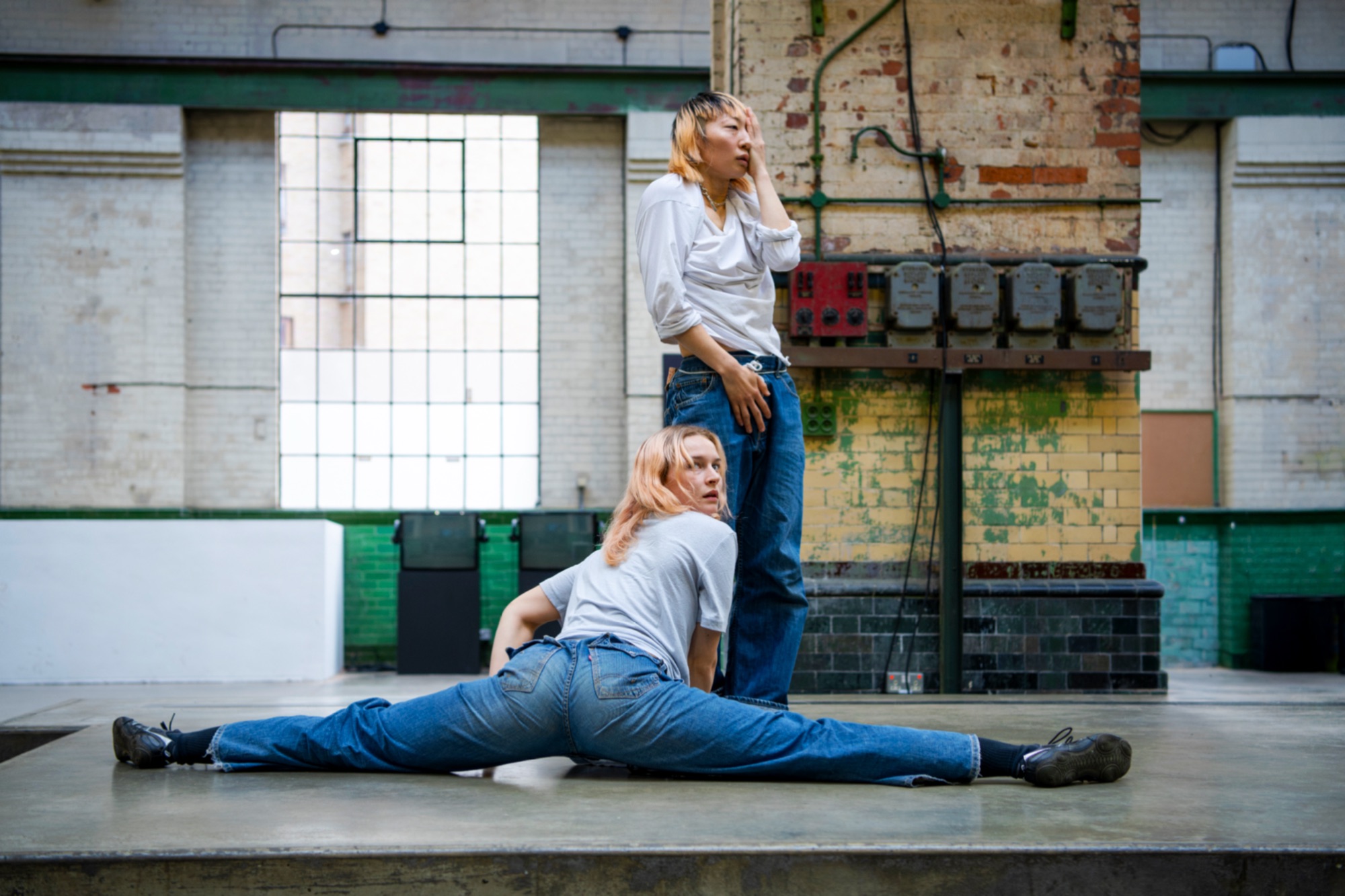
Entering Wapping Hydraulic Power Station as part of Somerset House Studios 3 Evenings felt like stepping into a deserted office space hijacked by the future. The cavernous power station, with its concrete slabs, towering ceilings and imposing machinery, had been transformed into a futuristic hall of glory. Robot greeters welcomed us into a dark, atmospheric landscape where blaring screens, pumping imagery and disembodied sounds seemed to occupy every corner. There was a sense of technological omnipresence: multimedia installations, erotic film cosmologies, multichannel projections and live performance collided across the vast industrial space.
Yet, for all its futuristic ambition, the experience felt strangely familiar. There was something of the late-night doom scroll about it, a fever dream of images and bodies assembled without an immediately discernible logic. I wandered through the power station following lights, people and sounds, trying to establish a sense of direction within an environment that seemed to resist being understood. The atmosphere was peculiar, occasionally intoxicating, but also frustratingly opaque. I felt that something was being communicated, although I wasn’t always sure what.
The exhibition’s multidisciplinary approach suggested a world in which technology, the body and feminist power might converge. There was something almost oracular about the experience, as if the performances and installations were attempting to uncover hidden cosmologies or reveal new ways of seeing. Holly Blakey’s choreographic language, in particular, seemed interested in the body as an object to be rearranged, reconstructed and made strange. Across the work, bodies became mannequins, statues, dolls and vessels for something both intimate and unsettling.
But how much of this world could actually be accessed?
A one-way system directed audiences through the power station, creating a viewing experience that was not always particularly efficient. At times, I found myself waiting, standing in crowded rooms or trying to work out where I was supposed to look. In one space, purple lighting transformed the room into something resembling a rave. Bodies crowded together, obscuring the performance, while I could see little beyond the backs of people’s heads. Elsewhere, I watched live performance on a screen while the physical space around me offered only fragments of the action.
There was a strange sense of road traffic to the experience: bodies moving through corridors, gathering in rooms, following the next light or sound. We seemed to be navigating an office that had been temporarily hijacked, attempting to make sense of a world whose rules remained unclear. I found myself wondering whether the disorientation was intentional. Perhaps the inability to see everything was part of the point. Technology is everywhere, and access to images does not necessarily mean access to the thing itself. We are increasingly accustomed to encountering performance through screens, livestreams and digital fragments, often without the choice to experience the work in person. In this sense, the exhibition’s fractured structure reflected something of our contemporary relationship with art and technology.
And yet, there is something undeniably precious about witnessing live performance. To feel that possibility being withheld, or to find oneself unable to see a work properly because of the conditions of its presentation, was frustrating. I wanted to choose where to stand, what to watch and how long to remain with an image. Instead, I often felt that I was catching glimpses of something that was already disappearing.
When a live performance is transmitted onto a screen, does it remain live, or does it become digital art? Can it be both at once? And what happens to the intimacy of performance when our relationship with the body is mediated by technology?
These questions became particularly pertinent during the Holly Blakey and Tai Shani’s presentation, I am a Glass Doll Under the Heel of a Dirty God.
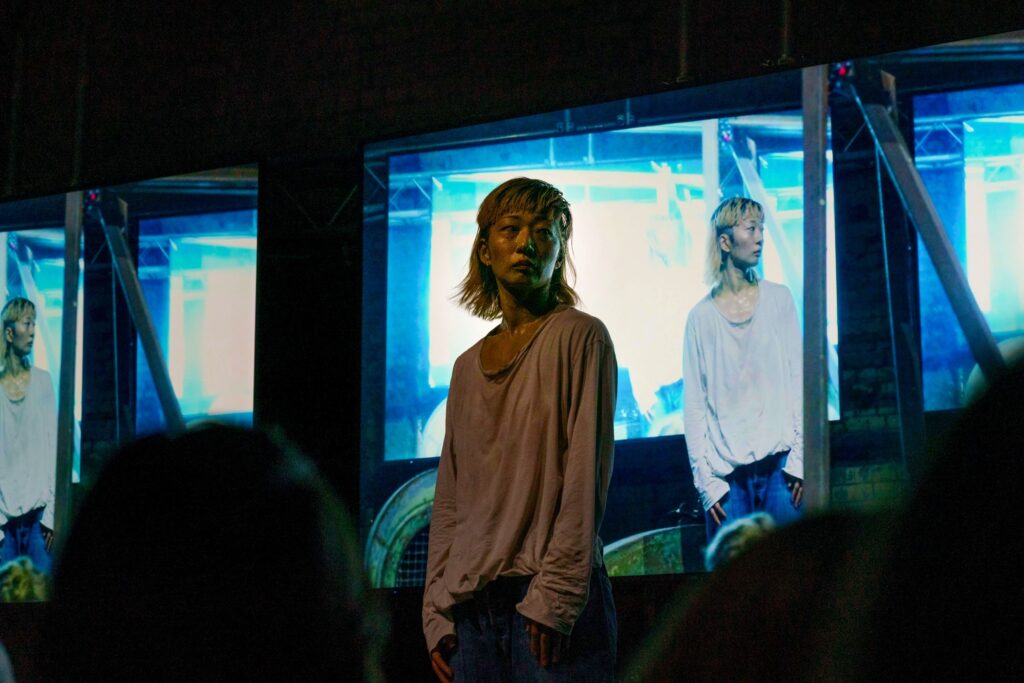
The performance began, from my perspective, on a screen. A figure dressed in latex, resembling a supernatural Barbie, lay on a table wearing a mask. The image was poetic and unsettling: a body presented as an object, simultaneously seductive, artificial and strangely vulnerable. Two other figures, dressed in more pedestrian clothing, approached and began to move and restructure the body. There was something clinical about the action, as though a human being were being assembled or disassembled before us. The image eventually gave way to live performance, and the transition from screen to physical space became one of the work’s more compelling gestures. I was watching something that had initially existed at a distance materialise before me. Yet the screen retained its own attraction. I found myself observing not only the performers but also the audience’s relationship with them, wondering whether I was more drawn to the live body or its mediated counterpart.
There was something fascinating about watching a performance on a screen while the physical version existed elsewhere in the space. The screen offered a particular intimacy, framing the body and directing my attention, while the live performance offered the possibility of proximity and presence. Neither experience felt entirely sufficient on its own. Instead, they seemed to compete for my attention, exposing the instability of our relationship with images.
The body itself was equally unstable. Draped in polka-dot latex, one performer evoked a retro, life-sized Barbie: recognisable, polished and apparently designed to be looked at. Yet the image carried an underlying sense of menace. The body was both desirable and alien, its artificiality exposing the discomfort beneath the fantasy of perfection. It was as though a figure created to embody intimacy and love had become something more sinister, a doll caught between tenderness and control.
This tension was heightened by the architecture surrounding the performance. The coldness of the power station, its concrete surfaces and enormous ceilings, created a stark contrast with the exposed, manipulated bodies. There was a sense of trying to manufacture intimacy within an environment that resisted it. The performances seemed to reach towards love, desire and vulnerability, but something darker remained beneath the surface.
The language, when audible, suggested an emotional world of longing and repetition. Phrases such as kiss me and love me seem to flicker through the work, carrying a sticky, almost desperate quality. Yet the monologues were often difficult to hear. I caught fragments rather than complete thoughts, leaving me to speculate about whether the work was concerned with grief, heartbreak, hope or the desire to be loved. One monologue appeared on a screen; another unfolded in the physical space, elevated above the audience in a way that lent it an almost godlike quality.
I wanted to hear more. Subtitles, microphones or a more carefully considered approach to sound might have allowed the language to hold its own against the visual spectacle. Instead, the words sometimes dissolved into the surrounding atmosphere, leaving me with the impression of an emotional intensity that I could sense but not fully grasp. This was one of the exhibition’s central contradictions. Its imagery was often compelling, but its meaning remained elusive. There was a sense of bodies being assembled within a giant computer, of sexualised figures arranged into a strange technological mythology. The work seemed to be reaching towards something profound about desire, power and the human condition, yet at times its visual language felt familiar, even repetitive. I recognised elements of Blakey’s choreographic vocabulary, but I wasn’t always convinced that they developed into something sufficiently unexpected.
Perhaps that familiarity was deliberate. The bodies seemed trapped within recognisable cultural images of femininity, beauty and eroticism, their movements and costumes exposing the artificial structures through which we understand desire. The feminist dimension of the work appeared less as a straightforward declaration of power than as an attempt to interrogate the mechanisms through which bodies are looked at, controlled and transformed.
Still, I struggled to establish a clear relationship between the individual works. The experience felt fragmented, as though I were moving between different dreams without knowing whether they belonged to the same universe. Some images lingered, while others seemed to disappear as quickly as they arrived. There was an underlying sense of doom, of beauty becoming corrupted, of the artificial becoming flesh and the flesh becoming an object.
The installation’s scale undoubtedly contributed to this effect. Across the power station, screens and bodies seemed to multiply endlessly, creating a world in which the image was never singular and the viewer was never entirely in control. Yet the sheer abundance of material sometimes came at the expense of clarity. I wanted more direction, more opportunities to spend time with individual works, and a stronger sense of how the different elements spoke to one another.
For an exhibition so concerned with technology and mediation, the question of how an audience encounters the work felt particularly important. The structure did not always allow me to experience the performances in the way I wanted, and the resulting frustration became part of my response to the work itself. I was conscious of missing things, of being unable to see properly, of having to choose between competing images and sounds. Perhaps this, too, was a reflection of contemporary life: the impossibility of seeing everything, the constant circulation of images, the feeling that something is always happening just beyond our field of vision. We are surrounded by screens and bodies, constantly offered new things to look at, yet rarely given the time or space to understand what we have seen.
But there is a difference between disorientation that deepens an encounter and disorientation that obstructs it. I wanted the exhibition to give me more reason to follow its images, more instruction in how to inhabit its world, or at least more room to find my own way through it. Instead, I was sometimes left wondering whether the confusion belonged to the work or to the conditions under which I was experiencing it.
Ultimately, I Am a Glass Doll Under the Heel of a Dirty God left me with a series of striking images rather than a fully coherent vision. Its world was cold, erotic, mechanical and strangely tender. Its bodies seemed caught between desire and disintegration, while its screens offered both intimacy and distance. There were moments of grace and moments of frustration, moments when the live body felt extraordinary and others when its digital double seemed just as compelling. I left thinking about the relationship between presence and absence, between seeing and missing, between the body as something living and the body as an image to be consumed. The exhibition seemed to understand that technology is no longer separate from our experience of the world; it is the world through which we increasingly encounter one another.
Yet I also left wanting something that the screens could not quite provide: the unmediated pleasure of watching a live performance unfold, of being close enough to hear its words and see its details, of having the freedom to remain with an image until it reveals something unexpected. Perhaps that was the most revealing tension of all. In a world saturated with images, the opportunity to truly see something has become strangely precious.