Words by Georgia Howlett.
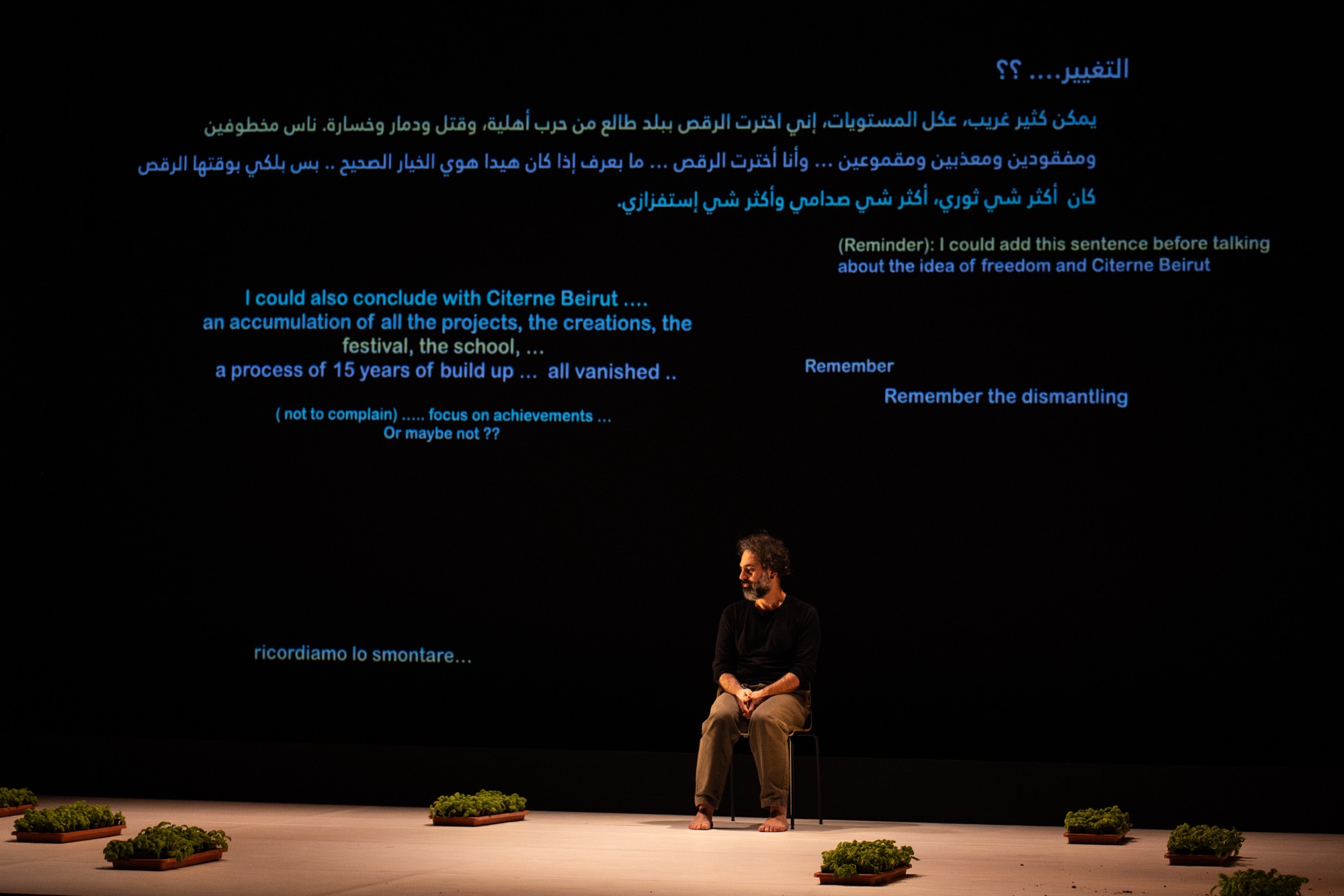
The Barbican’s Pit theatre is a black box. A large upstage screen speaks to us to start the piece, Dance is Not for Us, a solo work by Lebanese choreographer, festival director and cultural architect, Omar Rajeh.
The text that appears brings awareness to the present moment, to the collision of events that occurred for us to all be here at a Dance Umbrella show, watching this dance, wondering when Rajeh himself will appear, which he does, right on cue. He is dressed casually in green cargo trousers and a grey top, holding a plant. Speaking in Arabic, he describes what plants mean to him, their connection to childhood memories and metaphors of growing towards the light, to freedom.
For a brief moment, Rajeh sits at a table and types on a macbook, but from here onwards, the onscreen text is typed by an invisible hand. It is nonlinear in the way it unravels.
Sometimes English, sometimes Arabic. The font size changes, and the theme jumps around as reflections do when cast far back enough. It feels like reading Rajeh’s creative process, fed by the harsh context of a country in a civil war, and his own personal revelations, doubts and gathered quotes. We learn of Citerne Beirut, a cultural hub that was forced to close, of which Rajeh was the Artistic Director. Question marks appear constantly; doubt sprinkles the text from the start as if to echo the chaos unfolding at the time of writing.
We learn of how Rajeh first encountered dance as a boy, and on why he chose this path, a strange choice “in a country that was coming out of civil war, destruction, death and loss”. In doing so, he presents the familiar question of what dance can offer us in times in crisis and collapse? Perhaps unsurprisingly, the question is best answered by movement itself.
Rajeh’s dance starts facing away from us. The movement exists in the space behind his back, shoulder blades squeezed together and chest puffed out. Hands scribble the air as if they are pen tips, fingers unfurl and clench, fast and tight, held up to the side of his head as if shielding from a bright light. At times, he appears to be trying to contain in his palms a flitting butterfly. Rajeh is intricate and restless, while remaining compact and tense. The energy travels down into his knees as he starts to take up more space, yet every burst of movement returns tightly to his centre space like his limbs are on a short leash. Maqam is Rajeh’s practice of instant composition, and while dance is always ephemeral, it feels here in particular like his movements are impossible to grasp; his body occupied with continuous internal impulses.
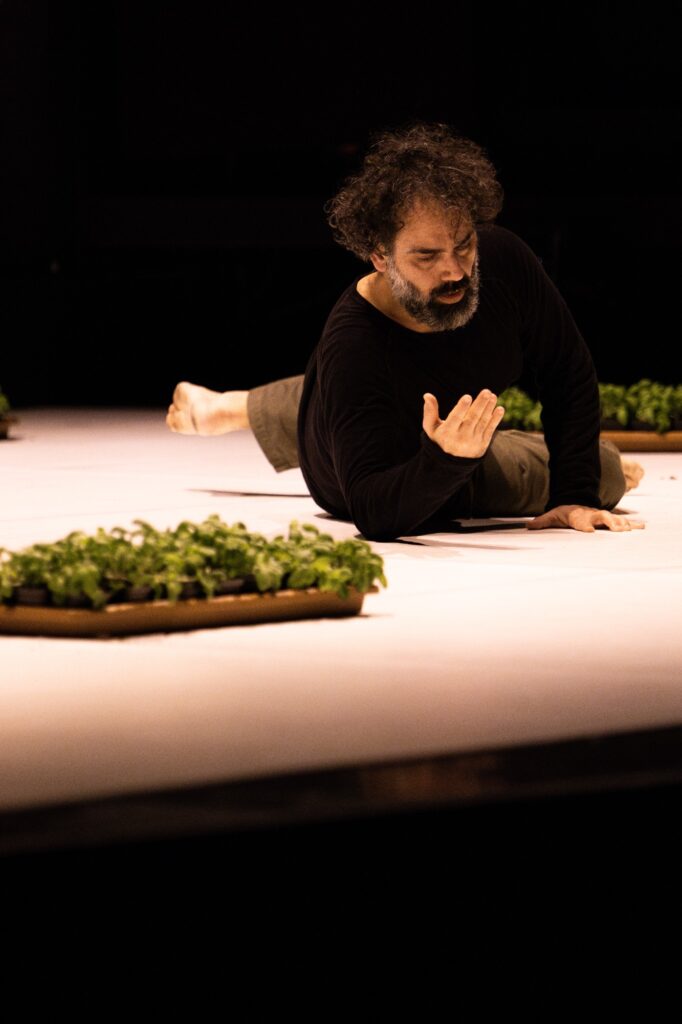
Metallic percussion accompanies this dance. Rajeh pushes himself to keep up, bound to relentless drums. With one arm glued in space and held in front of him, the rest of his body swings, ducks and writhes around the point that is rigidly stuck. The percussion subtly becomes dissonant. Rajeh slams his palms into the ground, trembles, jumps up, up, up with arms raised. Trays of basil plants he previously laid around the stage almost trip him up several times; an object that began as a comfort has become a quiet threat.
An overwhelming sonic atmosphere is broken when Rajeh calls for a 5 minute respite, as if whatever we were all feeling, or thought was happening, is not the case. Knowing the context of civilian unrest, the sudden break feels like a reminder that one can’t get complacent when everything is always changing around you. It is as if the dance had pulled Rajeh back in time, but the respite sees him re-emerge into the present moment, even if cruel memories live just beneath the surface.
There is something too in Rajeh not indulging. The text has a stream of consciousness feel to it, reflections clearly collated for this performance, but in the digital presentation of them, Rajeh has inserted pauses, brief interceptions that decide the rhythm the words take, and how he behaves alongside them onstage. When the text directly and poignantly distinguishes everyday pain from unnecessary pain, encouraging reflection on our part, the words have barely landed when the moment is abruptly tempered by the word “(pause)”.
Rajeh takes a beat, pauses moving and again brings us back to the present moment of this performance.
When he moves again, he does so with more bounce, groove and smile, and a greater sense of agency around where to go and how to go there. The physical arc of Rajehs’ dance combined with his sharing of such intimate memories through text, is deeply moving. Though just one body, he conjures many others who occupied Beirut. A montage of photos, with the content and the date taken, passes by on the screen, except there is only black absence where the actual image should be. Dance is Not for Us is a culmination of over two decades of choreographic practice, but it is also a memoir ridden with ghosts, and thus also feels like a dance for those lost.
What does chaos do to the body and mind? Rajeh finds inspiration in the idea of many bodies existing inside one self. Watching him move evokes false starts, memories cut short and maddening contradictions. In setting up the context at the start of the piece, Rajeh invites us to read these themes very vividly in his body. We live in a time where war and suffering appear on our phones, and can be disappeared with an ease that leaves us increasingly desensitised; this piece forces the opposite. Witnessing how the experience of war exists in a body, moving onstage only meters away, offers a uniquely visceral perspective on such themes, often not felt in other contexts.
So when Rajeh decides to end the piece by gifting the audience gathered before him, it is a tender moment of radical kindness. He hands out the basil plants, now returned to their status as a symbol of hope, and we pass them along the rows to each other. Here, Rajeh once again acknowledges our presence and brings to the forefront our commonality, proving that if dance can be used in this way to practise greater empathy, then his decision to pursue it was the right one.