Words by Gus Hodgson.
Erwin Olaf’s photographs of ballet dancers aren’t what you’d expect.
There’s a whole subgenre of photography capturing ballet dancers with its own norms and stylistic conventions: dancers in technically demanding positions but with a sense of ease; they are graceful and beautiful, almost superhuman. You can trace the lineage of this aesthetic, past Degas and Renoir, back to Renaissance sculpture and classical ideas of perfect form. You instinctively know the kinds of images I mean – the dancer is on pointe in a long reaching arabesque or caught midair in a perfect grand jeté.
Olaf’s photographs are not these. They are shocking. At first glance they appear almost sarcastic, even ridiculous, but put them together and look again. You will see that they form a moving portrait of the artform itself – that he has a love and understanding of ballet developed from spending countless hours with dancers and choreographers. What’s more, he understands that perfection often limits what ballet is and can do rather than being the source of its power.
Born in Hilversum in 1959, Erwin Olaf was one of the great Dutch photographers. He worked for himself and for commercial clients, clients as famous as Levi’s and MTV. Much of his art is filled with a sadness and melancholy – one of his most famous series is literally called Grief. He constructs worlds that feel so cleansed and oppressively perfect that to exist happily within them must be impossible; “a perfect world with a crack” was how he described it.
Equally, much of his work is celebratory. An openly gay man, he grew up in the wild nightclubs of Amsterdam and Berlin where equality and celebration were – unlike the often bigoted and closed-minded world outside – the watchwords. As he would say toward the end of his life, “art is my tool to explore freedom and my weapon to defend it”. And by the end of his life, he was eminent. He had made official portraits for the Dutch royal family and had several dozen photographs acquired by the Rijksmuseum to sit amongst the likes of Rembrandt and Vermeer.
His connection to ballet comes through choreographer Hans Van Manen. The year Olaf was born, Van Manen was a dancer in the newly founded Nederlands Dans Theater, made up of dancers who broke away from Het Nederlands Ballet. Later he became its artistic director. After that, the ballet master of the Dutch National Ballet. Like Olaf’s, his work is often rooted in freedom. He worked very collaboratively believing that the best work is made by dancers who are encouraged to boldly experiment outside of rigid structures.
“I never walk into the studio with a particular idea or emotion in mind that needs to be reflected in my choreography. I think it’s important not to force things and ‘just let them happen’, a choreographer shouldn’t strive to make it ‘pretty’. I’m not interested in pretty, it’s quality that counts. And if it is good, it’ll be pretty.
[…] Complete freedom is imperative to me, I’ve never settled for anything less.”
Hans Van Manen in an interview with Odeon, the magazine of the Dutch National Opera and Ballet.
He and Olaf met in 1983, when Olaf photographed him for SEK, the magazine of the Dutch LGBTQ+ campaign group COC. From there, they became friends and Olaf was regularly asked to come in to make photographs of Van Manen’s dancers, both informally and on commission.
Later he would ask Van Manen if he could make a series of his own devising, Dance in Close-Up: Choreographer Hans Van Manen Seen by Erwin Olaf. It was, in a way, a look back at two careers and lives lived in parallel. The final image of the series: Van Manen and Olaf bowing together. There’s a lifelong exchange going on here. Van Manen was, alongside his work as a choreographer, a photographer and the language of photography seeped into his work – there’s a fascination with stillness and he was also one of the early adopters of using live video in ballet. In the reverse, Shirley Den Hartog, the head of Olaf’s estate, describes how it was through dance that Olaf learnt “how you can fully direct a body, down to the smallest gesture. [That] every finger, every position counted”.
So Olaf isn’t an outsider to ballet, making radical and unusual photographs of dancers just to be controversial. Quite the opposite in fact. He’s in an unusual position: a close friend to one of the Netherlands’ most gifted choreographers with unlimited access to the rehearsal rooms of the country’s foremost companies for several decades.
He loves ballet and understands it intimately, but unlike those typical photographs of ballet dancers, he doesn’t love it narrowly. In those photographs there’s the same kind of beauty shown over and over again – beauty arrived at through perfection, through elegance, through the illusion of ease. These photographs love ballet but conditionally. Olaf loves it unconditionally; he loves every wonderfully contradictory part of it all at once.
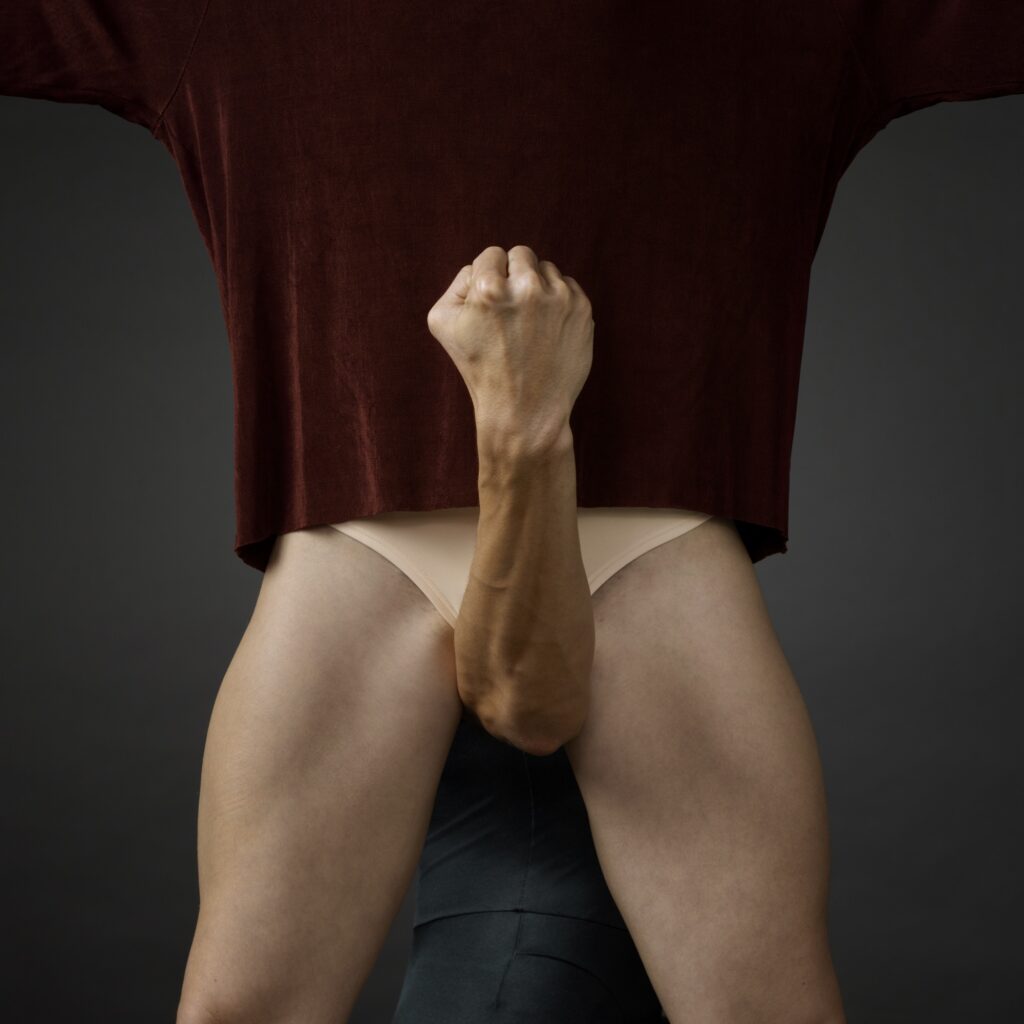
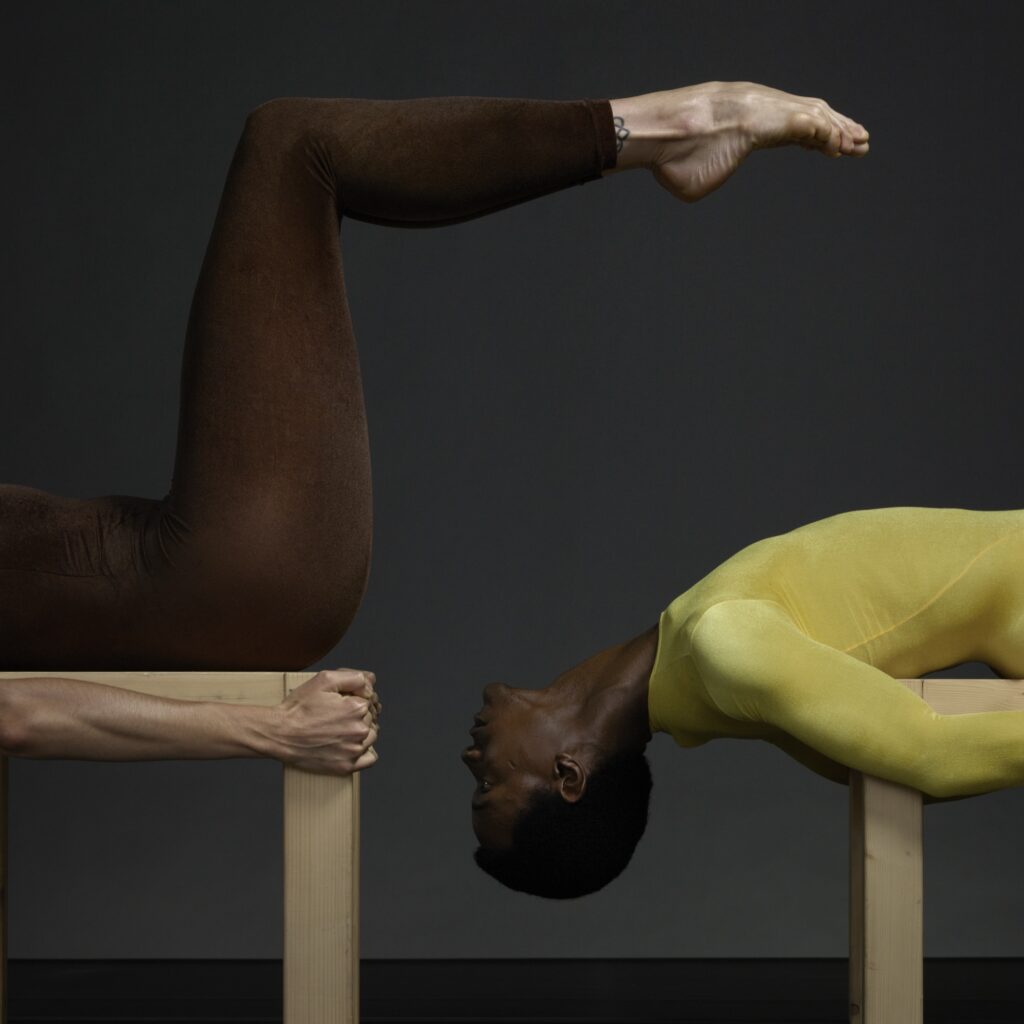
Take Opening, a shockingly bawdy photograph, almost vulgar in how obviously it wears its suggestiveness – but ballet can be bawdy, so why not show that? Or Kammerballett I, a bizarre and surreal photograph – but ballet is often bizarre and surreal, so why not show that too? It is just as Van Manen believed. Once freed from needing to show a “particular idea or emotion”, it becomes easier to explore more interesting possibilities.
It’s not that Olaf couldn’t make beautiful, conventional photographs of ballet dancers. He could. Look at Giselle II, for instance. It’s the conventions of typical ballet photography taken to their most sublime. The way in which the translucent veil carves the movements of the upper body into the air, the present moment expanding as these motions linger; the poise of her standing foot supporting the arabesque that has an impossible lightness, as if that foot could come off the ground to join the other and her body would stay suspended in ghostly flight. He could do that too.
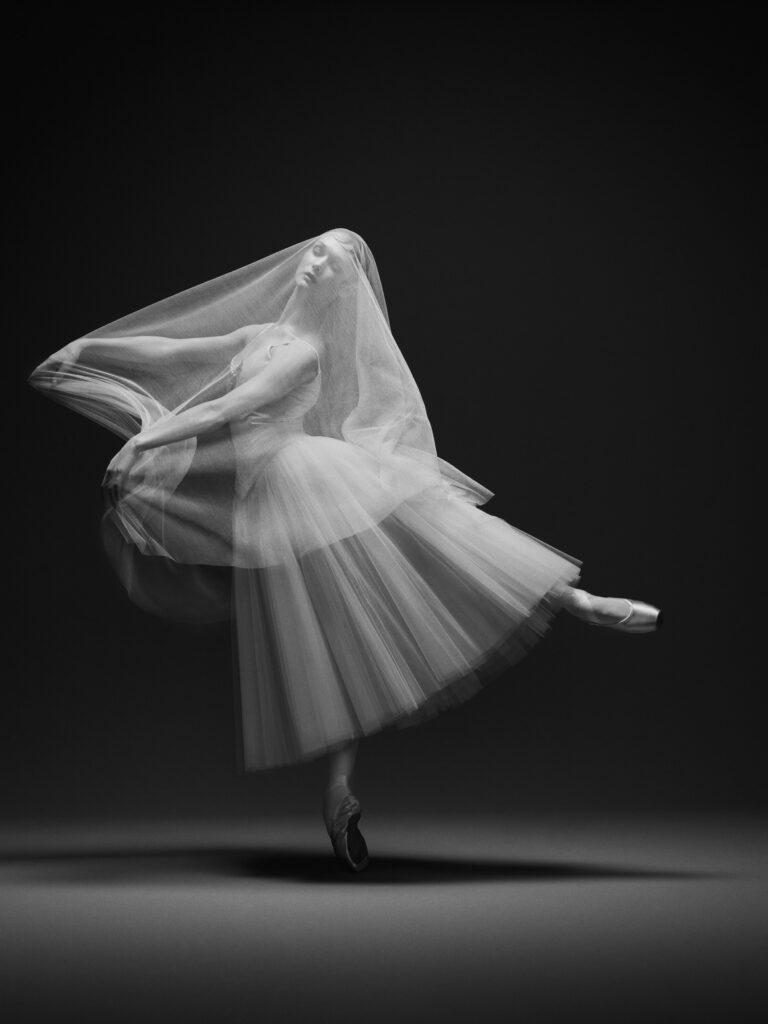
Ghostly is exactly the word for this photograph – it is Giselle after all. But this ghostliness comes from more than that. In photographs interested in this kind of perfection an erasure of the body takes place. Perfection is like a horizon, constantly receding as you walk toward it. The line of the body can always be more pristine, its position closer to the imaginary ideal. It asks the body to outdo itself and, at the same time, disappear. The more sublime the photograph the less legible the body. We see a set of ideals – ideal line and ideal poise – but we don’t quite see a dancer. The body has been asked to become an idea of itself, and the closer it gets, the less it’s actually there.
Olaf understands that this kind of perfection is destructive. His understanding of dance comes from decades beside Van Manen, and from the shared desire for freedom that sat at the centre of their friendship. Van Manen’s dancers were never made to chase “pretty.” Perfection asks a body to submit to an ideal. It creates a hierarchy of correct and incorrect. Freedom asks it to be itself. The two cannot coexist. “Let the perfect world be imperfect”, Olaf wrote of these photographs, “beauty and imperfection are very exciting”. Beauty and imperfection. The two at once, balancing each other.
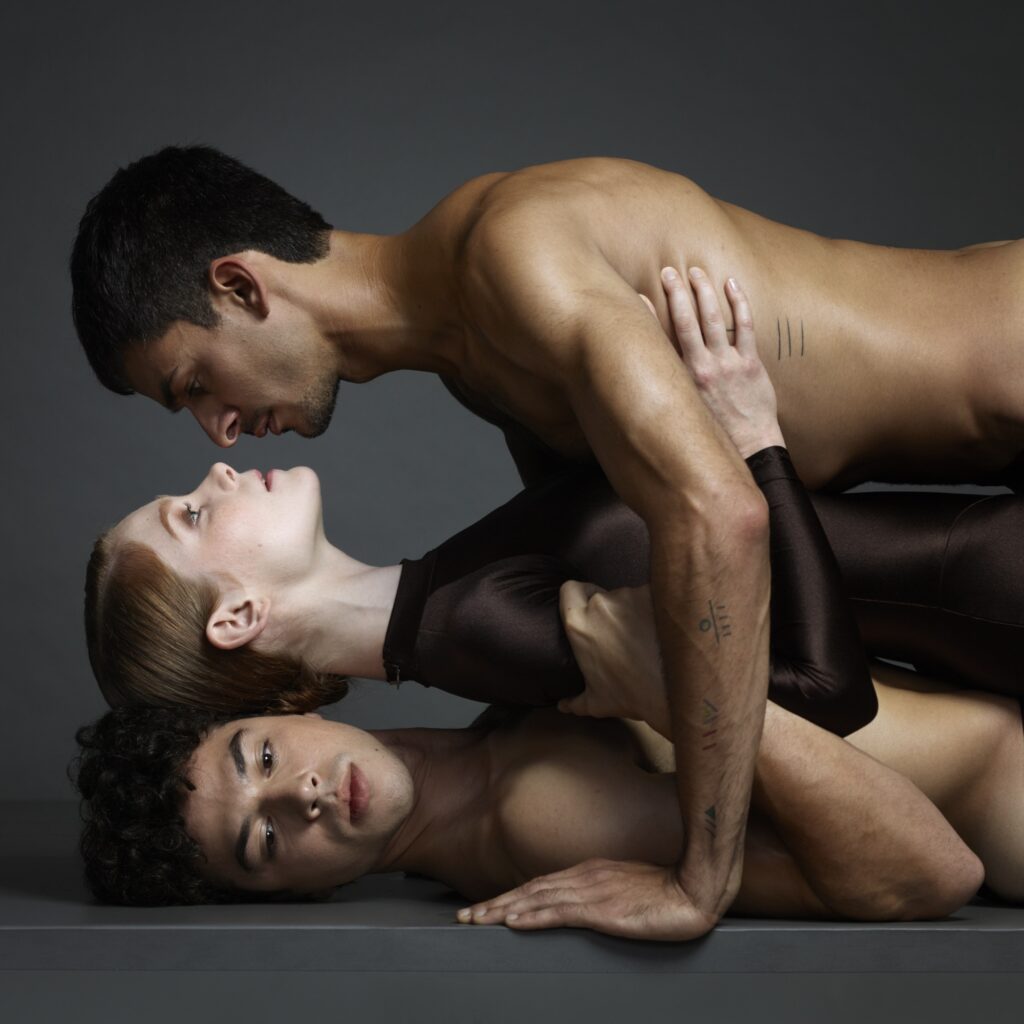
Look at Kleines Requiem III. Three bodies, stacked and entangled, heavy against each other and against the floor. There is nothing here that was only there for a moment – no grand jeté caught at its impossible peak, no body suspended in the half-second before gravity grabs it. These positions could be held. The body is at the centre of this image, as it is in every photograph in Dance in Close-Up – not an idea of a body, not a line, but the body itself.
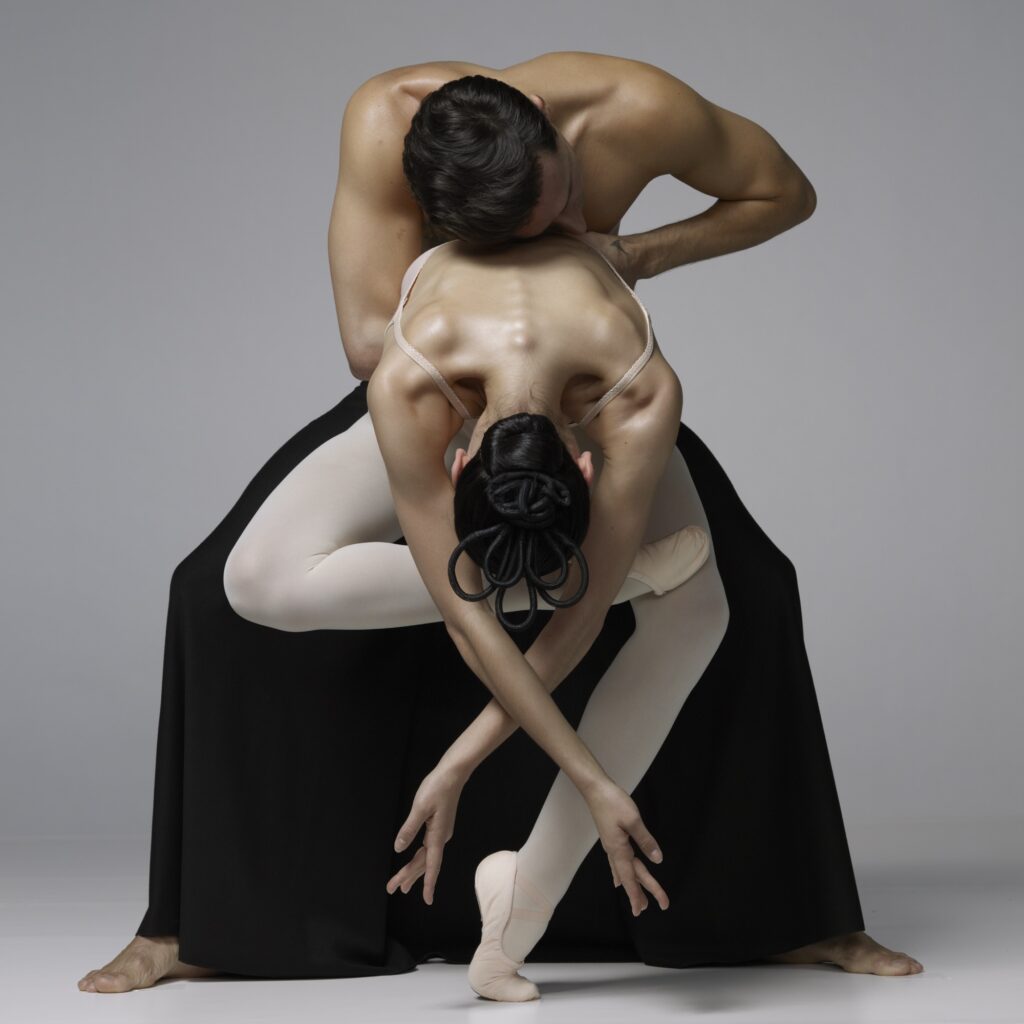
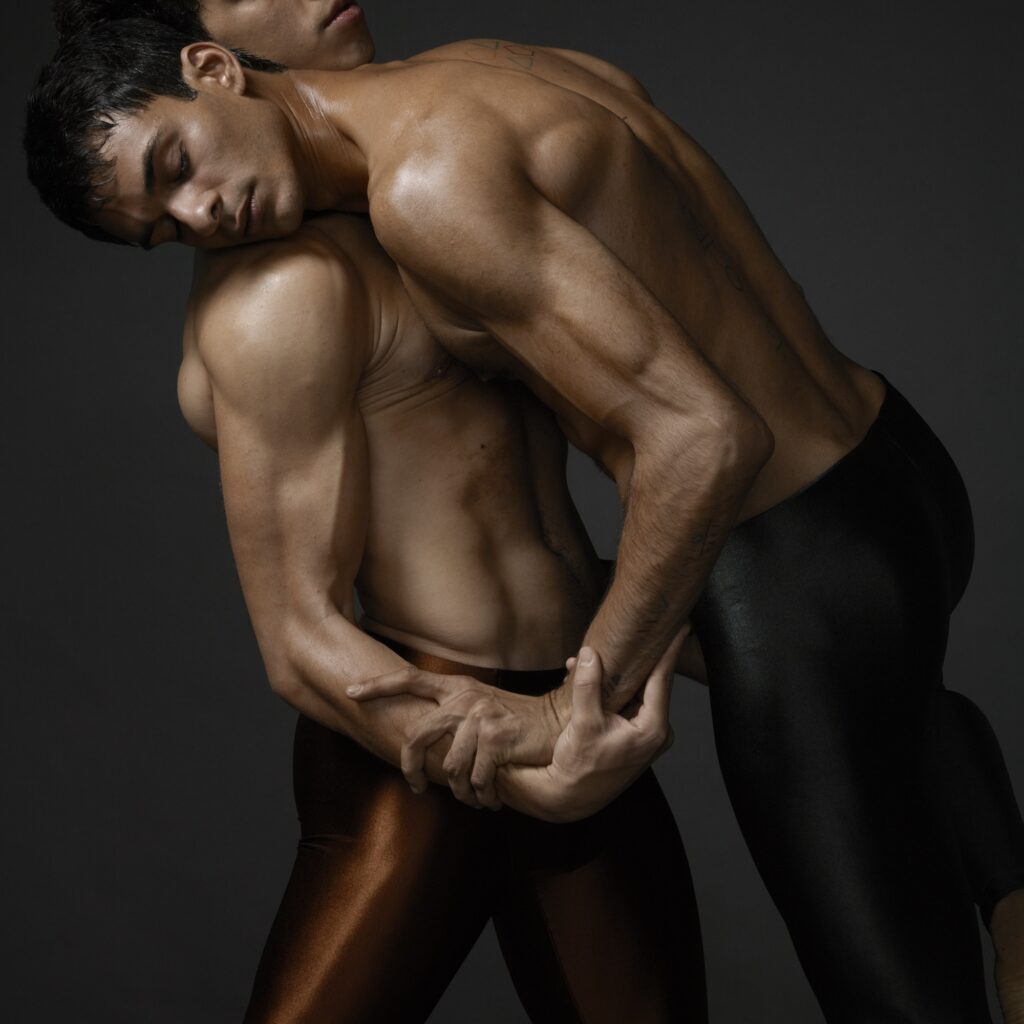
They are wonderfully bodily photographs and to look at them is a physical experience, one that engages our body’s engrained imagination and memory. In Grosse Fuge I, we can feel the weight of her body in our own arms and feel the roughness of her spine on our cheeks. In Kleines Requiem I, that same sense of a body’s weight, this time on our right shoulder and over our chests. The ghostliness of those perfect photographs disconnects ballet from any sense of physicality but in Olaf’s work the images are almost felt rather than seen, every body has a sense of weight and presence.
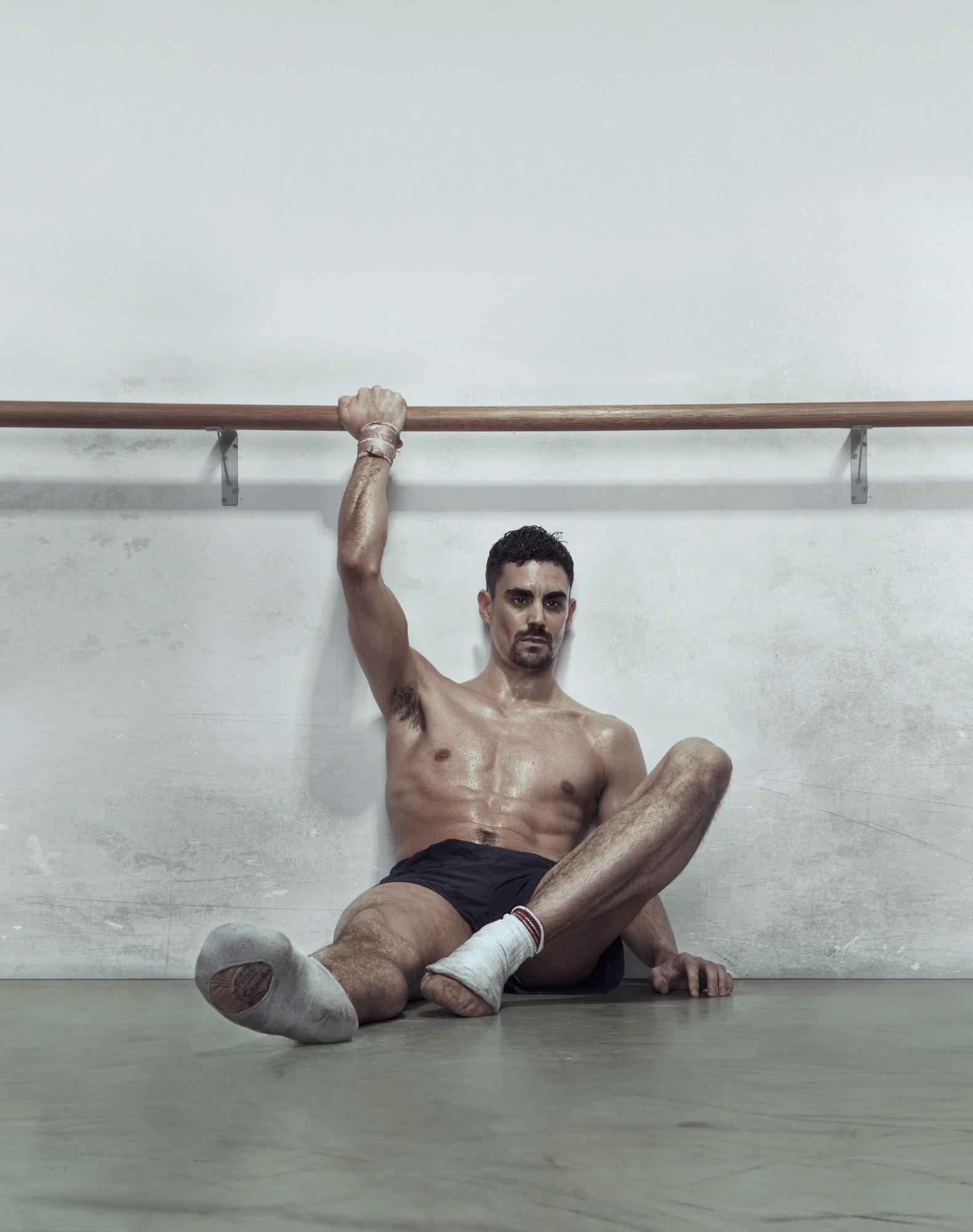
His sweat-drenched series for the Nederlands Dans Theater in 2009 takes this bodiliness to an extreme. The dancers of the NDT lean against ballet barres or collapse onto studio floors; many wear bandages on their feet and hands; there is a heaviness in their bodies as they are compelled by exhaustion toward the ground. This is as much a part of ballet as ease and grace. It is what makes those things possible. It’s easier to look away from this side of ballet, to let it be obscured by perfection, but Olaf refuses to do that. This is what I mean by his unconditional love of ballet: his ability to look with equal care and attention at all parts of it – the perfect and the imperfect, the beautiful and the messy. He knows that there’s often a bloody plaster under the smooth silk of a pointe shoe.
It’s this honesty that moves me. He has the same braveness that Van Manen has, to never go looking for prettiness. Ballet is, after all, a strange artform. Bodies are trained from childhood to move in ways no body moves naturally – turned out, pulled up, balanced on the tips of the toes. It is an artform that already operates so far beyond the safe waters of naturalism. It has the capacity for strangeness, bawdiness, oddness, humour,imperfection, pain, irony, ridiculousness, sarcasm, the weird, the wonderful. It has all this because people do. It is a deeply human art form; its material is the body itself. To notice these things does not lessen its beauty, it creates more places for it to been found. Ignoring this to just focus on the sterilely perfect, is to love only a part of ballet. Erwin Olaf refused to do that, in the same way that Hans Van Manen refused to choreograph like that. He sees it all and he loves it all, because of that he did something rather extraordinary – he photographed dance itself in close-up.
Header image: Image 7: Erwin Olaf, Nederlands Dans Theater – #05, 2009.