
Words by Luella Rebbeck.
There was something fitting about encountering FEEDBACK to FEEDB’ACK inside the Horse Hospital, a Grade II listed building that already feels like it has absorbed years of bodies, pain, movement and disappearance. Presented by Bad Bias, FEEDBACK TO FEEDB’ACK brings together women and gender-marginalised artists from East and Southeast Asian (ESEA) and diasporic backgrounds to explore feedback through the ways we meet, affect and are changed by one another.
By the time we entered, October was beginning to close in. Darkness climbed through the branches outside, and the light seemed to thin around us. Inside, there was a strange stillness as if the building were waiting to witness something. Bad Bias brought together sound, movement, technology, queer ritual and collaboration in three acts that seemed less interested in telling a story than in creating a temporary ecosystem. Sound moved between bodies. Bodies moved around pillars. Objects became participants. The work created its own weather.
And feedback was everywhere.
Sounds returned altered. Movements repeated. Bodies encountered bodies. What had happened before seemed to leak into what was happening now. There was something comforting about these unfamiliar sounds: a warm concoction, almost medicinal, almost a potion. At times it felt like a prayer without a god, or a spell whose instructions had been forgotten. The first act was overwhelming in a way I found both exciting and difficult. There was so much happening that the eye could not settle. Dancers moved around pillars while sound, light and sculpture competed for attention. It became a kind of beautiful disaster—not a disaster of failure, but of excess. Too many bodies, too many signals, too many things asking to be watched at once.
I found myself wondering: when does abundance become meaning, and when does it simply become noise? There were images I enjoyed precisely because they refused to behave. Flickering lights, fire-like gestures, sculpture, bodies, the strange phrase “jingle jangle morning.” It was playful and abrasive, sometimes almost ridiculous, but also strangely sincere. There was pleasure in seeing people given permission to occupy the space without having to make themselves easily understandable.
The second act pushed this feeling further. It made me think of insects outside in oppressive heat, flies, swarms, infestation, movement without hierarchy. Yet here that sensation was trapped inside the Horse Hospital. The pillars became frames, cages, shelters, stages. The body would appeared and disappeared between them. I liked the tension between pleasure and pain. There was something teasing the senses, something that almost belonged and then withdrew. The sound was sometimes so physical that I felt the beat in my chest rather than simply hearing it. But this was also where I began to lose the work.The improvisational quality could be exhilarating, but at times it became so diffuse that I found myself watching interactions without understanding what was carrying them forward. There was a muffled, back-room feeling to some moments as though I had entered halfway through a private ritual. That sense of being an outsider was interesting, but it also created distance.
Perhaps that is part of the work’s interest: beings that are not supposed to belong, trying to make a place for themselves.
But there were moments when I wanted the work to give me a little more to hold onto. Not an explanation. Not a message. Just a thread.
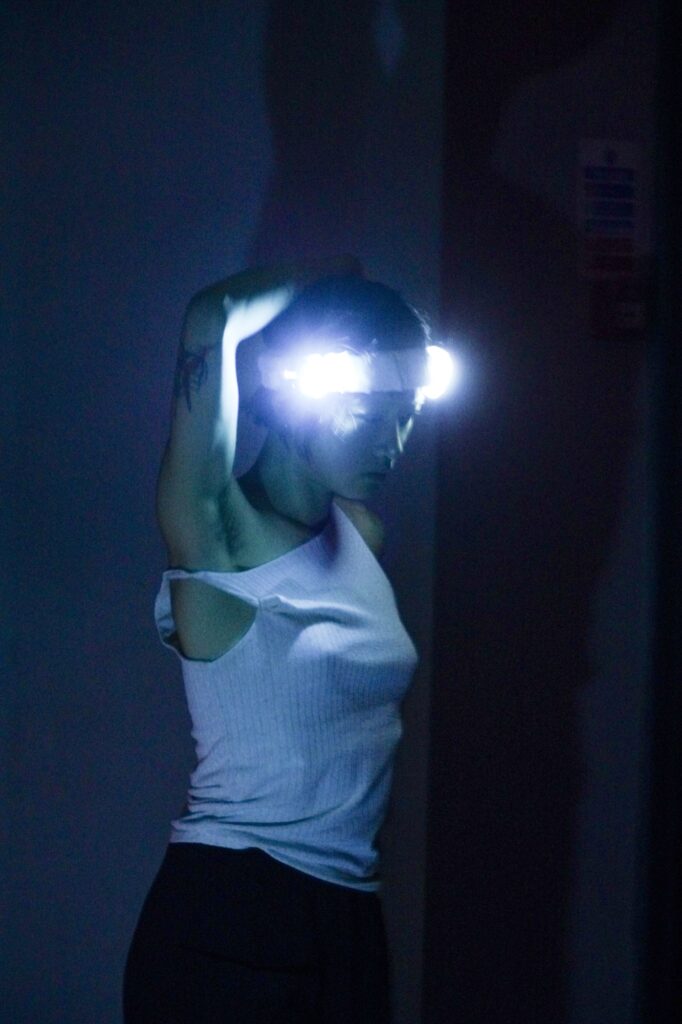
The third act, felt closest to ritual in its most recognisable form. Head torches cut through the darkness. Insects, incense, candles and humming created an atmosphere of ceremony. There was something sacrificial about it, something concerned with severing and transformation. The performers seemed to move towards becoming something other than themselves. It was one of the most visually concentrated sections, and yet I still found myself asking what the ritual was asking me to witness.
This became my central question throughout the night. Was there one thing being said, or were there many things being allowed to happen at once?
I don’t think ambiguity is a weakness. In fact, much of what I enjoyed about FEEDBACK to FEEDB’ACK came from not knowing exactly where I was. But ambiguity needs rhythm. It needs something to return to. Here, the gaps between the acts sometimes felt less like productive silence and more like having to restart the journey.
The beginning happened several times.
The ending happened several times.
And each time I had to decide whether to enter again or let the previous world disappear. This made the collaboration fascinating but also slightly frustrating. I could see the relationship between people and things, bodies and objects, sound and architecture. What I wasn’t always sure of was whether the performers were deliberately allowing those relationships to remain unresolved, or whether the work itself had lost its centre. Perhaps that is the risk of feedback: the signal can become so loud that the original sound disappears.
Still, there are moments from the night that have stayed with me. The beat in my chest. The strange warmth of unfamiliar sounds. The flickering lights. Bodies passing between pillars. The feeling of insects. Fire. Incense. Humming. A room full of people temporarily making a world together.
I don’t know exactly what FEEDBACK to FEEDB’ACK was saying. But perhaps I don’t need to.
What I wanted, and sometimes found, was the feeling of being inside something, something alive that was continually forming, breaking apart and forming again. Where I struggled was when that breaking apart became so complete that I could no longer feel what I was being invited to carry with me.
Maybe the question isn’t whether the work had something to say.
Maybe it was whether I could hear it through all the feedback.