Words by So’l Jelenke.
From all corners of the globe, students presenting their final research projects at the London Contemporary Dance School‘s MA Dance: Participation, Communities, Activism symposium often began with a provocation, inviting online audiences into collective acts of, in their words, “grounding”, “rooting” and “centring” as a way of cultivating “connection to self, others and the Earth.” These provocations took the form of embodied practices. Some students led guided introspection, visualisation and breathwork, while others encouraged the audience to feel the sensation of being noticed by each other. Another turned the various audience locations represented online into a virtual map, reaching across digital space to give us a sense of their practice in real time.
Through films, documentaries, poetry, practical demonstrations and live drawings, the students revealed not only the outcomes of their research but the processes that shaped it.
Centred on this year’s curatorial theme of repair – a lens for both students and staff to reflect on their work with communities across the globe – the presentations collectively explored the question of whether dance can contribute to the creation of a better world. The projects drew inspiration from American activist writer and facilitator Adrienne Maree Brown’s Emergent Strategy, which proposes that small, interconnected actions can generate large-scale social transformation.
Avni Sethi, she/ her (India) State Subject; Dance Object
What forms of embodied notation emerge from the everyday gestures of citizenship, protest, and survival inside the urgency of a burning country?
Addressing the totalitarian violence concerning citizenship rights and more presently in India, Avni Sethi presents a choreographic score as an alternative way of understanding identity and belonging, arguing that citizenship is first embodied before it is legal. Avni presents the legal documents that constitute her own Indian citizenship as the state’s score for her body. The documents determine where she stands or may cross, a choreography she did not write and must perform correctly or not at all.
In response, Avni offers her choreographic object, a book of choreographic scores developed through and informed by multiple bodies. Rather than prescribing movement, the scores offer provocations for participants to author their own. While legal documents produce an archive that
has historically represented some lives while erasing others, Avni’s choreographic object belongs to what performance studies scholar and academic Diana Taylor, terms the repertoire: preserving memory and culture through embodied practice.
Sujeon Seok, she/ her (South Korea) The Uracha Project: Dancing to Pull Each Other Together – Rebuilding Kinship and Social Weaving Amongst South Korean Youth Through Community Dance
Sujeong Seok, the self-acclaimed “secret agent”, uses community dance as an artistic intervention within South Korea’s highly competitive education system. On the surface, Sujeong is preparing students for sports day. Beneath that, however, she is constructing a social safety net in which choreography creates the conditions for students to learn trust, confidence and vulnerability through movement exercises that cultivate belonging, collective care and cooperation.
“Trust cannot be forced, it can only be arranged for,” Sujeong claims. She is actively dismantling the notion that competition and achievement must rule the local education system, particularly where existing data reports that students are depressed, even suicidal at the pressures of learning. Here, ‘soft activism’ results in resistance in the form of collective joy and the beautiful symbolic significance of 400 students holding hands.
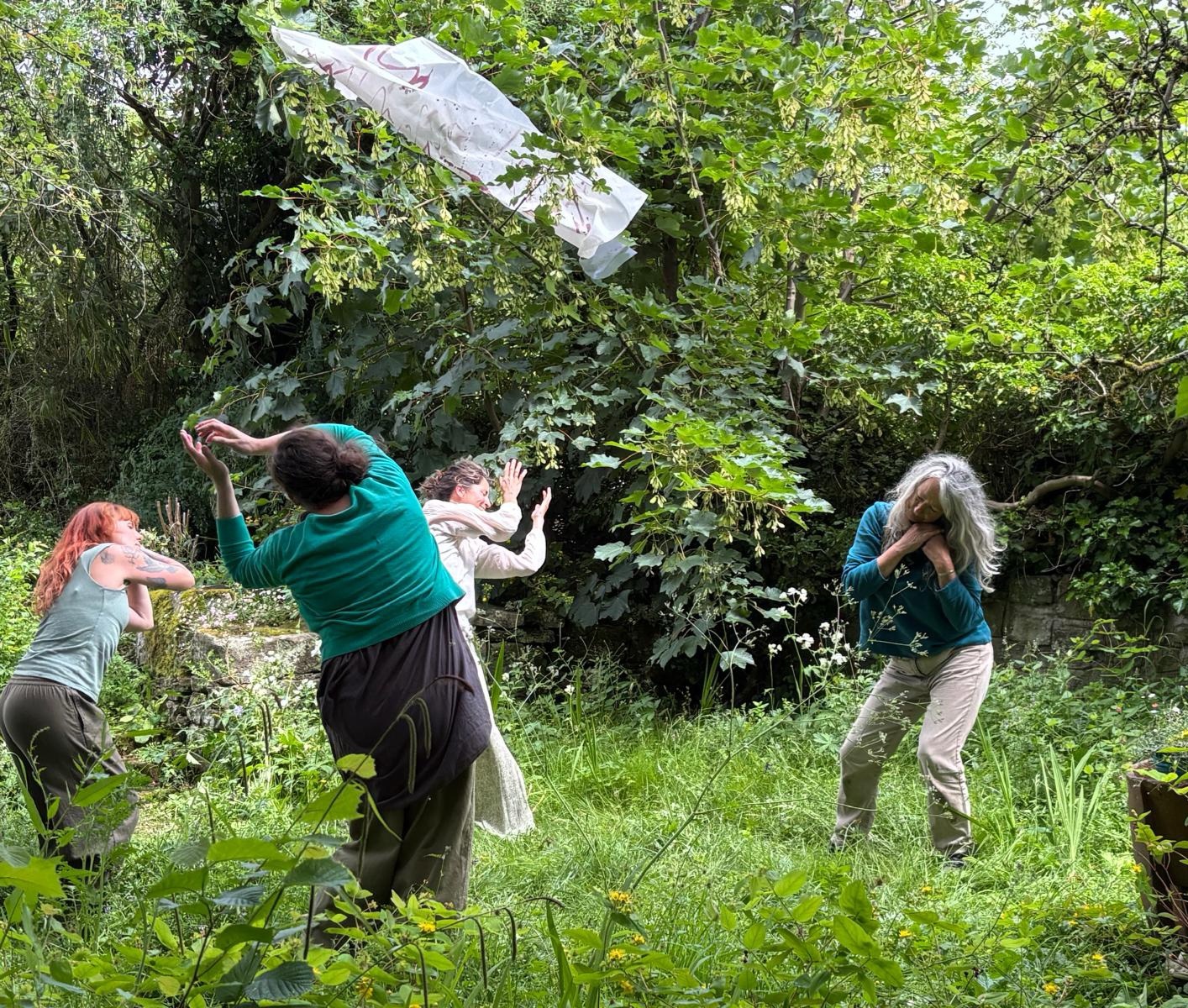
Eve Dent, she/ her (England) Birdsong Dancing: A Chorus of Voices – Exploring Embodied Kinship with the More Than Human
I once came across a comedic social media clip of a young man dancing to the familiar tune of the common pigeon. Eve Dent asks us to take this listening to nature’s soundtrack to our lives seriously, as a way of paying attention and forming what she refers to as “kinship with the natural world.”
Eve spent time with participants in gardens visually recording sound through drawings that captured the range of rhythms and patterns produced by a variety of birdsong. This would further be translated into bodily sensation as it inspired movement which participants used to develop a physical connection with the birds. Yvonne Rainer’s Trio A, recently performed at Tate Modern, comes to mind as a piece that also uses choreography to place attention and value to the ordinary.
Becca Townsley, she/ her (South East England) Rocking it! Adventures in Embodied Matrescence – A creative movement exploration of the lived experiences of motherhood
Becca Townsley inverts the meaning of “rocking it”, transforming a phrase associated with achievement into both a metaphor and practice, through which women caregivers use movement to soothe themselves, survive the struggles of motherhood, and reject its patriarchal expectations. Restoratively, not selfishly, women are encouraged to use their heightened-by-motherhood intuition and internal knowledge on themselves.
“Dancing was always what brought me back to myself,” Becca states, before sharing choreographic tools drawn from her own dance history to empower participants to improvise movements that meet their physical and emotional needs without scrutiny. “The trees do not know who is the regulated mother,” she says, returning us once again to nature, the recurring landscape of repair throughout the students’ research projects.
Manal Tass, she/ they (Morocco/ Berlin, Germany) Remaining Otherwise – Exploring dances of relating and resisting in women and queer people from the SWANA region
“Did you ever have to oppose or refuse something that was undermining your integrity?” is a leading question from Manal Yousfi Tass who guides conscious breathing and body scanning, as she asks the audience to observe what appears in our minds when we hear the word resistance. Immediately, Manal is framing resistance as a lived sensation above an ideology, and goes on to convey choreography as a way of practising and sustaining it as “an infrastructure of possibility”.
Just as we, the audience, had been invited to at the beginning, Manal’s work sought to create the conditions for participants to reconnect with knowledge already held in their bodies. Trust was built with participants through one-to-one encounters. With what emerged from these encounters through movement, conversation and questions, Manal carried elements of the participants into a solo performance at Herman Square (also known as Hind Rajab Square by activists), a public space heavily charged with political significance. Manal’s key observation: “What if our bodies were not finding new answers? What if they were grounded in what they already knew?”
Rhiannon Colvin, she/ they (Bristol, England) Resourcing Resistance – To sustain our social movements, we must sustain ourselves
If choreography can be the infrastructure of possibility within activism, according to Rhiannon Colvin, care is activism’s condition of possibility, a way to sustain the bodies that sustain political movements. Again, the audience is asked to notice arising physical sensations, as we think of a cause we deeply care about, highlighting that activism begins with feeling over opinion and that the political is already embodied.
Rhiannon’s central research question was this: “How do we take urgent action without carrying that urgency in our bodies every day?” Embedded within the question is a political challenge to capitalist individualism, reframing burnout not as a personal failing, but as a structural challenge facing political movements. Through both a queer weekend festival (KINDOM) and a six-week movement programme (Resourcing Resistance), Rhiannon uses somatic practices to facilitate healing through collective grieving, pleasure as resistance, gathering as activism and rest as repair.
Iona Hannagan Lewis, they/ them (Cardiff, Wales) Pleasure Gardens: Cruising, Community, and Queer Choreographies
Iona Hannagan Lewis sets out to investigate the effects of site-responsive community gathering and experimental performance through a queer lens, which Iona terms as a verb, not a fixed identity, but the ongoing practice of becoming. Consequently, choreography shifts from the production of movement to the designing of situations where participants can play and discover, whilst building connection, strengthening community and negotiating visibility – all queer ways of being.
The project’s focus then shifts from cultivating proximity, to what emerges when proximity is choreographed through queer methodology. Iona’s take on “choreography [as] the art of creating the conditions for something other to emerge,” echoes Sujeong’s “trust cannot be forced, it can only be arranged for.
Bronwen Wilson Rashad, she/her (Cymru/ England) No Slowing
Similar to Scottish folklorist and lyricist Hamish Henderson’s school of thought, Bronwen Wilson Rashad calls for allowing traditions to evolve- so long as they stay rooted, as they rely on bodies which change and develop over time to keep them alive. Intending to explore the impact of improvisation on folk dance like it appears in folk music, Bronwen asks, “what if doing something simple actually enables us to do it at all?” This emerged from working with the fears many participants – middle-aged white women – held about dancing, eventually finding joy and freedom in the act of embracing imperfection. Choreography was not limited to learning and developing dance moves, it extended to community building in the moments of shared meals, carpools and conversations. The social aspects surrounding the dance became just as important as the dancing itself.
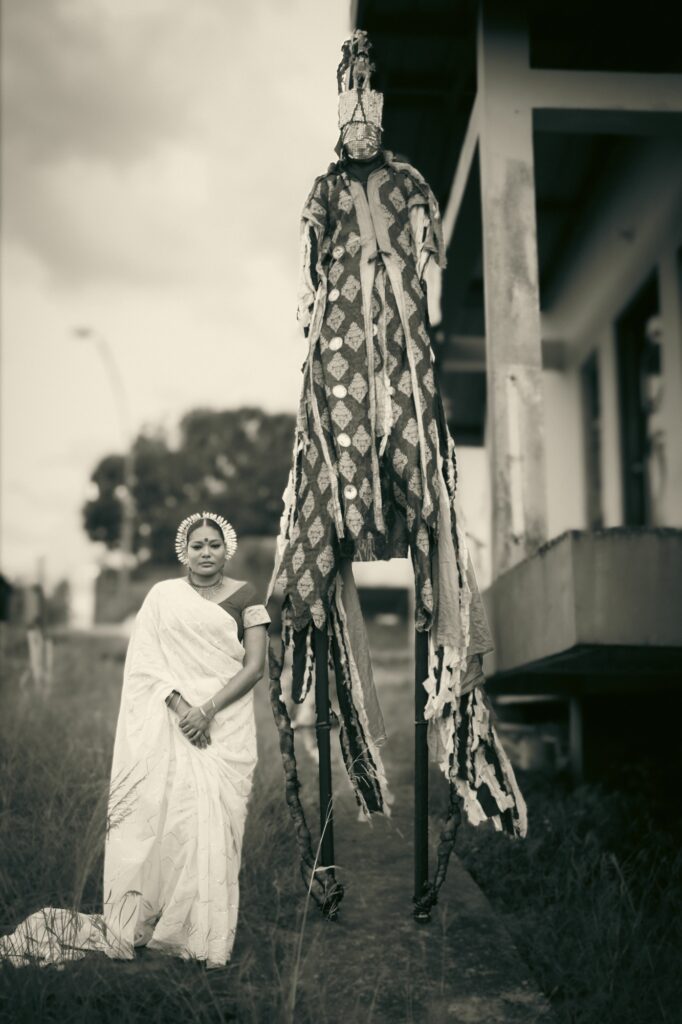
Sádé Budhlall, she/ her (Trinidad and Tobago) Disobedient Bodies – An exploration of Afro-Indo relational politics in Trinidad and Tobago through a collaborative practice as research process between Odissi and Moko Jumbie practices
Sádé’s starting point is refreshingly uncompromising: Afro-Indo tensions in Trinidad and Tobago are not interpersonal misunderstandings, they are structural inheritances of colonialism. This historical framing immediately distinguishes the project from seeking contrived resolution and goes on to question how people from different cultures can remain together without pretending they need to share similarities.
Through community engagement, Sádé noted difference as something to be preserved rather than overcome, as relation does not need to depend on sameness. However, this is only successful through accountability to difference. This ideology culminated beautifully in an accompanying dance film starring Sádé and her creative collaborator, Adrian Young. Their 10-day studio intensive became an embodied practice of staying with difficulty, building trust without sameness, and creating through difference.
Fernanda González, she/ her (Santiago, Chile) Women Cartography: Dancing in between otros mapas – Tracing Ways of Being Together
In this project, cartography enables women to collectively imagine alternative ways of inhabiting a place and recognising themselves in it. Fernanda González makes the case for “the recovery of the body as the primary territory,” directly supporting Avni’s insistence that citizenship is first embodied before it is legal.
The maps the women participants drew, many body tracings, resembled abstract children’s drawings, suggesting play and freedom of expression. These maps then transformed into choreographic scores as a means to relate with the self and others. Fernanda was adamant that the project was not a practice of countermapping which suggests conflict and opposition, but rather an alternative space to place one’s existence, described by a participant as “soft resistance that is loving, honest, playful.”
Silva Laukkanen, she/ her (Texas, Miami, USA/ Finland) Dancing the Conversation – Rehearsing belonging in dance and disability dance education
While several projects on the MA course explored how dance, movement and choreography can cultivate belonging, Silva Laukkanen interrogates what it actually means for someone to belong. In doing so, Silva reframes her project themes of accessibility and inclusion not as a technical problem to solve, but as an ongoing type of choreographic practice.
Interviews with disabled identifying artists revealed that belonging must first be cultivated internally and cannot be relied on to be offered by a space. But when a space allows for agency, there is an increased sense of belonging, suggesting that belonging is not fixed but a negotiation. To sum up, Silva reminds us that “Belonging is a feeling. The body recognises it faster than language can describe it.”
Melissa Gmuer de Mora, she/ her (Kentucky, USA) Derecho de Permanecer – Walking, visibility, and belonging across the fault lines of US immigration practice
Melissa Gmuer de Mora’s project, translating to ‘the right to remain,’ claims, “this project is not an attempt to speak for immigrant communities. It is an attempt to understand what forms of attention, movement and relationship become possible when we decide that belonging is something we can practice together.” I found the use of the word ‘practice’ as opposed to ‘achieve’ significant.
While on their routine walk, a participant noticing the sound of a woodpecker creates a moment of learning where a strong sense of community emerges “because for a moment, [despite differences,] we shared a common orientation toward the world.” Here, attention becomes a key tool of resistance – slowing down enough to notice and give focus when relating to others. This stimulates belonging and strengthens communities enough to, perhaps, foster change.
Lisa Mariko Gelley, she/ her (Vancouver, Canada) Welcome Back – Choreographies of hosting emergent rituals for intergenerational Futures
Lisa Mariko Gelley explores how hosting, gathering and everyday rituals can become choreographic practices for remembering, repairing and reimagining cultural belonging across generations where historical archives are fragmented or absent. Early into the process, Lisa
questioned the ethics of asking others to follow her own family history, recognising that every participant carried different experiences of migration, loss and memory.
Shifting methodology, Lisa shared authorship as she invited participants to co-host gatherings which took place in domestic and public spaces. A final studio session provided the neutrality needed to contain the movement inspired by the emergent rituals participants had created from the gatherings, a “sacred return” to the historic and cultural fragments that remained available to them.
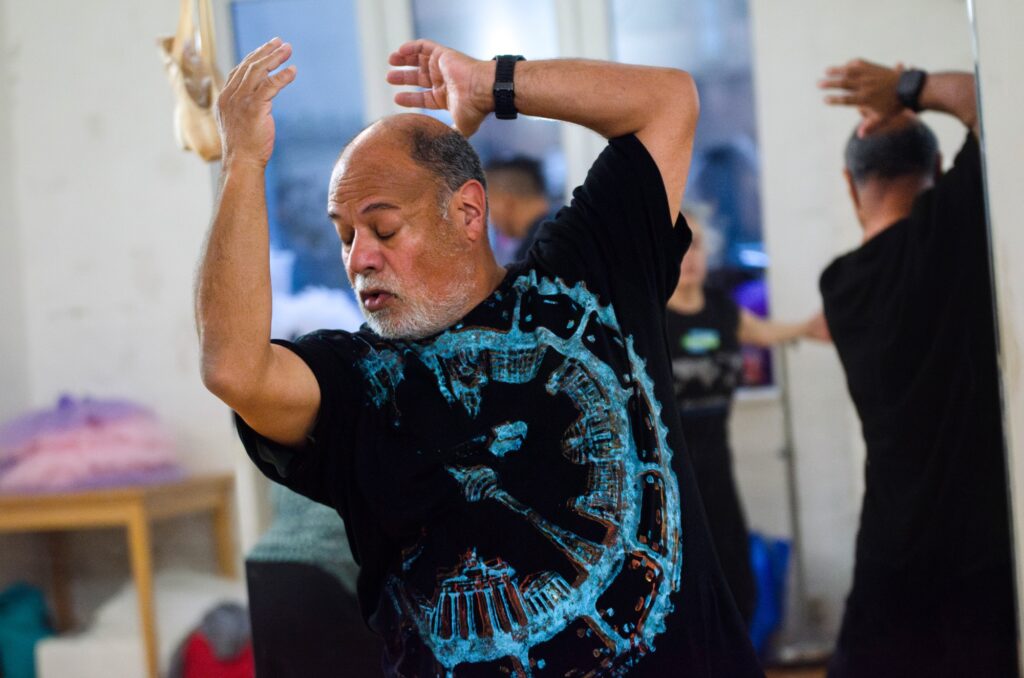
Hugo Peña, He/ Him (Chile/ Berlin, Germany) BODY, ARCHIVE, MEMORY
Hugo Peña presents the body as a living archive, not just a site of experience. Setting out to explore the long-term effects of political displacement in both Chilean exiles and former East German communities in Berlin, Hugo uses intergenerational movement laboratories to engage participants. Drawing heavily on participants’ memories, Hugo elegantly articulates that “memories are living archives inscribed in the body,” extending Diana Taylor’s distinction between the archive and the repertoire that Avni Sethi drew upon earlier.
Building on the significance of attention discovered by Melissa Gmuer de Mora, Hugo makes a profound ethical discovery when participants didn’t always have the words for their feelings and experiences: “To break the silence, I had to respect the silence.” This revelation came from recognising the cultural habits he was bringing into his role as a facilitator, as well as being a fellow displaced body and immigrant. Hugo opted for the anti-extractive approach and accompanied his participants on their journey, valuing methodology over certainty to say, “this research [can have] no conclusion. It’s only the beginning of a process…”
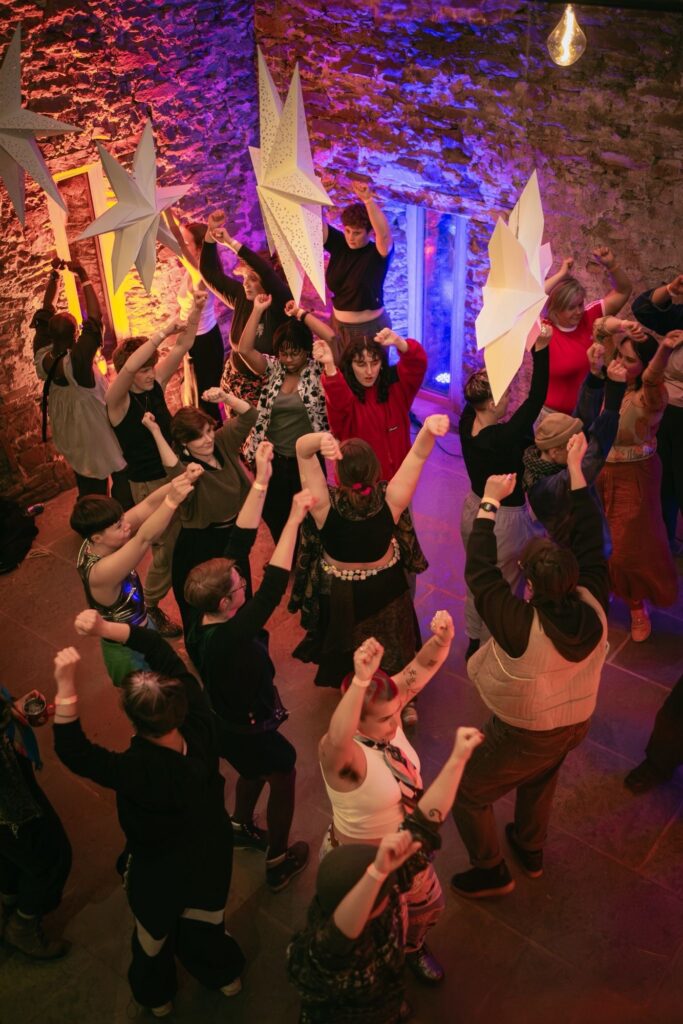
Photo credit: Charley Williams.
Sharing Hugo’s verdict, most students reject a definitive conclusion as they recognise the ongoing work in the bigger picture their research speaks to. At face value, many of the presentations seemed to be about dance, but as each unfolded, the definition of dance was expanded in a radically holistic sense. Recurring motifs appear regardless of country, political context or dance form; themes such as nature as collaborator over setting, body before words, pleasure, play and gathering as activism, trust, relation, belonging, and process over product.
There was nothing theatrical about the issues addressed by the presenting students. Dance, choreography and movement functioned as social infrastructure for possibility and change, designing conditions in which people can practise safe ways of being together that dominant institutions struggle to produce.
None of these projects actually ask dance to solve political issues. Instead, choreography creates space to rehearse political capacities: listening, trusting, witnessing, grieving, resting, risking, imagining, negotiating, and remaining in relation. In that sense, each research was less concerned with teaching people how to move than with asking what kinds of world become imaginable when bodies practise staying in relation to each other. The accumulation of project findings may even function as an emerging vocabulary for socially engaged choreographic practice.
Almost every presenter began by regulating the room before presenting research in varied artistic mediums. Students didn’t merely describe choreographic research, they also performed it. Each presentation became an encounter, asking listeners to experience, however briefly, the same relational and embodied conditions that underpinned the research itself. The body often knows what vocal language cannot yet articulate. Dance, therefore, is inherently a perfect medium for alternative modes of activism and political resistance in working towards a better world where future bodies dance towards repair.
Header image: Photo by Eve Dent.