Words by Rebecca Dodd.
Choreodrome is The Place’s residency programme designed for independent makers and choreographers to play, experiment, discover and act on their choreographic tendencies.
We watched one of the latest works in progresses featuring work by Eleanor Sikorski, Annie Hanauer and Oluwatosin Omotosho.
Eleanor Sikorski’s Instrumental (working title)
Inspired by Rube Goldberg, from the very beginning, the workings of the piece were displayed directly in front of us, revealing what felt like the product of Eleanor’s meticulous design.
Eleanor becomes both the composer and the ensemble of the machine, Eleanor as important as the objects and mechanisms around her. Fixated on watching how everything connected, waiting for the next thing to happen, suspensful of the outcome.
The sound and movement often became one being, coexisting through moments of immaculate unison. But the pacing was interruptive, never allowing the work to settle for too long.
Eleanor’s natural comedic timing brought moments of humour into the work, giving us glimpses of her personality without taking away from the concentration of the task.
The audience felt almost like a team alongside her, waiting for the next object to contribute to the choir.
Despite the complicated machinery, the outcomes can be surprisingly simple. Perhaps that is what spoke to the child in me: the fascination of making one thing cause another and wanting to keep watching just to see consequences unfold.
Annie Hanauer’s One, Two
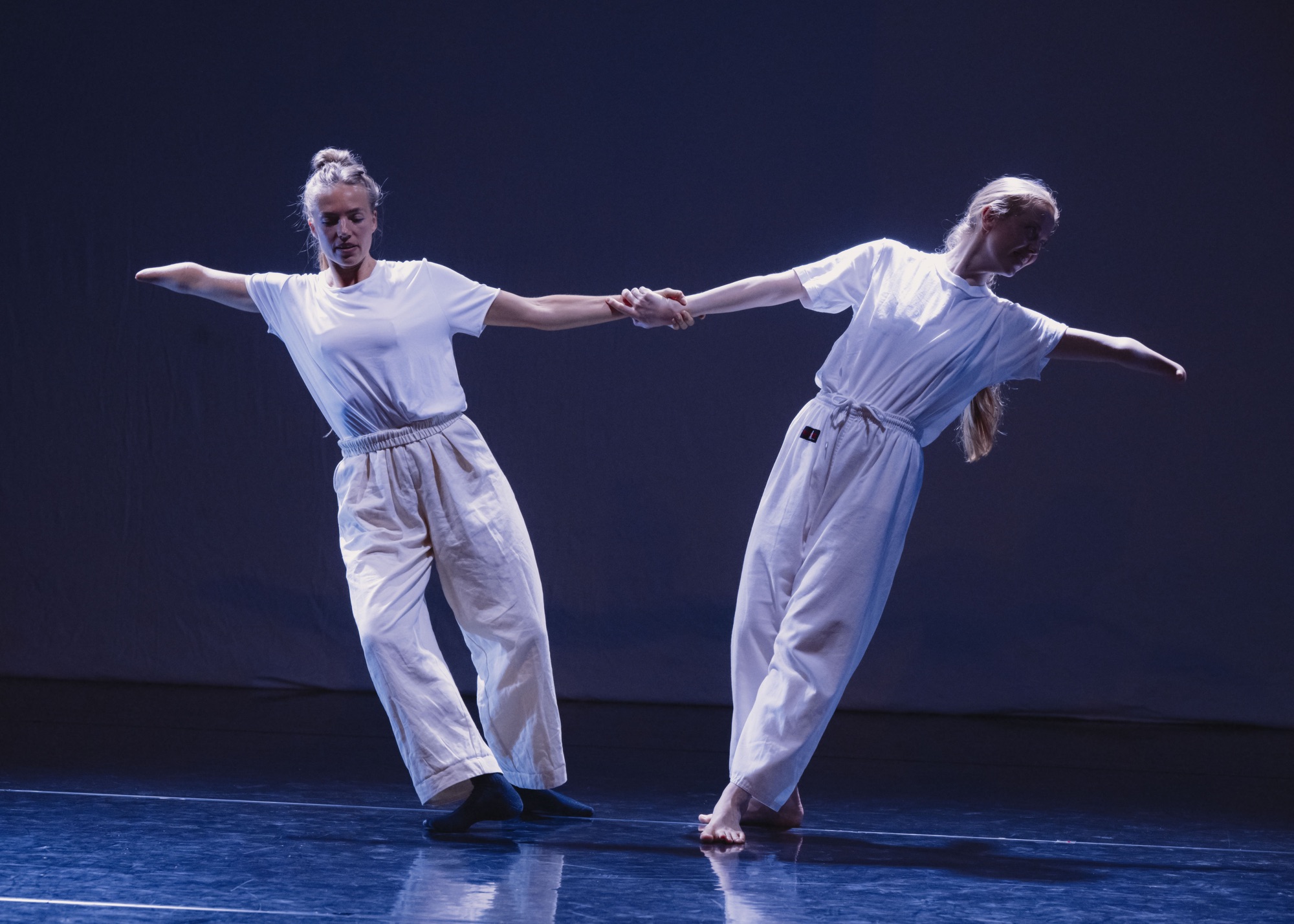
Two bodies, a camera, a projector. The dancers’ eyes remained closed as their limbs touched, organically lifting, pulling, shaping and moulding one another until the two bodies seemed to become one. The delicacy of their touch held my attention completely. Although tender, it felt powerful.
The music initially heightened this sense of intimacy, allowing me to focus closely on every movement and shift of weight. Then, without warning, the music was silenced. The lights switched and a beat abruptly entered, almost obnoxiously. A third dancer joins as the they replicate the music through their bodies, passionately stomping and hitting the floor
A projection appeared, revealing a side of the dancers I had not known was there. Faces, toes, fragments of skin appeared through the projection, creating an intimacy that I felt invited into. Their eyes had opened now, and they began making eye contact. I found myself questioning who they were dancing for: us, the audience, each other, or the camera capturing them?
Long hair was thrown through the air as the music intensified the atmosphere once again. Then, just as abruptly, it stopped. What remained was the sound of breath and the crispness of trousers moving against skin. It felt as though the music had only been switched off for us. The dancers still hearing the music, they had absorbed it, carrying the rhythm within their bodies.
Oluwatosin Omotosho’s The Aunties: The House of Masks
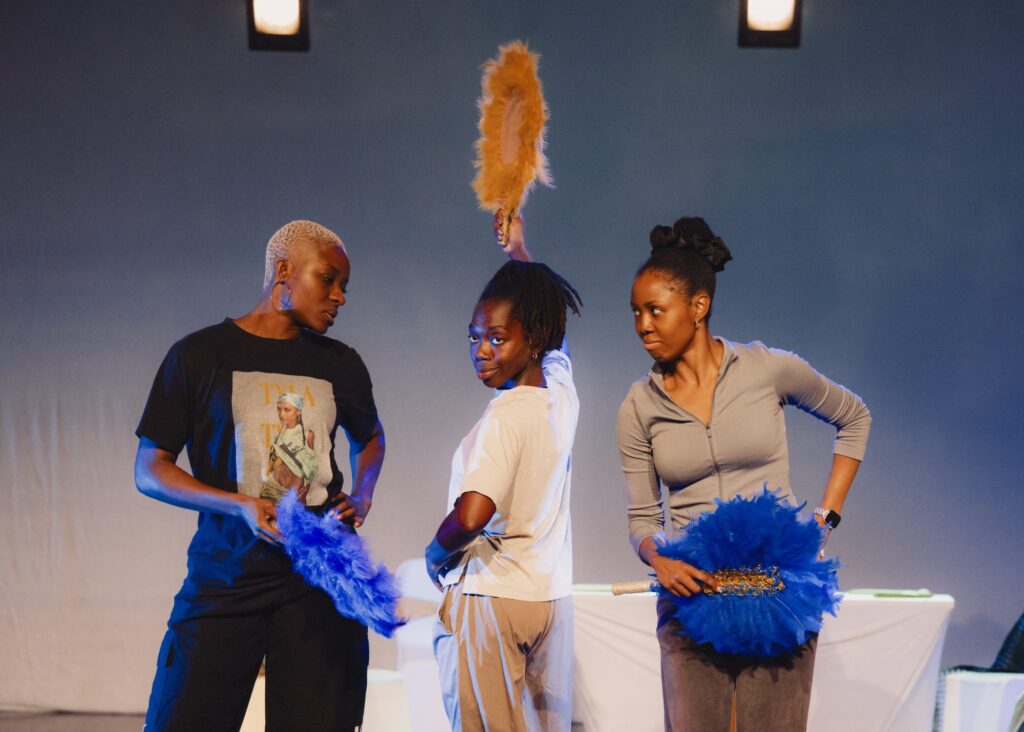
Five chairs and a table sit neatly in the centre of the space, dressed with a white tablecloth and gold ribbon, finished with a plant at the centre. The space is set for a gathering. The door opens. A flash of gold light enters the space, abruptly filling the room with sound, vibrant colour, movement and culture as five dancers and a drummer arrive. Nigerian culture fills the room with joy and expression. The dancers wear dresses reflecting Nigerian culture, juxtaposed with Adidas joggers underneath dresses and funky shaped sunglasses, creating a playful moment between generations. Comments such as “I smell Gen Z” play with the expectations placed on younger generations, while questioning what happens when inherited ideas of culture meet modern identity.
The ‘aunties’ feel larger than a family role. They appear as characters who watch, comment, advise and judge, but there is a warmth and humour within this too. The space begins to feel like a celebration, with a clear area for dancing and another for sitting and watching. At times, shifting from feeling both at the party and observing it from the outside.
The drums and movement exist almost as one. Every hit has a physical response, never a beat missed, creating a satisfying relationship between sound and body. The rhythm remains constant, while the rattling of jewellery becomes part of the soundscape. There is a richness to these details, hearing the celebration before you fully see it.
For this audience member, I found myself enjoying watching dancers watch other dancers, finding pleasure in their responses.
The space that began so clean and carefully arranged slowly shifts. By the end, the chairs have moved, the table has been disrupted, miscellaneous objects on the floor, and the room carries the evidence of what has happened. We are left with the aftermath. A space changed by the people who filled it, and perhaps a reflection of what happens when generations, expectations and identities occupy the same room.