
Words by Eoin Fenton.
The Last Quartet by Seke Chimutengwende, inspired partly by T.S. Eliot’s poetic cycle Four Quartets, is imagined as a last work, a last opportunity to dance. The choreographer enters the space with his cast and grabs a mic, informing us that this is what he imagines his last piece might look like. “The end is where we start from” he says with a gentle smile.
Though placid in his demeanour, the atmosphere is a little funerary, but also spectral and slightly odd. Gorgeous pale drapes occupy the back of the foggy space, and the cast wear a tuxedo. Not tuxedos, just one. Each of the four dancers (including Chimutengwende) and the musician wear different parts — one in a blazer, another in spats etc.. In the back wearing a bow-tie and white undies is composer Jamie McCarthy, who provides both soaring, reverberated chords on his violin and moody electronic soundscapes. The vibe is certainly ephemeral, so it’s only fitting that the true nature of the work is intentionally elusive.
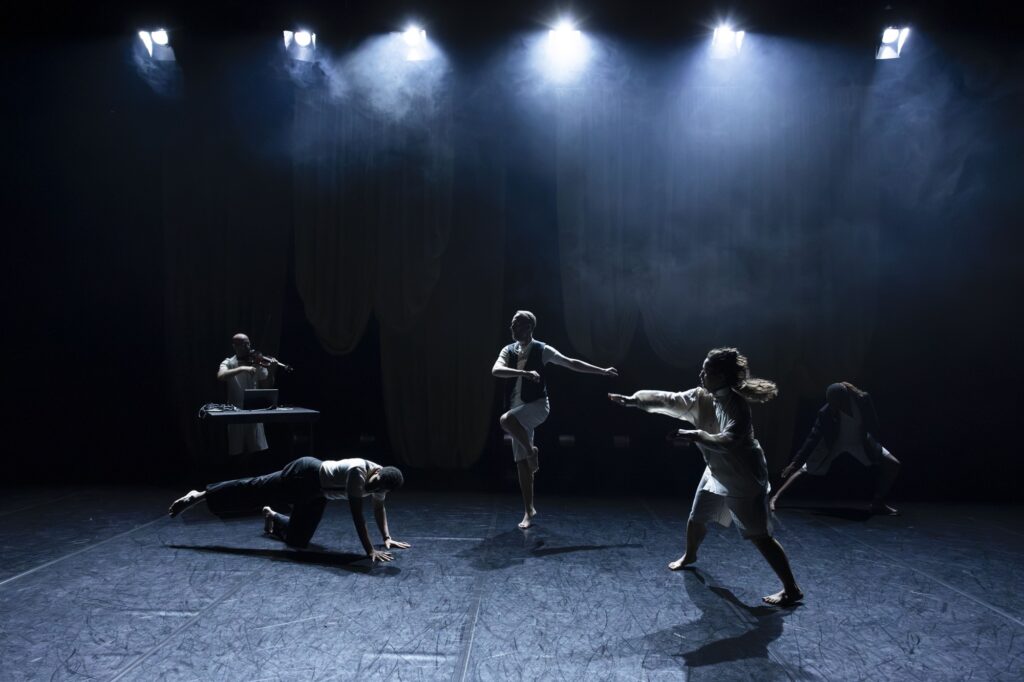
This has its merits, particularly in relating and re-relating to the cast members and their movements. Temitope Ajose is particularly magnetic, one minute hunching shoulders like a big don in her blazer, tracing the air around her with her arms with the utmost fragility the next. She dances with charisma. More broadly it feels as if the dancers, who come and go from the space as they please and improvise the movement each night, are a ragtag cohort of individuals lost in limbo, haunting the stage for one last boogie.
Within this limbo, this inbetween state the piece occupies, we do find some of the shortcomings. Being improvised, certain patterns begin to emerge within the cast that remain unsubverted or toyed with — habits die hard. Interaction, at least in this iteration, is rare or glossed over, and feels somewhat like a lost opportunity. The length of the work also only serves to dilute the impact of Chimutengwende’s meditation on loss, we become a little lost ourselves within pockets of the hour-long voyage. When we do see the piece hit its stride it does so with beauty, particularly in one sequence reminiscent of the kinetic hazard of a train station at rush hour. Bodies flinging past each other within a hair of calamity.
As a theatrical work, an exchange between the performance and the spectator, The Last Quartet’s impact is a little mild. However, as an experiment in loss and the ephemeral and the tensions between them, or even just as a mood-piece, Chimutengwende’s is an intriguing mission statement. It’s hard to judge accurately a show where even the lighting changes each time, but perhaps the end of each iteration will bring new places to start from the next time around.