Words by Josephine Leask.
Directed and produced by the 2026 MA Screendance cohort, this year’s Frame Rush brought together experimental films by the previous year’s graduates and selected work by established international dance filmmakers. The MA programme combines choreography, filmmaking, visual art, design and sound, helping students develop distinctive creative voices through the creation of short-films. It also builds practical knowledge of technical production, marketing, press and audience development.
Across the festival, cinematography, editing and spatial design became choreographic tools: the camera moved with, or responded to the dancers rather than observing them from a detached distance. The nine graduate films also reflected the cohort’s international character, with filmmakers from France, China, Hong Kong, the US and the UK. I love how although their subjects ranged from politics and competition to surrealism and empathy, many returned to a shared concern: how people form connections with one another and with the spaces they inhabit.
Graduate Films: Connection, Community and Place
That concern runs through the first group of films, in which domestic, public and natural settings actively shape relationships. In Jacy Keddie’s The Being of a Woman, three women express an intimate bond across contrasting environments: gazing out to sea from a misty clifftop, dancing together in a club and sharing the private spaces of their homes.
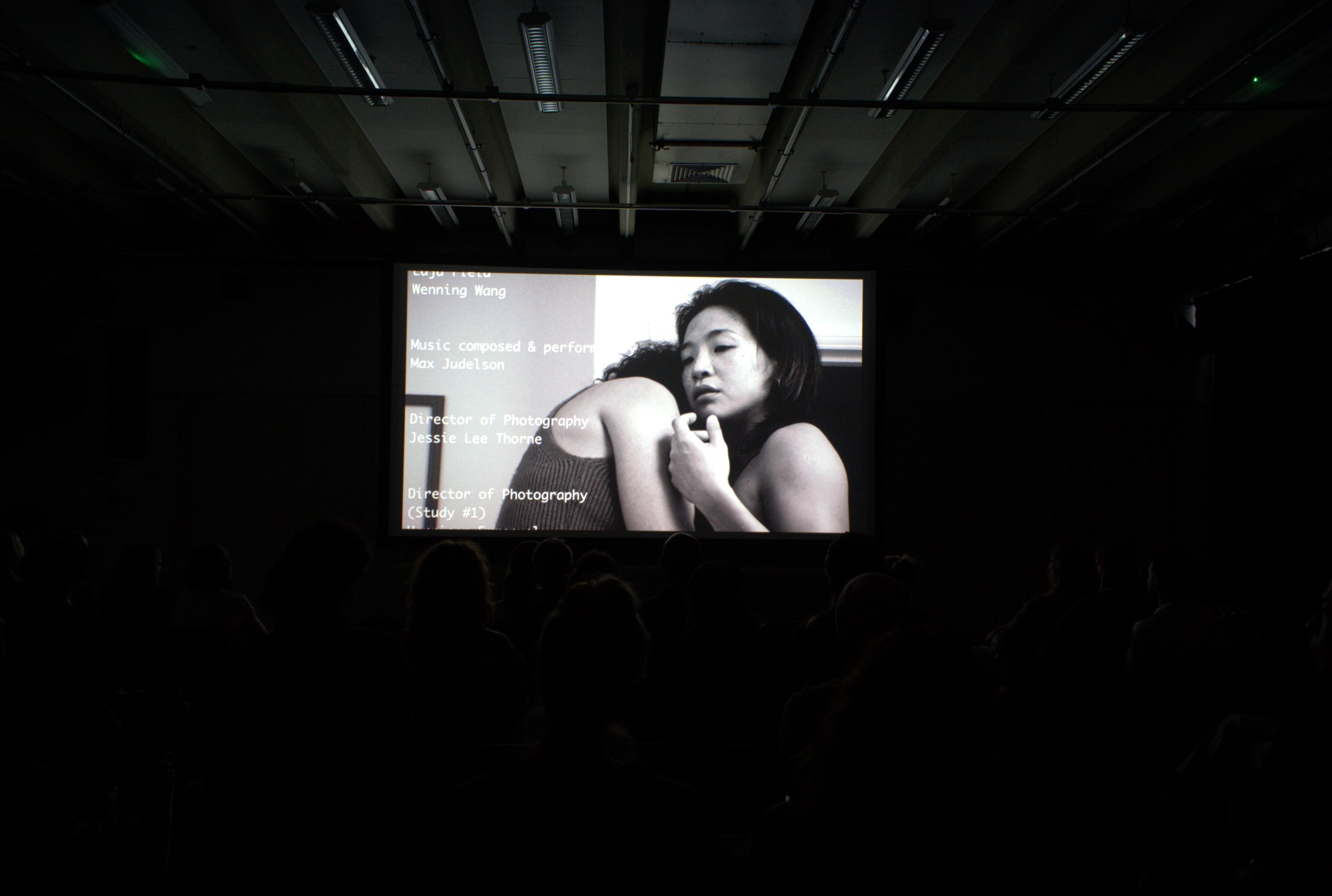
Jessie Lee Thorne’s Four Interpretations of a Scene, filmed in two similar bedrooms, explores one friend’s concern for another who appears to be experiencing poor mental health. Each of the four black-and-white studies takes a different approach to the friends’ interaction. Close framing draws attention to the micro-details of their body language, creating the feeling of being present in the room.
Eimyn Cheung’s The Cherry takes place in a derelict house, still marked by remnants of yellow wallpaper which creates an optimistic glow. Like a scene from Bake Off, dancers waltz amicably around one another, each proudly carrying a cake. When a cherry lands on one cake, all hell breaks loose as jealousy erupts: the group’s momentum accelerates as they dart and dive aggressively through the empty rooms, searching for cherries.
In Alexandra Turner’s Currents, a woman emerges organically from the sea and interacts with the waves. Her movement echoes their ebb and flow as she disappears and reappears in a continuous cycle. Variations in speed, close-ups and shifting angles create highly rhythmic camerawork and editing.
Becky Johnson’s documentary about Trades Hall—a former social club and now a popular non-profit, grassroots events venue in Walthamstow—captures the value of an inclusive place where everyone is welcome, while also highlighting its (and many other London venues’) vulnerability amid urban gentrification. Interviews with the dedicated management team, interwoven with footage of the popular and varied events, tell a heart-warming story of why the venue is so cherished as well as making a point
Alexandra Bechikh’s Free for the Night considers the need for safe night-time spaces for women. A group walks through the city searching for somewhere they can enjoy themselves without cost, eventually transforming a church into their own nightclub. Stained-glass windows, high ceilings and the peaceful atmosphere inspire their wild and abandoned dancing. Changes of speed and psychedelic colours layered over their clubwear evoke an arty 1980s electro-pop video, showing both their reclamation of the night and the timelessness of the church.
Graduate Films: Surrealism, Rivalry and Unease
Elsewhere, connection gives way to rivalry, fractured identity and psychological unease. Tacy Zhao’s Half a Mask and Fanshu Vikki Xu’s My Friends move into surreal and macabre territory, revealing the complexity of our relationships with both friends and ourselves.
In Zhao’s film, two women fight over a mask. After breaking it in half, they reconcile, each wearing one piece as they perform a series of stylised duets. Shifts between an art studio and a graffitied backstreet, day and night, combine with vivid, outlandish costumes and accessories to suggest that anything can become a fashion statement.
By contrast, the slickly edited My Friends unfolds like a feverish nightmare. A woman wakes in terror as her nightmare emerges physically from beneath her bed. Four zombie-like men lunge at her while she tries to escape, repeatedly reappearing closer and more menacing than before. Skilful cinematography makes the film nail-biting from beginning to end.
Riley Roberts’ Bargains Made is equally disturbing. Wide landscape shots reveal a social experiment or competition staged in a sterile hall, where nervous participants are sworn to secrecy. Forming a circle, each must fight off the others to win. As the camera closes in on the violence and mounting tension, the viewer is made to feel part of the competition.
International Perspectives: Ritual and the Human Condition
The international selection broadened these concerns, placing personal experience within wider cultural rituals and traditions. Featuring films from China, Portugal, the US, Finland, the Philippines and the UK, the programme was selected by the graduates and grouped together by a loose focus on ritual in both private and public life. Each work was imaginative and highly sophisticated, but my favourites were those that delved most movingly into the human condition.
Darmyn Calderon’s La Superstición del Huevo draws on memories of her superstitious Mexican mother, who used an egg to protect and heal her. A mother sweeps an egg over her daughter’s body; as the girl falls into a trance, she imagines her dancer doll coming to life. The beguiling cinematography creates a story steeped in magical realism, leaving the viewer both enchanted and uneasy.
Alice Underwood’s Search is a deeply poignant character study of an older artist and dancer. Drawing inspiration from her artwork, she creates a solo addressing her experience of gynaecological cancer. The camera follows her as she gathers found objects on the beach and assembles a collage, then cuts to the studio to frame her danced improvisation.
In contrast, Myca Guinchoma’s comic Parada follows a young woman commuting to work in a crowded minibus. She retreats into ballet music on her phone to escape the noise and bustle, but when her headphones break, she is forced to engage with the other passengers. Gradually, she comes to value those interactions and embrace the community around her.
Finally, Vanessa Rose’s The Weight perceptively captures the burden of motherhood through repeated versions of a mother and wife’s morning routine. The weary ritual of making breakfast for others grows increasingly absurd through movement, camerawork and an accumulation of coats, scarves and duvets, which her family lovingly piles onto her until she can barely move.
Taken together, the graduate and international films demonstrated the breadth of contemporary screendance practice. Their varied approaches to structure, movement and visual storytelling were innovative, challenging and rewarding. By organising the screenings around loose themes and concluding with a robust Q&A, Frame Rush gave the evening a coherent shape while remaining accessible to audiences less familiar with the form.