
Words by Sarah Lapinsky.
A blank projector screen. A click of a slide projector presents two chairs facing the ohter on the screen as lights fade up to reveal two chairs on stage. Slide click and two people appear in chairs as Elly and Olia, known in this piece as “E” and “O,” take their seats.
The slide changes and they match the new gesture. They face away from each other in the next image and then pose facing the audience in the next. I found myself wondering if there was a narrative. Try to grasp a sense of where, when and who is here as they return to the original image, smiling at the audience.
Alternating gestures, I see that a conversation could be forming as the performers embody the images, postures and facial expressions. They move with precision and efficiency, but do not appear rushed as moments of qualitative choices suggest a feeling behind the pose.
The poses vary between pedestrian and abstract, but with each new model, I gather that the performers have the ability to be anyone and anywhere. The uncertainty affords a freedom for stories to take shape yet remain malleable in meaning. As the rhythm of switches quickens, I ponder a question of dance and movement— how many of us may take for granted the expression our bodies are capable of and perform without us even noticing.
A shift occurs when the images are strung together and transform into snapshots of movements enabling running and smaller gestures. The photos amplify the performer’s movement like a close-up of the expression of eyes that slows down and highlights a blink or a clasp of hands. I feel completely engaged and am following through the gestures until the performers hit an abstract unison pose as Eurodance hit, “Freed From Desire” by Gala, comes over the speakers.
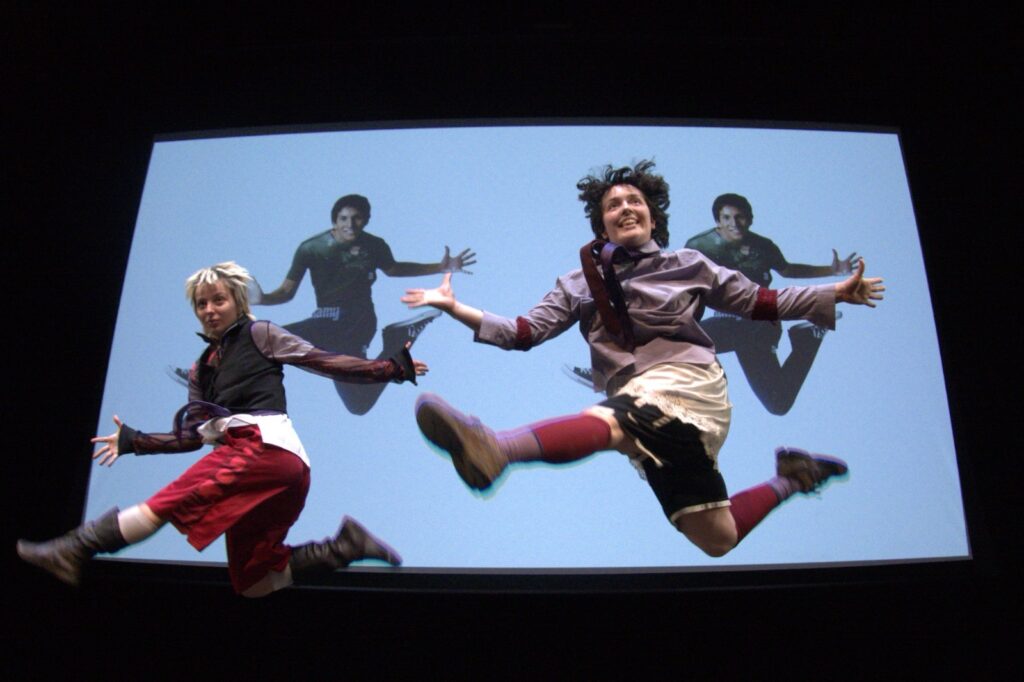
Building choreography in the movement between poses, E and O dance. This served as a welcome change of pace while offering a new insight into movement and image as any dancer who has had photos taken of their dance (flattering or not) will viscerally remember. At the end of the section, E and O leave as images of clapping audience members appear on the screen; the audience obeys their directions as the lights fade to black.
In the darkness, a narrator comes over the speakers informing the audience of E and O’s movements, including walking, tripping, “moving a massive tree” onto the stage, and performing an impressive but unseen gymnastics routine. I found this section incredibly clever and fun while wondering about the experiences of dance and audio description. Particularly, the description of backflips and landing in one-handed handstands hinted at a cheeky question of the truth and reliability of the narrator. Seeing the so-called “massive tree” is a chair with a sign on it makes me wonder if that matters in the world that has been created.
The following section titled, “it’s not about nothing, but what it is, I can’t say” features the narrator describing E and O’s movements like a choreographer or with words that a dancer might say in their head when performing a phrase. Moving mostly in unison, E and O get things wrong and change to match the narration. Having qualitative or interpretative meanings shared by the narrator presents questions of choice, agency and compliance. How many ways can you think to wave or embrace?
The narration speeds up, and E and O perform impressive feats of partnering and martial arts-inspired floor-work. Narration overlaps as unison is broken. The vocal tone influences performance, and the narration is nonsensical in a fun, difficult-to-predict way. Expanding the world with falling apples and other characters, the narrator builds and rebuilds a sense of place and character. E and O continuously add moments of levity and surprise. The narration evolves into sound effects amplifying and directing E and O’s movements before returning to directing them.
The final minutes of the piece disregard any notion of the fourth wall as E and O point towards their most and least favourite audience members. The narrator directs E and O to gaze at the audience as this unseen voice starts directing the spectators. This voluntary audience participation felt welcomed, with thoughtful directions to “put down drinks” or “jackets” before introducing gentle and achievable movements such as “raising an arm,” “standing up” or “high-fiving their neighbour” as “E and O watch.” I especially appreciated the narration that “E and O are enjoying this” and the cheeky moment of self-promotion as they posed for the audience’s Instagram stories. “E and O applaud the audience” as the lights go down and the piece finishes.
Take a Seat presents a series of stock images and narrated stage directions as a playful, well-crafted exploration of movement, image and gesture with questions of choice and what it means to be seen. Overall, this is an enjoyable piece that pushes concepts to the edge while remaining clear in intention. I would be very excited to see more from E and O and where their choreographic voices will take them.