Words by Maxime Swift.
Like all good fairytales, Ode to The Dark is full of magic. Sculptures are brought to life, bodies are reanimated, and anything could be happening in the dark. This one-off performance at Arbroath’s Hospitalfield, is part of a larger body of Florence Peake’s work, entitled Your Meaning Not Your Materiality, an interdisciplinary project exploring the potential of gaps, spaces, and chasms – the presence within absence.
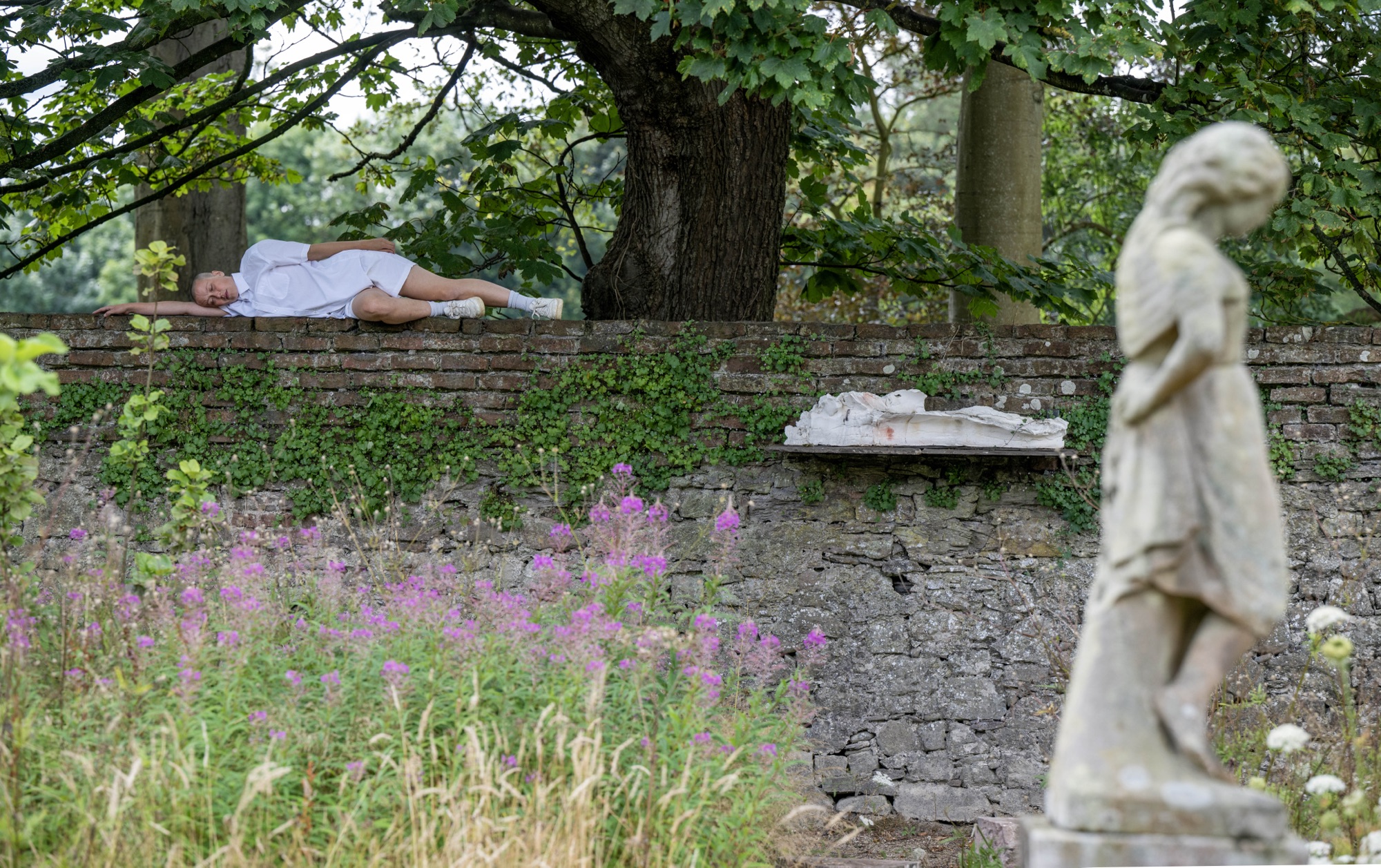
This is a performance in four parts. Each chapter is distinct; Peake and the troupe of dancers from the Scottish Dance Theatre respond playfully to the environment of Hospitalfield, the grandeur and eccentricities of Arbroath House. We begin in the walled garden: it is summer and the garden is at the height of its romance, the flowers are blousy and the orchard trees are beginning to fruit. Peake’s sculptures are quite the contrast. Like icebergs, they are white, ragged and imposing.
Others, stuck to the backwall resemble chewing gum, calcifying the thumbprint that tacked it there. The sculptures were formed between two bodies, the bodies of sisters. The casts look profoundly unbodily. There are hints and glimpses as to the bodies that came before, with the odd shoelace or shirt cuff peaking through, but the shapes themselves no long carry the sisters’ warmth. They are part of this attempt to articulate the missing, a portrait of grief. But then, the magic begins. As dancers stretch out like cats along the tops of the garden walls, the sculptures seem transformed. Their silhouettes are mimicked in the dancers’ poses, statues no longer seeming abstract. This is the first of many transformations.
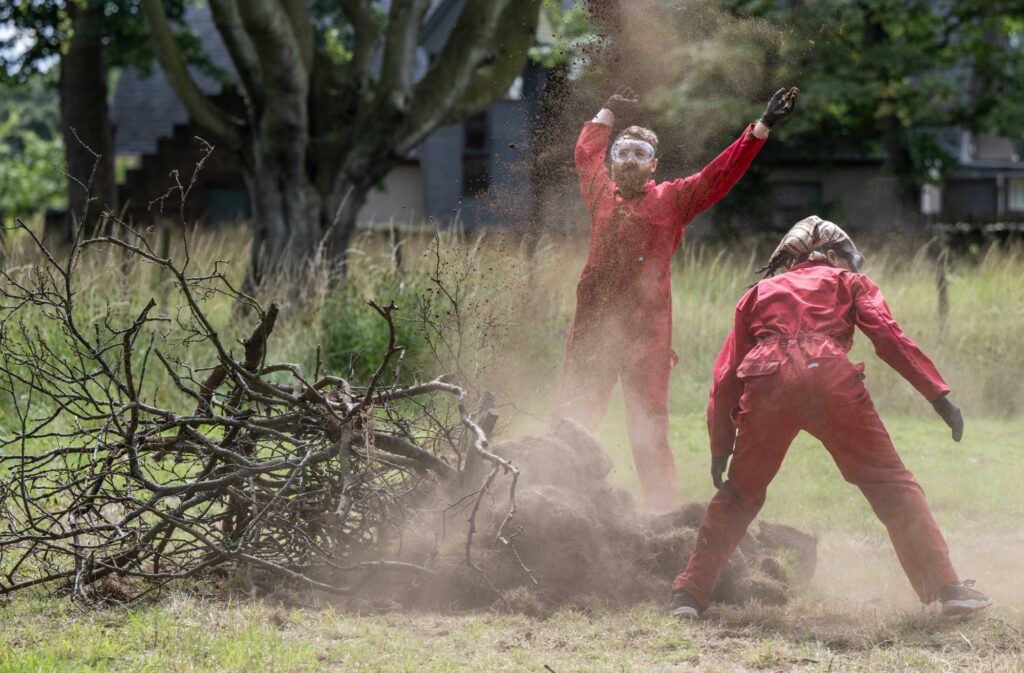
For the second section, we move into the Paddock, three people in bright red boilersuits pile up sticks and soil into a sort of makeshift pyre. It is like watching a funeral in reverse. Once all the sticks are gathered up, they start to dig with increasing urgency – dry soil is thrown about creating puffs of dust, like brown smoke – a sort of makeshift flare, a distress signal. As they claw at the earth, bodies are revealed. It is unnerving. My mind flits back and forth between images of an archaeological dig, unearthing roman statues and the more gruesome idea of body bags and mass graves. As the three dancers dig and dig then finally collapse onto the bodies in the graves, the feeling of futility seems to peak. Their energy seems to seep out of them into the bodies beneath. Ever so slowly, the bodies start to rise. They crawl out of the graves painstakingly slowly, carrying the dancers on their backs. The audience parts for them as they make their way through, holding their breath as they are passed by.
This brings to an end the outdoor performances in the Ode to the Dark programme. Within the boundaries of the house, the tone shifts; the dancers are more playful within these surroundings. After a dance up the staircase, we enter the picture gallery. The dancers stand poised as we gather round the edges of the grand gilded room. Once we are seated, the curtains are snapped shut and the din of the dancers begins. Panting and slapping and scurrying and sighing, it is impossible to place the location of anything. Deep, deep breaths resonate in the pitch black. It is thrilling for dance to be no longer a show of spectacle, just pure sensation. I loved this feeling, this final dance managed to be silly, sexy, scary and serious all at once. When you feel as if this cacophony will not end, a game of silent statues begins: the curtains next open, and we see all the dancers frozen in new positions. This repeats, then the sequence changes. Now, in the darkness a hum begins, the kind that disturbs sleep: the hum of an incessant whining mosquito circling, or the hum of a mini fridge in a cheap hotel. The different pitches join together and back in the light they crescendo into a euphonic, almost ecclesiastical, cry. Bodies cling to bodies. The curtains are shaken to create strobe light. The effect is magical.
After the climax, one dancer approaches a harp and starts to play. We end with a fairytale, a story of a witch, a castle and plenty of treasure. The dancers are clearly enjoying their collective telling of the story – there is a hint of the renaissance fair in the camp, hammed up delivery of the story, borrowing the voices of nursery teachers, that specific cadence used for reading stories aloud to children. The story brings together the notions of objects’ energy, their meaning (rather than their materiality), a tale that warns that even if some may ignore or dismiss their significance, others will find it impossible to ignore. I leave Hospitalfield following the dancers that have streamed out from the balcony stairs, a casual procession chanting the last refrain of any good fairytale “forever and ever and ever”. The magic and the message stay with me well beyond the walls of the grounds, and I will continue to seek out Peake’s work to get another chance to experience her alchemic transformation of energy and space.