
Later this month, choreographer Theo Clinkard will restage his work Ordinary Courage over 10 years since it was first performed when Theo launched his company in 2012.
A moving piece exploring grief, Ordinary Courage comes to Sadler’s Wells East as part of Blue | Glas double bill by National Dance Company Wales, which also features Untamed, a new work choreographed by Sadler’s Wells Associate Artist Alesandra Seutin.
We spoke with Theo to discover more.
Q: What has it been like to return to your first work and work with NDC Wales dancers?
A: Ordinary Courage tracks my experiences of loss but also, it was my very first dance piece, so for both reasons it feels quite tender. I was honestly quite scared going back to it after so many years, especially bringing it to a repertoire company context and to dancers I didn’t know. However, I’m so glad I did! It can be intimidating entering repertoire company as a maker. It’s the dancers domain and though you’re the new kid, you have to lead the room and establish trust and foster enthusiasm within just a few days.
The NDCWales dancers have truly astounded me- expanding and deepening the work in ways I didn’t know it needed. It’s become physically braver and performatively more expressive. Rehearsing alongside big questions about life and vulnerability and care and control has required courage for all of us and each individual has found a way to relate personally to the work. I’m deeply grateful for how carefully they are holding it all and how welcomed I’ve felt.
Returning to Ordinary Courage was weirdly like mentoring my younger self, with a bit more perspective, more choreographic experience and a whole lot more life lived and loves lost. The process has reminded me of something I had forgotten around the universal within the personal. The world has moved, dance has moved but this theme of loss is so fundamental to the human experience. I’m curious about how a new generation of audience will meet it.
Q: Since returning to the work, are there any aspects or things that have challenged, surprised or inspired you?
A: The initial creation process feels far from the way I approach choreography and collaboration now – how subject is held, how the dancers body is authored, how ideas are practiced or represented, movement and meaning etc. But in some strange way, it feels refreshing to my eyes again. Back in 2012 I wanted to find form for my experiences and clearly articulate that through the dance. I think the sincerity of that act reads differently amongst today’s dances.
At time of making, there was a real lull in dance that foregrounded dancing. The formal movement work of the late 90s/00s on which I was raised had phased out and dance theatre, text and character led work was thriving. I made Ordinary Courage partly as a response – I missed dance that trusted the communicative potential moving body and that trusted the audiences capacity to read it – not as an intellectual exercise or struck in awe at dancers physical feats, but through the empathic lens. I see that movement and I know it in my own bones.
In recent years, I’ve worked more with scores and improvisation – a kind of choreography as hosting of dancer practices. But I’ve had a growing need to find more of my own voice again. Listening to my partner Fionn write songs with a kind of ‘rip your guts out’ brutal honesty, I have a new appreciation of a more direct kind of authorship. Bakani’s (NDC Wales artistic director and joint CEO) invite to return to Ordinary Courage felt like a well-timed nudge.
This restaging came pretty soon after my dad’s death back in February. I would wake up in Cardiff each day to read, write and listen as I sought to learn about this new grief in real time and often adapt the work based on these revelations. I had a lightbulb moment when I shifted my position from ‘expert’ or ‘here’s something I experienced that I want us to embody’, to student – asking the dancers to embody things that I struggle with. How does your fury show up? What would it really take to feel that vulnerability in a theatre? What is the time of a depressed body? How does anxiety shift your relationship to the ground? I’ve been surprised at the unexpected ways this process has been cathartic rather than simply confronting.
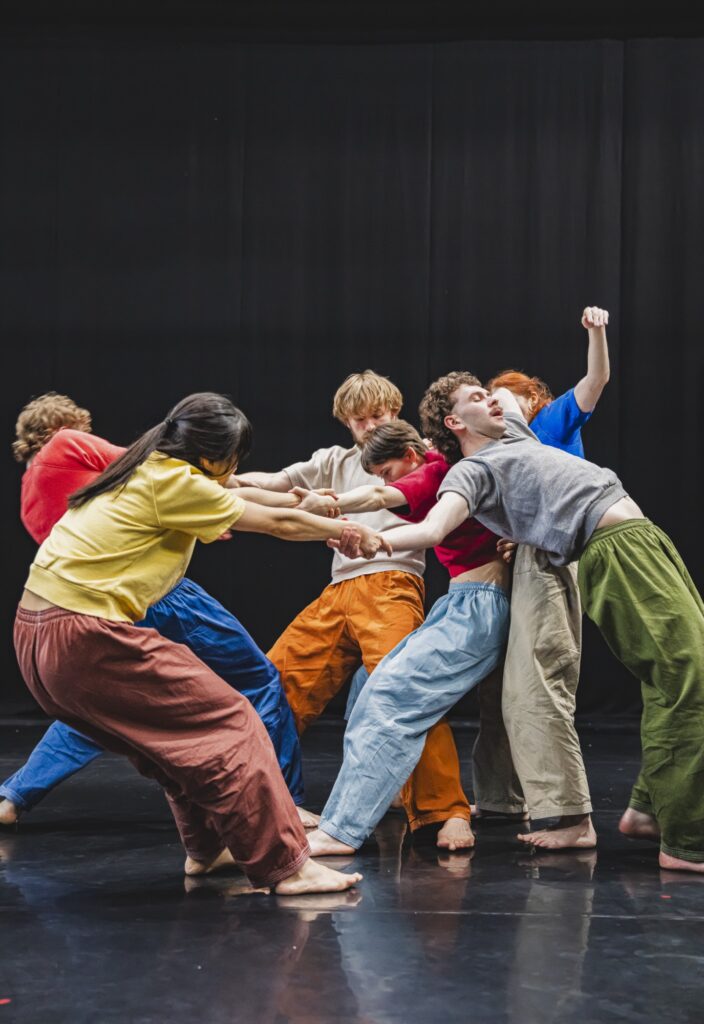
Q: The work looks at the grief you experienced after the loss of your mum. Grief is something that is so subjective and experienced so differently. How do you ‘present’ or ‘show’ grief in Ordinary Courage?
A: It’s deeply subjective and even for one person, each loss is utterly unique. The first time you lose a loved one, the bubble of this only happens to other people bursts and your whole world view reorientates as you wrestle with this gaping chasm, your own mortality and the devastation of those around you. Each time it comes, grief has a way of speaking to all the previous losses- they all come to the surface again. There is eventually a point at which you start to understand it as part of life. It brings such depth and meaning and urgency. It sounds odd to say, but I would miss the ways grief has made my life so vivid and full.
The work houses the different ways we navigate that uneven terrain. I actually perceive the group as a single multi-faceted body with sides of the same single journey. I drew upon Elisabeth Kübler-Ross’ writing around the stages of grief and returning to the work this year, I identify with different moments as I find more permission for my own darker parts – I guess my ‘shadow’ in Jungian terms.
As an audience, I love when the dance is suggestive enough to light up some recognition, yet leave enough space for my personal imprint so that I am reminded of my own body and its experience in the world. I’m into work that lets my mind drift and reflect rather than claim my attention.
I imagine it is a Victorian thing, but unlike many other cultures and geographies, we lost tools, practices, rituals and guides to handle loss. I know many artists and thinkers that are actively reviving or reinventing how we better prepare for death’s arrival and how we gold each other in the aftermath. I feel like dance is well placed to articulate something of that experience as it is all so deeply of the body. I also believe that the context of performance – that rare collective concentration and safe dark space – is perfect for noticing or even healing parts of ourselves.
I like the idea that Ordinary Courage might be useful. Sometimes we need to see things play out to understand them or to see other pathways modelled for us. For audiences, I really hope that there is comfort for those that need it and recognition for those that are struggling.
After my mum died, a dance producer said to me I lost my dad and want you to know that, in time, there will be joy again. That one sentence was the guide rope through the cave toward some light that I needed and I hope this work can offer people something similar.
Q: You’re presenting your work alongside Alesandra Seutin. What does it feel like to present work alongside Alesandra’s new work?
A: Alesandra is great, we actually shared a double bill almost 10 years ago and I still remember the urgent impassioned performances she drew out of the students. I cannot wait to see her work as part of the programme as it sounds like a great pairing with some shared themes but a whole different approach.
For more information and to book visit: https://www.sadlerswells.com/whats-on/national-dance-company-wales-blue-glas/. Running from 24-26 September.