Words by Luella Rebbeck.
Somehow, after spending an afternoon moving between performances in Queen Elizabeth Olympic Park, that felt true. The Greenwich+Docklands International Festival (GDIF) 2026 is dance in its honest, raw, fun-loving and sun-kissed form. It is majestic and thoughtful, impressive and intimate, big and bold. It is also a festival that understands that dance does not always need a theatre around it to be dance.
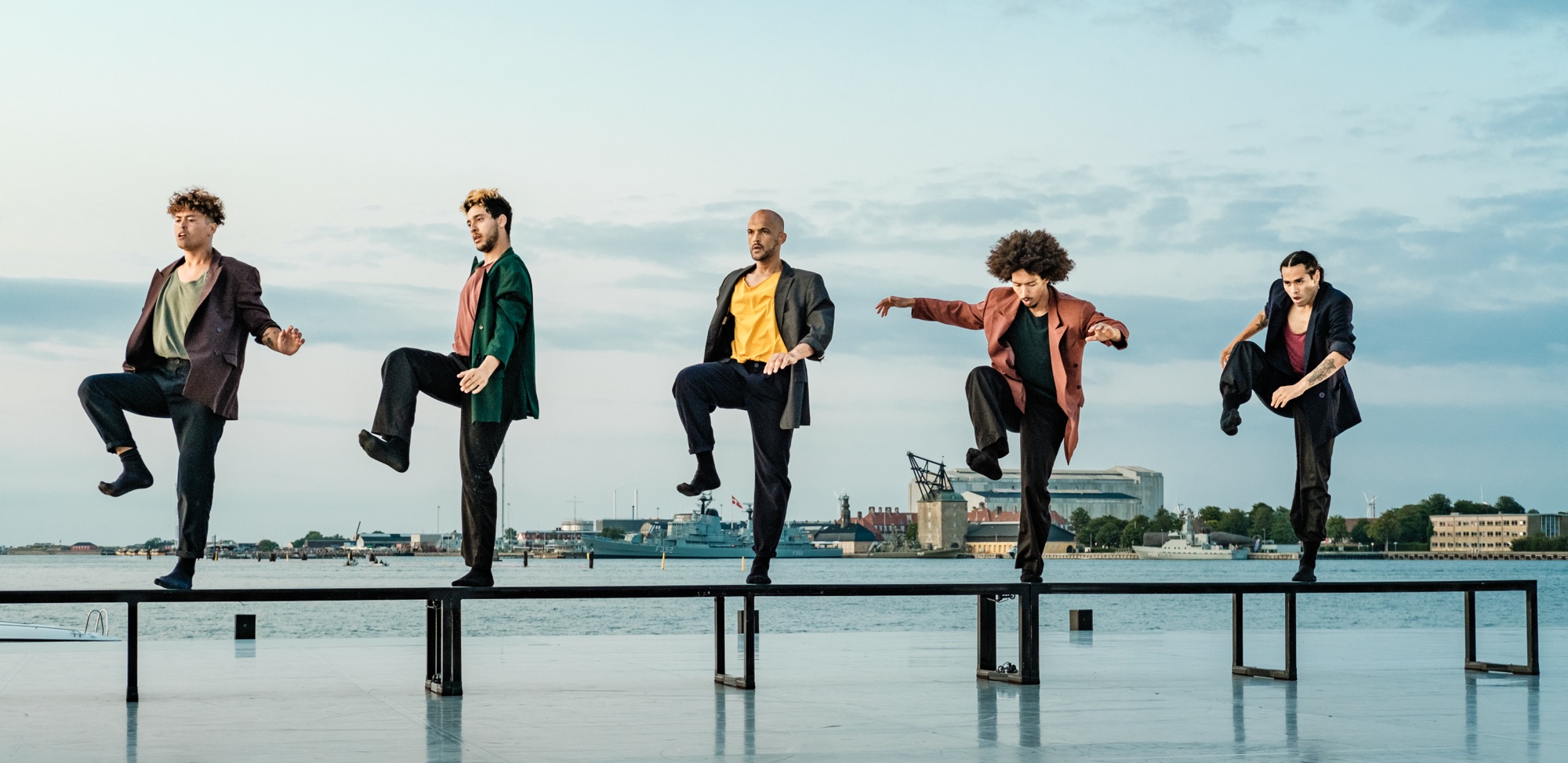
The day began with Benched by Uppercut Dance Theater, a piece that immediately established one of the festival’s most interesting ideas: infrastructure as a partner. Benches became more than benches. Three tables turned and revolved while five men danced around them, leaning, balancing and supporting one another. The movement felt surprisingly soft. There was a musicality that seemed to come from within the bodies rather than being imposed upon them.
What stayed with me was the trust.
The benches became structures of support, but also structures of dependence. The dancers constantly negotiated weight, proximity and timing. Duet followed duet, one relationship dissolving as another began, creating a growing sense of totality. There was something quietly sacrificial about the work — an understanding that to dance together, you have to give some of your weight to somebody else.That idea of collective support continued through the festival, although in very different forms. Kokkon by Grensgeval and Aifoon brought concrete blocks into the equation. There was something almost magical about watching the performer transform such heavy, immovable material into a playful choreographic environment.
The contrast between the weight of the concrete and the lightness of the body created a beautiful tension. And then there was the wider environment. A football match was taking place in the stadium behind the festival. The sound of the stadium became part of the soundscape of the afternoon. There were people who had deliberately come for dance, people who had come for the football, families, children, passers-by and people who perhaps had no intention of encountering contemporary performance at all. Both things could exist at once.
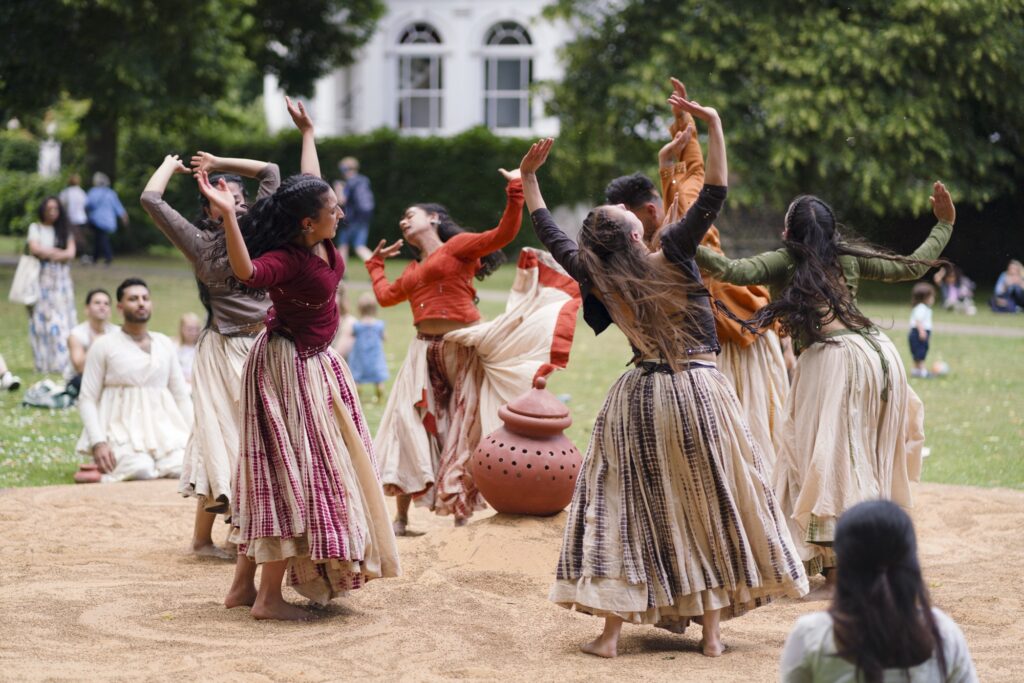
That felt particularly important to the spirit of GDIF. The festival does not demand that everyone arrive with the same cultural references or the same reason for being there. It simply creates the conditions for people to share a space. Cicatrius by Vero Cendoya explored this collective nature more explicitly, with belonging and dancing as a community at its centre. The work felt connected to the idea that dance can be something we do with and for one another, rather than something that is simply presented to an audience. There was a generosity in that. GARBH, choreographed by Shyam Dattani and Mira Salat meanwhile, felt like a celebration of dance in its totality — a work that embraced the physical, communal and celebratory possibilities of movement. Across the festival, there was a recurring interest in what happens when people dance together, rather than simply watching someone else dance.
That spirit was particularly evident in the festival’s use of folk dance, understood broadly as community dance. Different cultures and movement traditions were placed alongside one another without the atmosphere becoming judgemental or overly critical. There was an openness to exchange rather than an insistence on explanation. Man Down by Fuse Theatre the duet with beatboxing, offered something more confrontational. The live vocal element gave the work an immediate physicality, while the duet played with expectation and presence. Yet this was one of the works where I wanted more.
There was clearly something underneath the surface that could have gone further. I wanted greater strength, but not simply physical strength — I wanted the work to expose more vulnerability. At moments, the energy felt slightly lacklustre, and I wondered whether a more intimate setting might have allowed the relationship between the performers and audience to become more charged. This is perhaps one of the challenges of a festival on this scale. Outdoor work gains atmosphere, accessibility and spectacle, but it can lose intimacy.
That was not a problem for The Aunties: The House of Masks by Olúwatósin Omotosho. Comedic, unfiltered and intimate, it felt completely at ease with its audience. Even though I was not necessarily part of the culture or community represented within the work, I could still understand its humour and warmth. It did not feel like culture being displayed for an outsider to inspect. It felt like an invitation into a world that was already having fun.
That distinction mattered.
Then came Lea Anderson’s BUG, a soaking-wet bug-like celebration of absurdity, intensity and sheer fun. The work kept swelling and insisting on its own entertainment value, repeatedly reminding us that this was, indeed, entertainment. It was funny because it understood the ridiculousness of its own theatricality. And it was exactly the right way to move towards the end of the festival. As It Was brought popping to the programme, turning the form into a kind of ongoing exchange. It felt like a demonstration of training together: bodies communicating through a shared vocabulary, showing not only what popping can do but what years of practice with other people can produce. Again, the theme was collective knowledge.
By this point, the festival had accumulated a strange and wonderful vocabulary of benches, concrete blocks, beatboxing, popping, comedy, folk dance, community, steel, sound and sunshine. The infrastructure of the park was no longer simply the backdrop. It had become part of the choreography. One of my favourite moments came when steel poles, during the duet of Kokkon, carrying speakers were used almost as bouncing tools. The performers worked with the structure, sending movement and sound echoing around the space. It was circus-like without becoming circus for the sake of spectacle. More importantly, it was a perfect demonstration of trust and professionalism.
The promenade format was one of the festival’s greatest strengths.
Moving between four sites meant that the audience was never entirely fixed. Sometimes we were watching a circular stage; sometimes we were walking alongside performers; sometimes the work felt interactive; sometimes we became spectators from a distance. The changing perspective made the park feel different from one performance to the next. It also exposed one of the festival’s limitations. Timing could become haphazard. Outdoor performance is vulnerable to the realities of public space, and the scale of the audience meant that some moments inevitably felt less intimate than they might have in a theatre. Some pieces would, in my opinion, have benefited from a closer performer-audience relationship. When hundreds of people gather around a performance, individual performers can become difficult to distinguish, especially when one journey ends and another has already begun.
And then there was the sun. The surprisingly blaring, relentless London sunshine turned the festival into a genuine endurance test. I was hot, but not bothered. Because ultimately, that was the atmosphere. People were sitting, standing, walking, dancing, laughing and shielding themselves from the sun with their paper festival guides. Children were moving through the crowds. Different communities were occupying the same park. The stadium was roaring somewhere behind us. Performers were taking risks with benches, concrete, steel and one another.
It felt enormous and intimate at the same time. That is perhaps what GDIF does best: it makes room. Room for different cultures. Room for different bodies. Room for people who know dance intimately and people who have simply wandered into it. Room for spectacle and vulnerability, professionalism and play. Room for a football match to happen behind a dance festival without either needing to apologise for being there. There is, of course, always room for improvement. Some works needed more intimacy; some needed to push their emotional or physical ideas further; and the practical realities of outdoor festival scheduling occasionally interrupted the flow.
But these limitations did not diminish the larger achievement.
GDIF felt like dance stripped back to its most generous form: raw, communal, playful and physical.
Majestic without being pretentious.