Words by Maxime Swift.
Before the opening of this year’s Edinburgh Art Festival, I was reading about The Mechanicos, the dance of the sponge divers. First devised by Theophilos Klonaris, it represented the daily toil and peril that these Greek workers faced, using music and dance to both celebrate the fruits of their labour and honour the dangers they were met with. The youngest man leads the circle of dancers, playfully twirling a stick in the air. Then, the violin shifts, the stringed instrument becomes menacing; the dancer responds, writhing in pain, the stick now supporting his weight. This represents the onset of “the bends”, a common cause of disability and often fatality for sponge divers. In The Mechanicos, the dancer’s fate rests on the violin, his pain and rehabilitation decided by it alone.
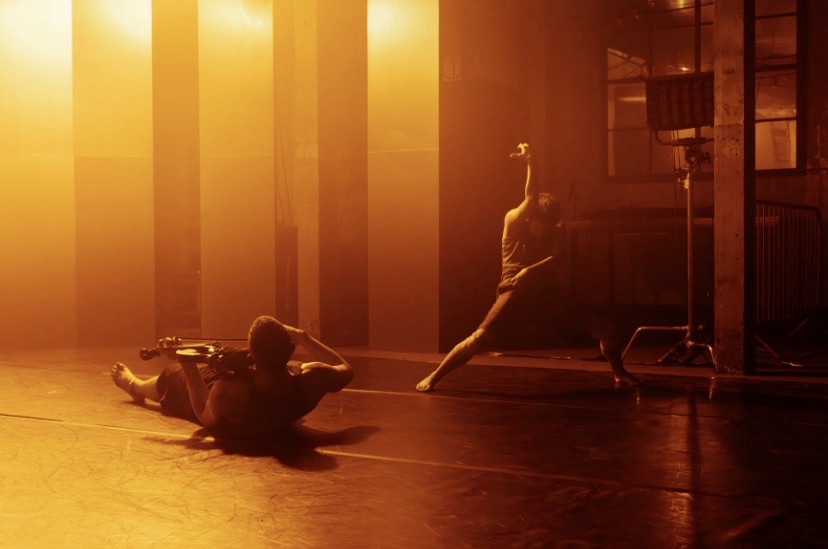
It was with this inauspicious violin playing on my mind that I entered Magnus Westwell’s work in progress performance, Caught Hold of Nothing. Here too, the violin is the linchpin for atmosphere and action. Westwell slinks around the back of the room, playing sloping minor arpeggios as they lope around, occasionally stumbling to the floor. The other dancer on stage, Océane Robin, is also moved by the music, hands slowly twisting into claws in response to the sounds. The two dancers do not move as one; each is in their own lonely reverie. Westwell’s movements are especially narcoleptic – they remain fallen after collapsing about halfway through the performance, violin resting to the side. The weak tremble of the violin’s simple reprieve is then absorbed into the droning soundtrack. Neither Westwell nor the violin rise again.
With a body now slumped on the floor behind them, Robin is left to dance alone on this desolate stage. They run through a repeated routine that cuts across the narrow space: from kneeling on the floor arms outstretched, a short sprint, their hands leap up to cover their face. They remain here for a moment, then their arms are thrown to their side and the whole sequence is repeated. I think again about The Mechanicos, picturing Robin as the young, lone dancer left to struggle through the anguish.
Caught Hold of Nothing is imbued with eery solitariness throughout. It is minimal to the point of loneliness: a barely-there set with two dancers on stage, a simple soundtrack droning into oblivion. The dancers’ connection is oblique, no touch or gesture in sync. There is a lack, a deliberate lack I feel, of true cause and effect in the choreography: pre-collapse, there are no rolling beads of sweat or heaving chests, they come on almost like a fainting spell, as spontaneous as a migraine. It all seems like the result of vertigo or heatstroke rather than physical exertion. All the exhaustion without the dopamine kick. A slow wasting away.
The dance of The Mechanicos ends in celebration, the man throws down his stick and joins hands with his fellow men, they dance to the violin that has changed its tune, a celebratory folk song to bring together a community oft fractured by grief, pain and absence. It is a dance that acknowledges that these things cannot be overcome alone. There is no such resolution for the dancers of Caught Hold of Nothing. Westwell and Robin must accept their isolated fates, both end up curled on the floor, Robin reaching up into a beam of white light, an intangible figment of hope perhaps? – they catch hold of nothing.
Image by Charlotte Cullen.