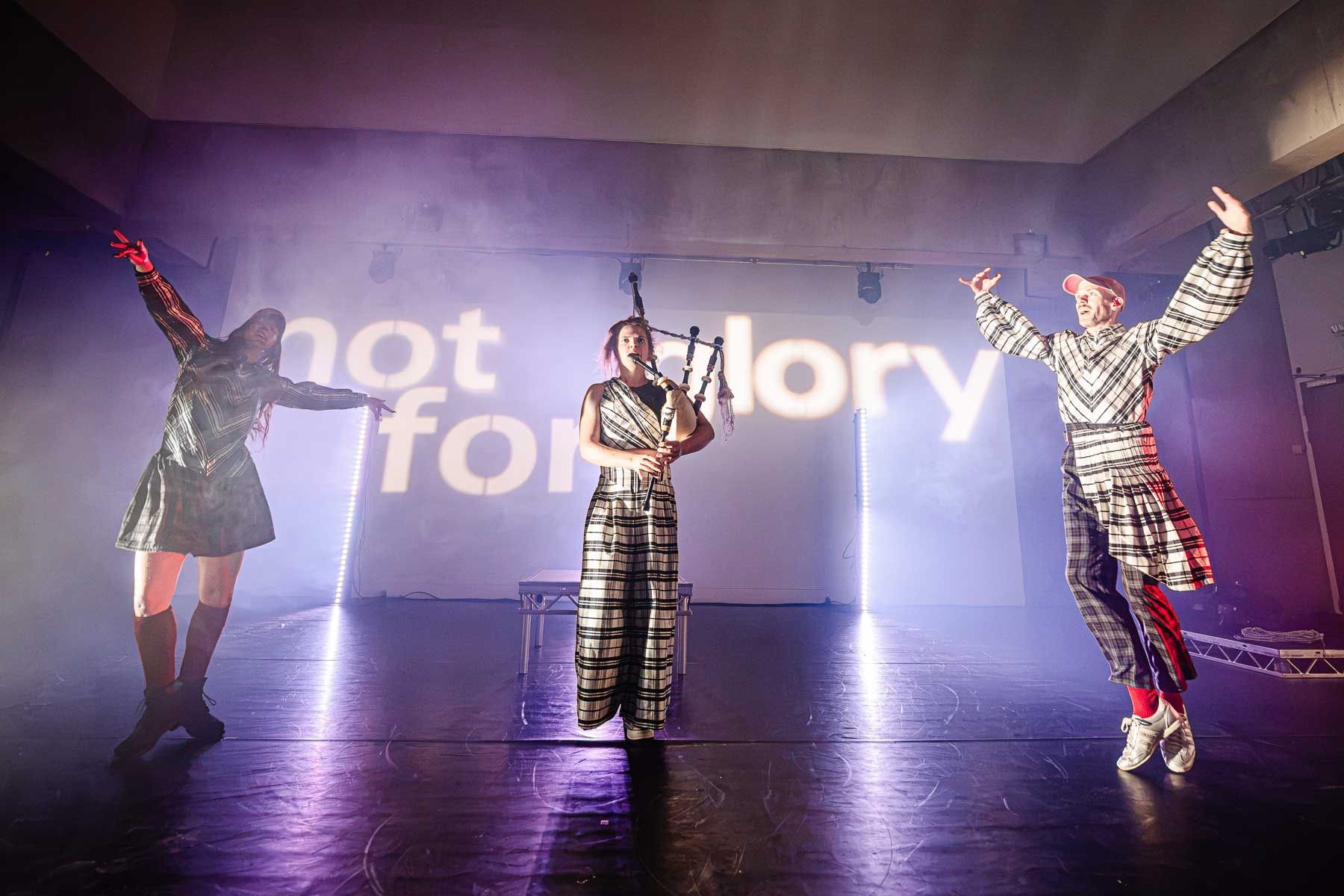
Rebellious yet joyous, fun with a dash of fury, Charlotte Mclean and Jack Anderson’s not for glory has premiered at Edinburgh Fringe and runs until 23 August ahead of Scottish tour next year.
A reworking of traditional dance forms, we sat down with Charlotte and Jack to discover more.
Q: Tell us about not for glory?
Charlotte: We describe not for glory as a restless, rebellious, unravelling of traditional music and dance. All three performers on the stage grew up competing very intensely in their respective traditional forms. I grew up with Scottish Highland dancing, Jack grew up in the Irish dancing world and Malin grew up playing and learning how to make the bagpipes. All of our competitive childhood experiences have formed who we are today, and all of us left these traditional worlds at some point, Jack even felt ashamed to tell people he was an Irish dancer. But we’ve all come back to these worlds with fresh eyes, and a deeper understanding of the history, politics and future-building we want to shape, defend and offer to these traditional forms. The show is a celebration of that, of embodying over thirty years of tradition and having fun with it, with friends, on a stage, in front of people who might have also experienced a competitive world as a child.
Jack: At the heart of not for glory are the experiences we all had as young people – competing in Irish dancing, Highland dancing and piping, respectively – and a desire to seek some collective, rebellious joy in them. The show takes an unflinching look at what happens when music and dance are regulated and defined by competition – becoming hyper-specific, distorted way beyond their original contexts, thrilling but also sort of bizarre. Growing up in these worlds, with all their adrenaline and intrigue, we found power in the precision and discipline of the forms. Somehow we found resilience on the lonely and brutally objective competition stage. But later we each questioned what we had absorbed – what it meant for us to be part of these traditions, and what notions they had given us about belonging and our own bodies. not for glory undoes expectations around who can express themselves through these traditional art forms, how and why. Holding on to the inherent joy and energy of these traditions, we look square in the face of their histories. We throw out the competition rules and hold open the door to more inclusive and hopeful future traditions.
Q: What has the creative process been like?
Jack: Charlotte and I trained alongside each other in Dundee and London, so have known each other for a long time but hadn’t had the opportunity to work together before. The collaboration with Malin has been really invigorating – the three of us all have quite distinct ideas and aesthetics so on just about every detail we were coming from divergent perspectives and had to really work together to find something that satisfied them all.
We are so lucky to work with Helen McIntosh (creative producer), Emma Jones (lighting designer / production manager) and Cleo Rose McCabe (costume designer) – every one of them is incredibly talented, competent and generous. This core team were all involved from the very early stages of imagining the show and it feels like we have all supported each other to find new directions and highlights in our work.
Charlotte: The creative process has been long and slow, something we aimed for from the beginning. We made the show in six weeks over three years and it’s been a blessing. There have also been some cursed moments with major hiccups along the way, but that’s brought the team together, and has been a testament to the resilience of the traditions. Each of our traditions are quite hardy. They are performed outside in the rain, they are extremely loud and overwhelming at times and all of them are very straining on the body. It’s been beautiful to find the softness, sexiness, cheekiness and strength in these forms.
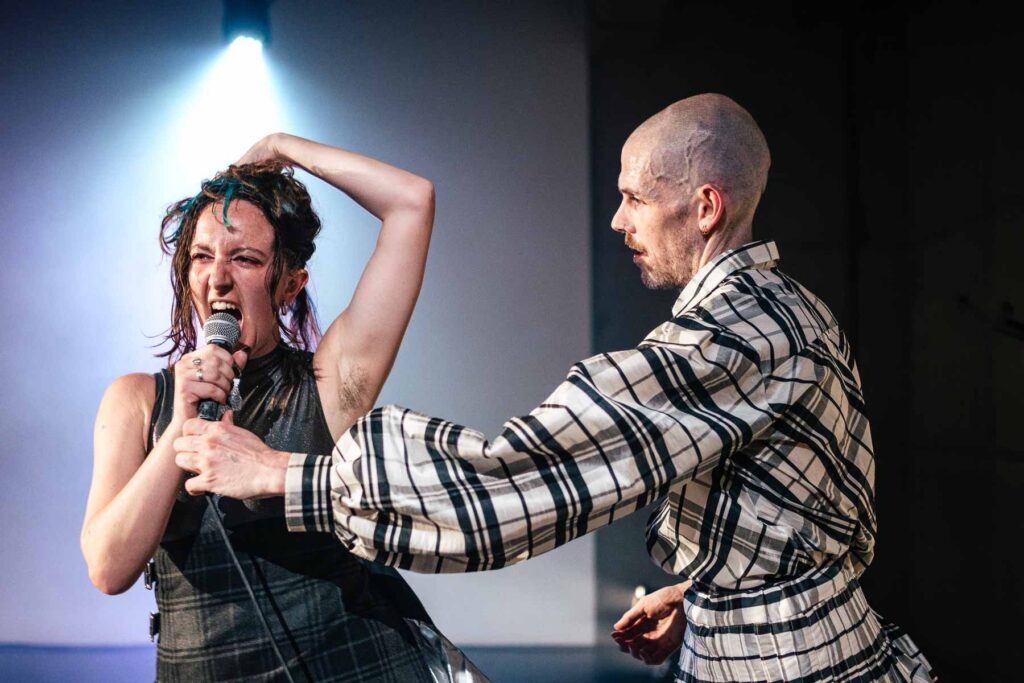
Q: What attracts you to this unravelling of traditional dance and music?
Charlotte: For me, it’s therapy. I can begin to understand my intense childhood experiences, and the intense political dynamics Scottish traditional arts uphold with regards to the military, the royalty and how Scotland has been victimised, as well as perpetrating. The history of Scottish Highland dance alone is so complex to even embody in one show so I think this unravelling is a continuation of a life’s work. I was born into the traditional world and hopefully I die leaving it a more inclusive, warm, soft, creative space.
Jack: One of the things I’m dealing with in this show is that, for a long time, I thought of Irish dancing and contemporary dance as two completely separate things. There was a real hierarchy implicit in that distinction – I allowed myself to be seduced by the notion that I had pulled myself up out of folk dancing into ‘proper’ dancing, and that to allow one to contaminate the other would be to its detriment. So to finally start unravelling and undoing that, to search for a dance that is innate to my body and not constrained by or ashamed of any specific vocabulary, felt really bold. I have the feeling I’m still very much at the beginning of that search, but I hope the show will invite everyone in the audience to own their own multitudes, traditions and contradictions.
Q: What does solidarity look like for you when you create dance/performance work?
Charlotte: Solidarity starts with the creative team. It’s important for me to have a core group of people I can trust with my tears, and who feel welcome into the space we create. When I was in my first summer of dance training, I worked at Dance Base as an usher and during that fringe, Plan B for Utopia by Joan Clevillé played. I think I worked the show around 15 times and I remember that during the work Solène Weinachter (one of the performers) said that one of her dreams for the future was: “to always work for people you respect” and that has always stayed with me. Now, over ten years later, we have our own show at the Fringe shared with a team of such wonderful, earnest, incredible colleagues. I feel proud of what we’ve cultivated. ‘Dance local, think global’ is hard as a travelling artist but my local is the people I work with and Helen McIntosh, our Creative Producer is my partner in crime, so shout out to Helen and the wonderful people we have the privilege of creating with.
Jack: One of the things that anchored us when making not for glory was trying to make the show for the audience, not for ourselves. Although it is a very personal show, there has to be a reason to invite people into it and share it with them. So trying to craft something that builds trust with the audience, that is transparent about what it’s offering to them and hopefully doesn’t make them feel like they have to work to understand it – that’s an important form of solidarity. On an even broader scale, and without wanting to be too grandiose – in an increasingly extreme, atomised and dysfunctional world, just gathering people together for a live, human experience is a way to offer a wee piece of hope. That really matters.
Q: What is it like to take a production to the Fringe as independent dance makers?
Charlotte: Tiring, exhilarating, confusing, fast, lonely, immensely FUN, beautiful, wonderful, incredible, I’m constantly in awe at everyone… and lucky because I’ve been coming to the Fringe as a child and worked at Dance Base every summer through my dance training so I learned the beast from the inside. It’s also fun to enjoy the Fringe through the eyes of new people coming for the first time. My no.1 recommendation is to enjoy the chaos and surrender.
Jack: We are incredibly fortunate to be able to do it, and the fact that we are is as much thanks to a messy network of pals, favours, winging it and good luck as it is to do with any funding or formal support. Like Charlotte said, there’s a really special aspect for us as Scotland-based artists who have grown up around and inside the Fringe – it’s sort of the ultimate aspiration and it’s uniquely exciting to be able to share your work with a ‘home crowd’ and what feels like the whole world at once. I’m fully expecting to experience just about every conceivable human emotion and physical sensation during the next two weeks… here we go!
not for glory by Jack Anderson, Charlotte Mclean and Malin Lewis has its world premiere this year, with a run at Assembly@DanceBase until 23 August 2026. Book here.
The work will transfer to London as part of Dance Umbrella from 13-14 October 2026, before touring across Scotland in 2027. Book here.