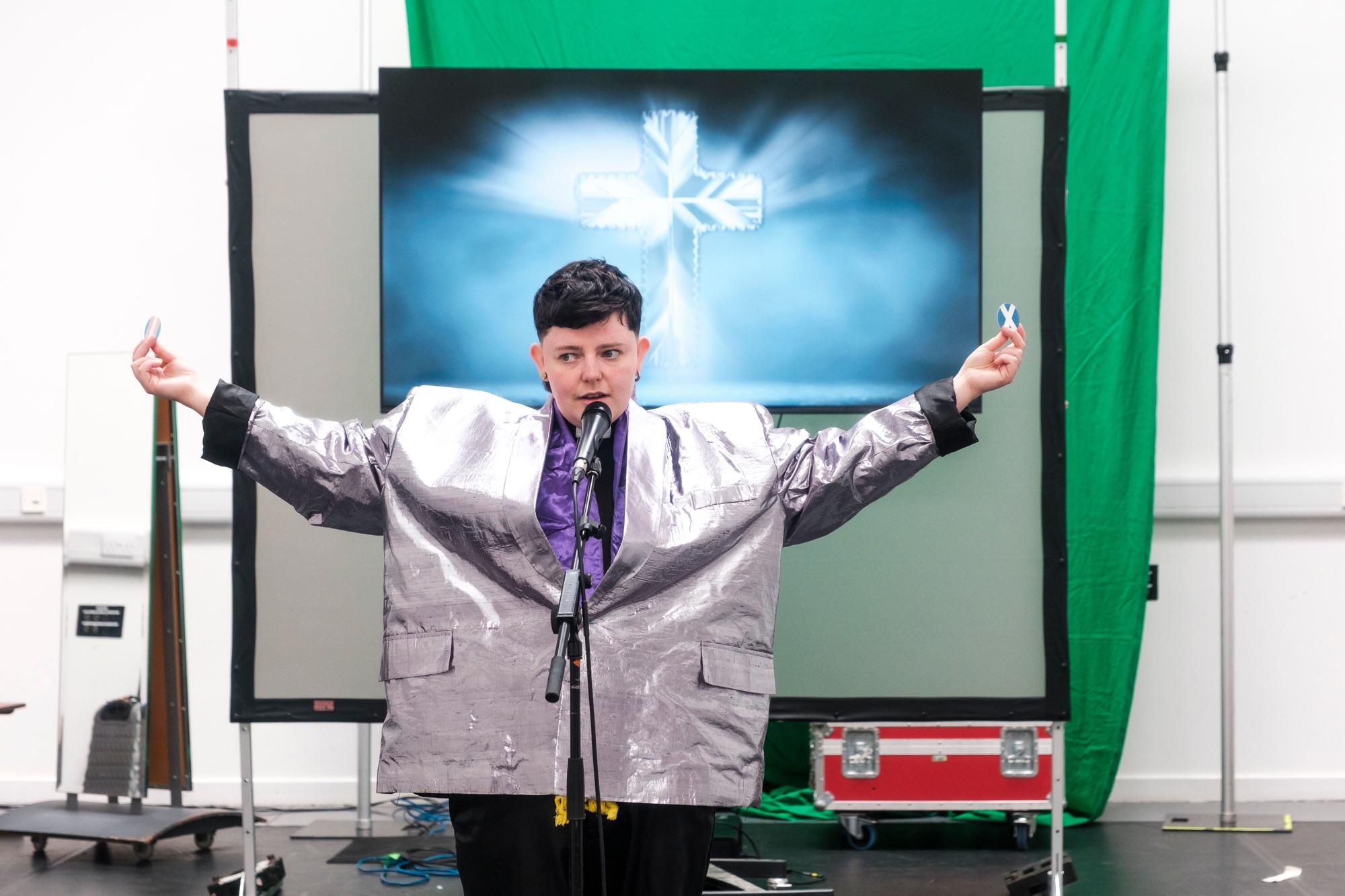
This Edinburgh Festival Fringe, performer and drag artist Nelly Kelly presents the world premiere of their timely, mischievous and political new work Transmission at Summerhall from Wednesday 19 – Sunday 23 August, 7.15pm, following a preview performance on Tuesday 18 August, as part of the Made in Scotland programme.
Produced by Sanctuary Queer Arts, and co-created with award-winning theatre director Susan Worsfold and creative access collaborator K Biff Nicolson, Transmission is a bold new performance that blends political theatre, DIY cabaret and male impersonation to explore Scotland’s shift from world-leading around LGBT+ rights to becoming fertile ground for the anti-trans movement.
We caught up with Nelly to find out more!
Q: Tell us about Transmission.
A: Transmission in a lot of ways is a sort of absurd comedic call-to-action that asks its audience to reject divisiveness. Even though it’s a fantastical tale about a transphobic politician, it echoes all the right wing tactics used to sew division across all our communities. It celebrates our power to rally against that divisiveness when we physically come together in celebration of what joins us together and true acceptance of the differences exploited to keep us apart.
Q: What has the creative process been like?
A: The creative process has been wonderful. Honestly the first truly accessible process for me to make and be able to perform work since an increase in my access needs a few years ago.
The work has been co-created with award-winning director Susan Worsfold and creative access collaborator K. Biff Nicolson which was a huge part of sustaining accessibility throughout the development of the work whilst navigating health challenges and ever-changing access needs, as they were both able to co-facilitate building my artistic vision for the show in a way that allowed me to stay creatively playful and curious without exhausting myself in the process.
Another huge factor in that was working with artist-centred organisations like Sanctuary Queer Arts and Unlimited and getting to feel like my health and access requirements were central to decision making around the creative process. All of this combined to create space for a well paced and highly explorative creative process, which feels truly rare to achieve in the current creative landscape of the UK, usually a fast paced highly underfunded landscape that disproportionately negatively impacts on disabled artists.
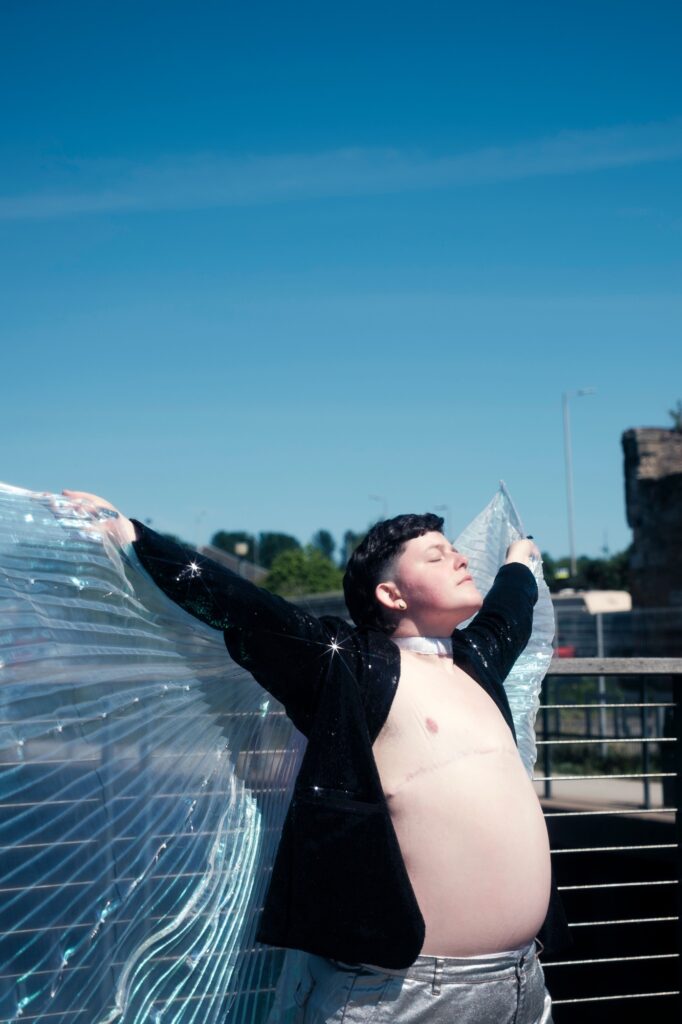
Q: Transmission examines how public perception of trans people is shaped – what perceptions are you interested in tackling/paying attention to in the work?
A: There were two starting points for this work, the first being a flurry of Scottish news stories referring to the ‘trans cult’ and the other was a large comms study that came out at the time that found only 1 in 5 people in Scotland knew of a trans person in their own life. That was a real light bulb moment for me, a sobering reminder that 4 in 5 people in Scotland’s perception of trans people was mostly shaped by the media, who in that moment seemed to be taking delight in referring to our community as a cult, a term I feel is inherently violent in its capacity to paint us as a dangerous ‘other’.
But oddly that also gave me a lot of hope, because it reminded me that actually what people often expect a trans person to be like, isn’t who we actually are, just normal humans trying to go about our life in peace and safety.
Q: Do you feel that Scotland’s shift towards anti-trans sentiment is part of a broader global shift? What can be done to combat this?
A: In short, yes, well in the West at least. Beyond that however, the show addresses the fact that Scottish anti-trans movements are very much at the root of what we are seeing in the West right now.
I adore Scotland in so many ways, but I think we have a history of Scottish exceptionalism, we have a sort of collective persona that comes from positioning ourselves in relation to England as the ‘good guys’, which often erases any and all harmful parts of our own history, particularly the parts it is essential to learn from.
And with trans rights I kind of feel like that is happening in real time. I don’t think Scotland’s people are more transphobic than anywhere else, quite the opposite, I find your average person in Scotland generally thinks trans people are being treated unfairly. But we have a particular issue in Scotland where small extremist groups are being mainstreamed by funds of a billionaire who is openly pumping funds into legislating against trans rights that has entirely decimated the protections we were once afforded, both in Scotland and the wider UK.
Q: What does it mean to bring a work like this to Fringe?
A: It feels vital right now, though the work is rooted in Scottish politics, it mirrors the political tactics of right wing politicians more generally. My hope is that this resonates with an international Fringe audience, giving us all a moment to feel/rage/laugh/cry together and remind us all that in spite of their isolating, dehumanising and ‘othering’ tactics that we have real power in being together, especially when we are prepared to meet and embrace each other in all our many messy complexities.
For information and tickets to Transmission, book here.