Words by Jo Leask.
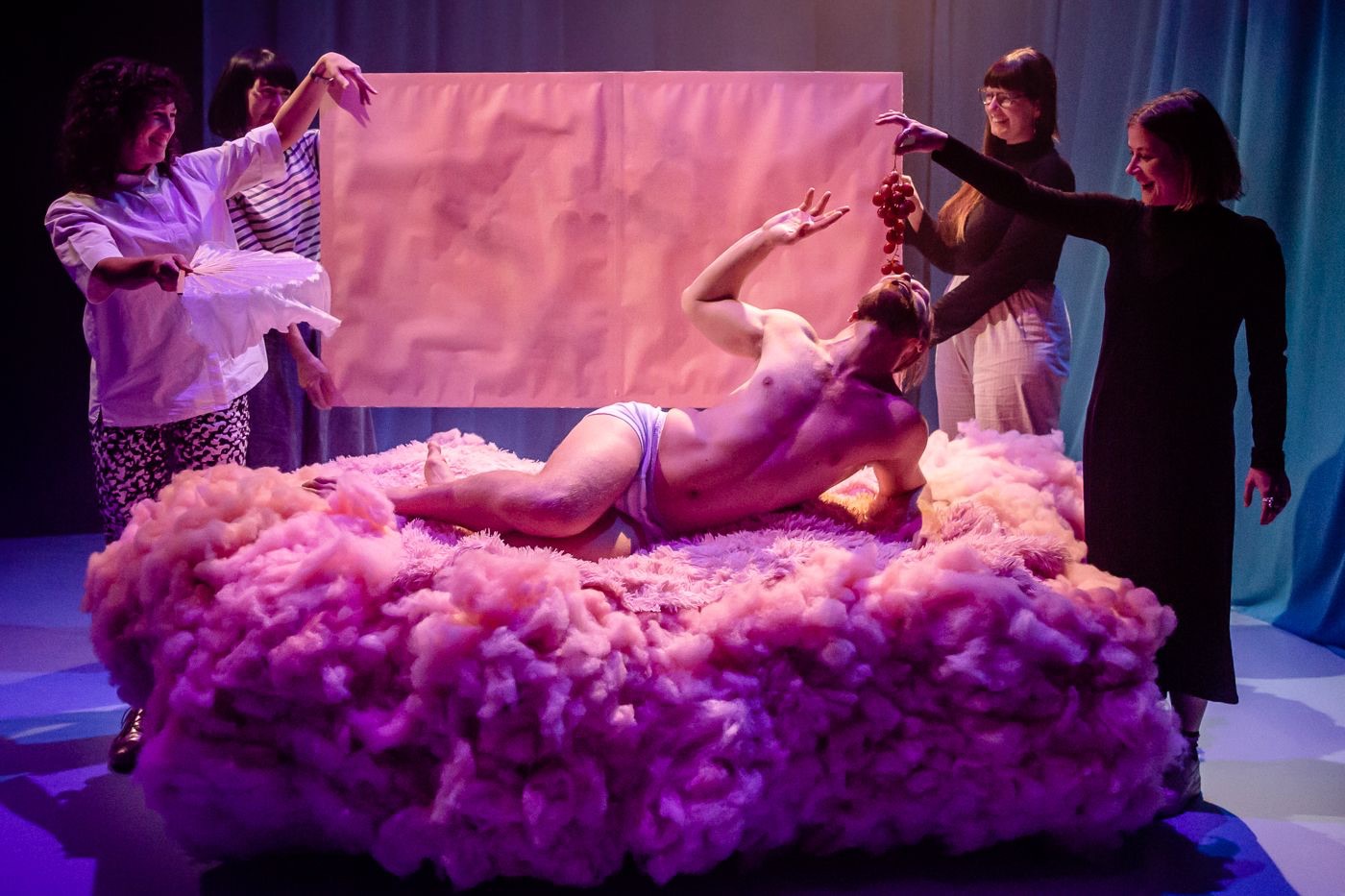
I spoke to Australian Aboriginal queer dance artist Joel Bray ahead of Daddy, his immersive and participatory show that he’s performing at the Edinburgh Festival Fringe. New to Edinburgh, Bray arrives with a work that has already toured several times in Europe and the UK to enthusiastic reviews. The show combines humour, audience participation and personal testimony to explore colonialism, intersectional identity and the lasting force of family trauma.
The conversation below has been edited for clarity and length, while retaining Bray’s first-person account of how the work developed and what it asks of audiences.
Q: What first prompted you to make Daddy, and what did you want the work to make visible or possible?
A: Several events prompted me to make Daddy. I had just come out of an epic relationship, I was back in Australia after working overseas as a dancer for 10 years, and I felt very distanced from my Aboriginal cultural identity. When I was in Europe, it was easier not to mention my Indigenous ancestry or my father, who had left the family when I was young. When I returned home, I felt disconnected from both my family and my culture. I started processing those feelings through movement improvisations and writing that I never intended to perform, but Daddy eventually emerged from that material.
I also made the work in response to the right-wing trope that says colonisation was terrible, but that is all in the past and can be fixed through reconciliation. Having seen the consequences of colonisation in my family and relatives’ lives — poverty, substance abuse and disconnection — I wanted to counter that argument and make visible how interconnected forms of marginalisation still hold power. In Daddy, rather than talking about colonisation in a grand historical sense, I approach it from a deeply personal perspective.
Q: Does Daddy feel like a departure from your earlier work, or more like a development of questions you have been exploring for some time?
A: I made my first choreographic work in 2017: Biladurang, a Wiradjuri word meaning “duck-billed platypus”. That extraordinary creature became the perfect metaphor for my experience as a gay Aboriginal Australian man raised in a white Pentecostal Christian household. Biladurang was an immersive Fringe work performed in a hotel room, in close proximity to the audience, and I asked spectators to help with technical elements such as switching on lights. I loved the immersive, connected and collaborative nature of that work, which suits me both as an artist and as a person, so in Daddy I wanted to explore the boundaries and possibilities of working in that way more explicitly. Daddy however, was a departure from working as a dancer for other choreographers and my second work in my role as choreographer.
Q: Daddy sounds playful and humorous but it also seems to move through questions of self-discovery, family, and identity. How do your Aboriginal and queer identities, and your relationship with your father, shape the work?
A: The personal approach to my cultural identities and family history intersects in my body and in my relationship with my father. At the beginning of the work, I draw a line from Captain Cook and the arrival of the English in southern Australia through to the present generations of my own family, telling that story in the form of a fairytale. My queerness in the work is a search for love, belonging and safety, and that search speaks directly to my father leaving when I was young. I became politically active as an adult and felt the lack of understanding about Aboriginal dance in my body, because I had never had the opportunity to learn cultural traditions from my elders. Part of reclaiming my identity and culture has been learning what I feel I should already have known. In Daddy, this manifests through the Wiradjuri dance Warran Jarra, or “shake a leg”, a traditional Indigenous Australian dance that footballers now perform before matches. It features distinctive lower-body movements such as stomping, twisting and continuous pivoting or vibrating motions of the legs, which are challenging to perform. Originally a cross-gender dance, it has now become hyper-masculine and macho. I perform my own version of Warran Jarra in Daddy as a motif that I wrestle with, because I do not feel comfortable dancing it. My natural body expression is camp, lithe and sensual, whereas this dance is hard and masculine.
Q: Where do you see your work sitting within the Australian contemporary, experimental dance landscape, particularly in relation to Indigenous and queer voices?
A: Aboriginal dance is present in mainstream Australian dance through companies such as Bangarra Dance Theatre, while organisations such as BlakDance in Queensland support First Nations contemporary dancers and choreographers, and NAISDA Dance College in New South Wales serves as an Indigenous training institution. The problem with Bangarra, a big, successful and ubiquitous company that “sucks up the oxygen”, is that it can overshadow emerging artists. Historically there has not been much space for experimental queer work, but there is a Blak renaissance happening now that counters embedded Australian assumptions that Indigenous culture and Aboriginal presence exist only in the north of Australia. Because the genocidal effects of colonisation wiped out many people in the southeast, those of us from tribal families in that part of the country — I am from New South Wales — are part of a new wave of contemporary artists showing that we do have culture, and that although it differs from the north, it is beginning to flourish. My work, and the work of other queer Indigenous artists, also challenges the idea that Aboriginal identity is fixed. For example, Aboriginal work is often expected to live up to the “noble savage” idea: serene and well behaved. I aim to show that our identity is complex and changing. My work is sex positive, and I engage with sex as material for creative practice.
Q: Which artists, collaborators, teachers, or communities have most shaped the way you think about performance and dance?
A: I was a highly trained, virtuosic contemporary dancer when I went to Tel Aviv and trained with dance artists Niv Sheinfield and Oren Laor. They taught me about using text and collaging theatrical material to create different performance languages, which I had never done before. Their advice to “use anything as long as it is the right thing” changed the way I approached choreography, and in Daddy I mix and match different forms — language, cabaret and contemporary dance — that each do very specific things. Anouk van Dijk, from the Australian contemporary company Chunky Move, changed the way I moved. Her major contribution to dance was Countertechnique, based on Alexander Technique and applied to high-velocity work. Through her use of direction and counter-direction to release the body, I learnt how to work with anatomy, imagination and imagery. Another incredible artist who shaped the way I make work was Bernadette Lewis, whom I first collaborated with in 2016. For the work we were making, instead of trying to find inspiration in an empty studio, we went on a multi-terrain hike that required our bodies to respond differently. We talked as we trudged through sand, wove through trees and climbed rocks. From that hike, and from the corporeal memory of those different experiences, we created our own methodology, which I still use today to make work.
Q: What do you enjoy most about performing Daddy, and what has the work taught you through touring or sharing it with audiences?
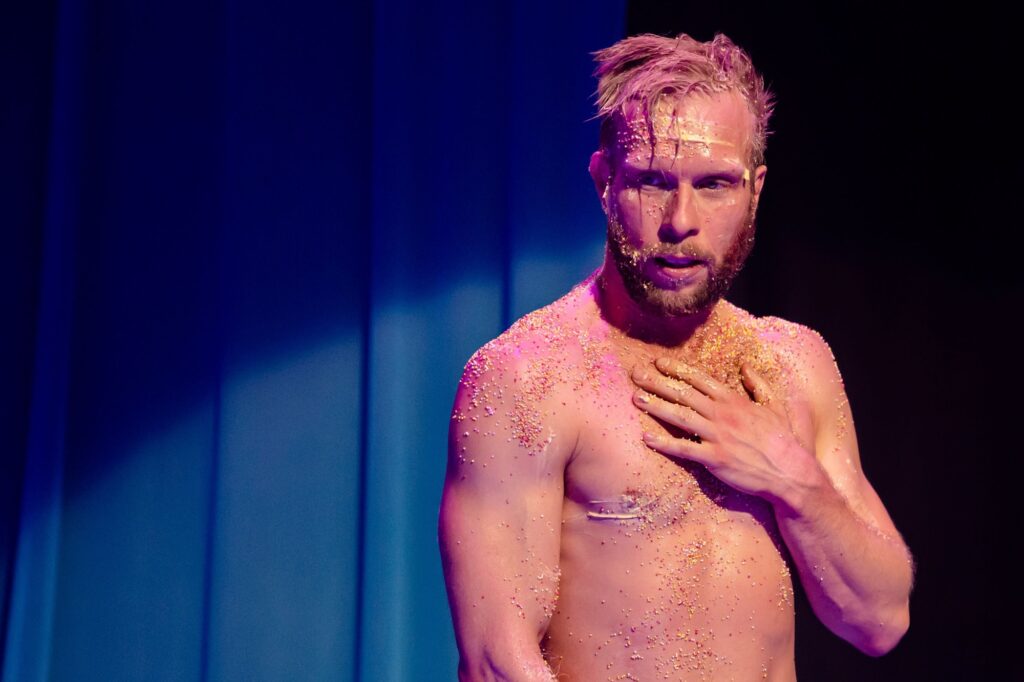
A: When I see audiences walk into the theatre looking a bit apprehensive about the participatory experience, I know that within 55 minutes they will be elbowing each other out of the way to cover me in chocolate syrup. My favourite moment is when they lose their inhibitions. The other best moment is when I fall in love with a member of the audience and we embrace in a beautiful, sexy and tender dance.
Performing Daddy has taught me how universal the themes of the work can be. Although it is specific to Australia and to my personal experiences of love and loss, its questions of love and belonging seem to resonate with people in many circumstances: striving to become something, leaving a relationship, or struggling with a new language in a different country.
Q: When audiences leave Daddy, what do you hope stays with them – emotionally, politically, or physically?
A: I hope audiences, especially as native English speakers, leave feeling touched by the human experience but also alert to the double entendres, jokes and nuances in the way I use language. And politically, that the work as it talks about the history of colonisation not as a lecture but as a conversation, will persuade audiences that it is a conversation that British people should be having.
Daddy is in the Main Hall, Summerhall until 31 August at 22.40. Tickets: https://festival.summerhallarts.co.uk/events/daddy/