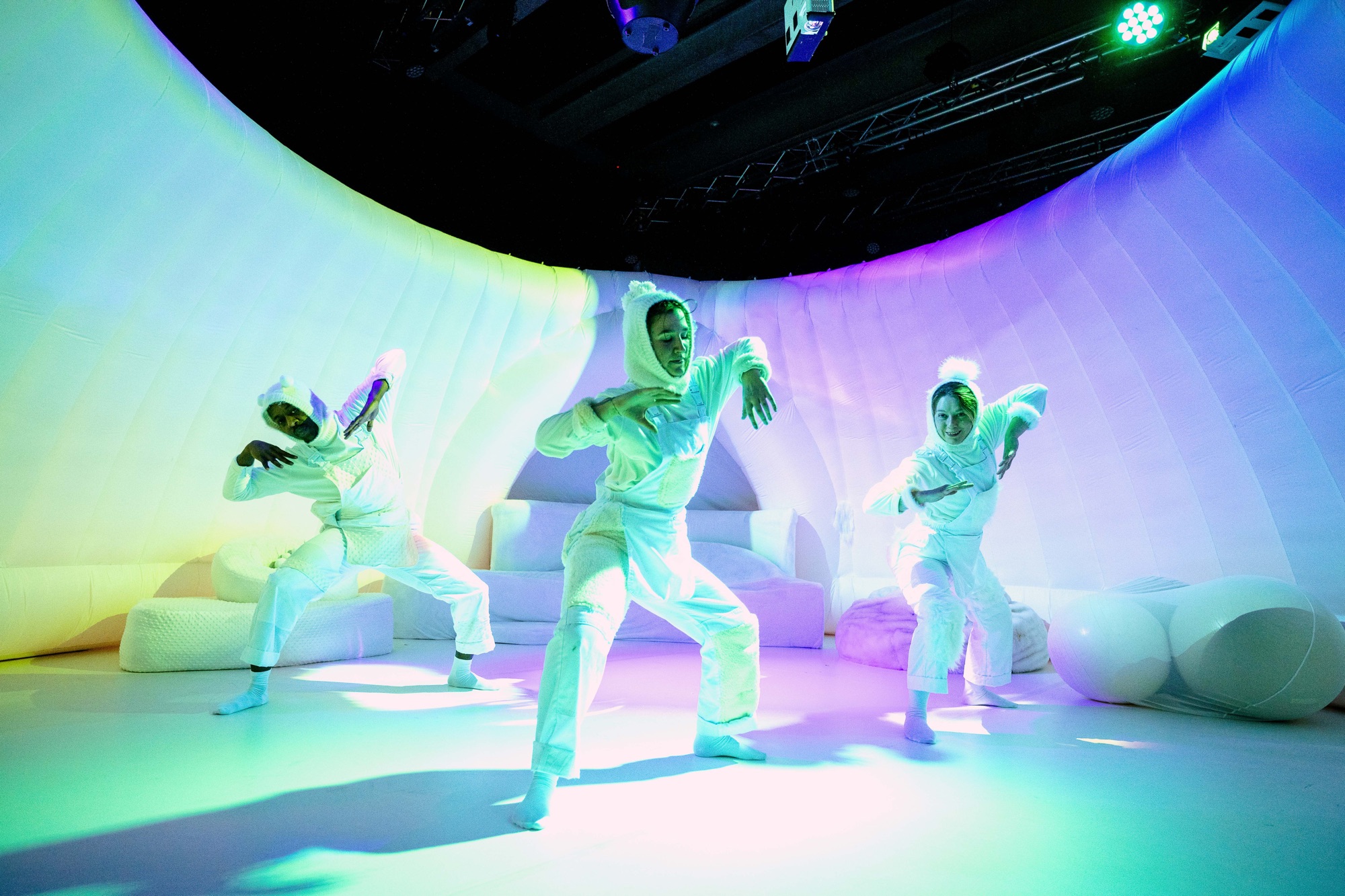
This year, award-winning choreographer Hayley Earlam will present her new work Brrr at the Edinburgh Festival Fringe from Tuesday 18 – Saturday 22 August, as part of the Made in Scotland Showcase. A leader in the practice of sensory choreography and integrated performance, Earlam is a dance artist, choreographer and facilitator based in Glasgow whose work centres inclusivity, accessibility and sensory performance for young and disabled audiences with complex needs.
Her latest piece Brrr is a multi-sensory installation and dance performance for young audiences with complex needs aged 10-18, created in collaboration with young people and artists specialising in inclusive practice.
Q: Tell us about Brrr.
A: Brrr is the onomatopoeic sound you make when you’re cold. Set inside a giant inflatable dome, the performance sits somewhere between a multisensory installation and a live dance work, created specifically for young audiences with complex needs.
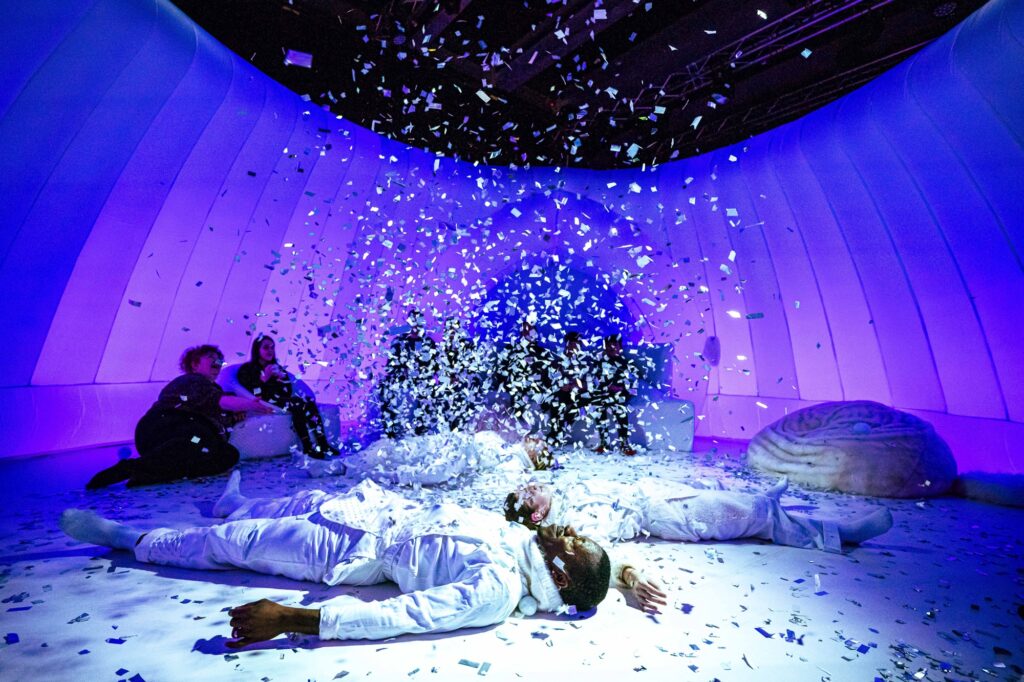
Brrr is an immersive exploration of winter featuring contemporary dance, multisensory design, immersive video, original composed sound and a lot of snow. I was interested in the turbulence of the season from the parties and gatherings, changes to routines and structures, and, of course, the unpredictability of Scottish weather. I wanted to create a performance that acknowledged that turbulence while offering audiences something calming, beautiful and responsive.
Q: What has the creative process been like?
A: A significant part of the creative process took place in Additional Support Needs (ASN) schools across Scotland. It was exciting to transform school gym halls and classrooms into temporary theatres, inviting young people with complex needs into the creative process and their responses shaping the work in an organic and collaborative way.
Rather than simply asking what audiences might want, we observed how they responded to the rehearsals through body language, facial expressions, vocalisations, focus and engagement. Their responses became a form of creative consultation, and their expertise directly influenced the decisions we were making.
I was also fortunate to work with an exceptional team of disabled and non-disabled creatives who were deeply invested in making something that was not only accessible and inclusive, but genuinely responsive and relevant to the audience.
Q: What does great access look like in the context of performance and also participation (of both performers and audience?)
A: With Brrr, we deliberately undo many of the traditional theatre rules and expectations placed on an audience. You are welcome to move around, stim, make sounds, leave the space and return again – the door stays open for the duration of the performance. There is even a space outside the dome where audiences can watch a live feed of the performance. Audience autonomy is essential. A performance shouldn’t restrict someone’s ability to respond to their own needs.
As a choreographer, bringing accessibility into the creative process from the very beginning — not as an addition or consideration at the end, but as a creative collaborator. Fundamentally, it changed the way I make choreography. Because movement can be received and interpreted by audiences in so many different and unpredictable ways, it was both exciting and challenging to find a balance between developing an intentional movement language and structure, while remaining responsive to what is happening in the room.
That responsiveness also requires a particular skillset from the performers. Performing Brrr isn’t simply about executing choreography; it’s about being able to read the room, notice subtle shifts in an audience and adapt without compromising the integrity of the work. It takes a particular kind of performer: one who is highly attuned, generous and comfortable with uncertainty, and who can still hold the choreography enough to allow each performance to become a genuine exchange between performer and audience.
When we discuss audiences with complex needs, they are often described as participants rather than audiences, as though being present for a performance isn’t enough. Although there are interactive moments within Brrr, there is no expectation of joining in. Some audiences love getting into the thick of the action and moving alongside us, while others prefer to watch from a distance. All are equally valid ways of experiencing the work.
For me, great access is about creating a performance that adapts to its audience, rather than expecting the audience to adapt themselves to a performance.
Q: What are you looking forward to most about the Fringe experience?
A: Brrr was created in response to a particularly turbulent time of year. For those living in Edinburgh, the Fringe brings its own kind of turbulence to everyday life: the crowds, noise, movement and constant activity.
I’m excited to offer audiences a moment of respite from that busyness and chaos, while also inviting people who might not expect to be able to attend the Fringe a chance to fully be part of its audience. As the largest arts festival in the world, it is important to make space for everyone to access the Fringe.
Q: What can audiences and their network expect?
A: I hope audiences can expect an experience that feels welcoming, accessible and inclusive from the moment they arrive. There isn’t an expected or prescribed way to experience Brrr, and we want audiences to have the freedom to engage with the show in whatever way feels right for them.
Most importantly, it is an opportunity for audiences with complex needs and their caring adults to share the experience of theatre together.
Brrr will run at Edinburgh Fringe festival as part of the Made in Scotland Showcase from 18-22 August at either 10.30am & 1pm.
Location: The Great Hall at Nicolson Square Venues. Book here.
Brrr has been created in association with Capital Theatres, with support from Creative Scotland, the Royal Conservatoire of Scotland’s Innovation Studio, and The Work Room’s Residency Programme.