
A daring, beautiful dance and multimedia show that challenges assumptions about gender, society, and power – what does it mean, and how does it feel, to be a woman in today’s complex patriarchal society?
Produced by celebrated Edinburgh dance company Theiya Arts Dance Collective, Maiden|Mother|Whore is a deeply compelling, fearless, and visually beautiful dance and multi-media performance that unravels the intricate knot of relationships that exist between women, social structures, health and social policies, and institutions.
Q: Tell us about yourself?
We are Theiya Arts, a South Asian dance organisation based in Scotland. Our work
has four strands: Theiya Arts School, where we teach South Asian dance forms; Theiya in the Community, through which we bring South Asian dance to communities with additional support needs and to communities where these art forms are underrepresented; Theiya Connect, through which we support and advocate for other South Asian arts practitioners; and Theiya Arts Dance Collective, where we develop performance work rooted in South Asian Classical dance vocabulary that is culturally grounded and critically engaged.
We recently became the first South Asian dance organisation in Scotland to receive multi-year funding. Theiya Arts is led by five artists, Karen Watts, Gabriela Albornoz, Himadri Madan, Nandini Manjunath, and Tharanga Wickramasinghe; we work through a feminist leadership model, with shared decision-making and a flat hierarchy. That way of working also shaped Maiden | Mother | Whore, which was created collectively by the five of us.
Q: What is your work about and where did you find inspiration? What kinds of questions do you ask in the performance?
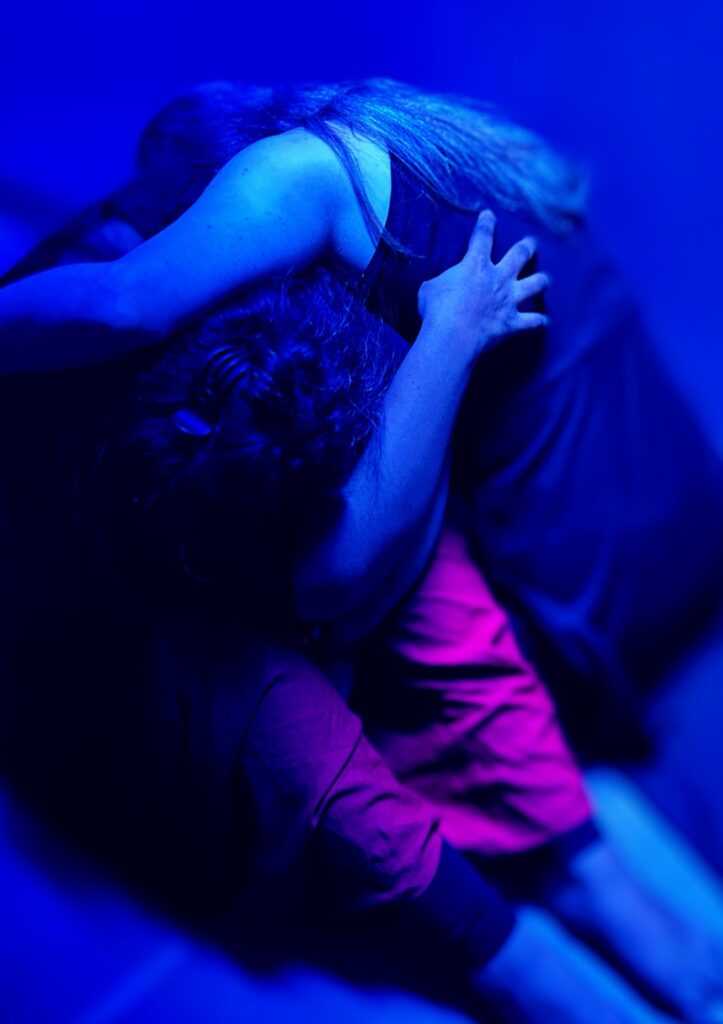
Maiden | Mother | Whore can be described as an interdisciplinary, interactive multimedia performance rooted in South Asian classical dance vocabulary. The themes of the project explore the complex relationships between women, social structures, health and social policies, and institutions. It challenges assumptions about gender, society and power.
Maiden | Mother | Whore emerged from a creative partnership between Theiya Arts Dance Collective and academics, Dr. Agomoni Ganguli-Mitra and Dr. Ingrid Young from the Centre for Biomedicine, Self and Society. The collaboration initially included a series of reading groups, where we read academic articles and short stories based on the themes we were exploring. This material included work like Lihaaf by Ismat Chughtai, Anna Gotlib’s “But you would be the best mother”, Teaching reproductive Justice by Loretta Ross to name a few and the themes that emerged from those reading sessions formed the foundation of the project.
Also, while working with the text, we realised that the themes required a multidisciplinary approach for us to capture their nuance. We wanted the audience not just to be spectators, but also to interact and engage with different elements and become part of the creation process. And that led us to create the project as an exhibition. The exhibition included different mediums like photos, projections, an interactive game, a reading corner and and a creative corner along with live movement and music performance.
However, for Fringe 2026, we are presenting a theatre version of the show, where the multidisciplinary approach will still remain intact and the audience will still be invited to co-create with us. Through this project we hope to open up a dialogue between the academic community, artistic community and audience, urging all of us to consider the interaction between self and society.
Q: What would you want the audience to take from experiencing your work?
To answer this question, let us tell you a little about what the audience experience will look like:
As the audience enters the theatre, they will be invited to interact with the Postcard Library. This is an installation featuring images on postcards that capture the themes of the project. Audience members will be invited to pick an image they feel drawn to, write a response on the back of the postcard, and add it to our library. After this, they will be invited to take a seat. On their seats, they will find excerpts from reading material that has shaped the project. From there, they will watch a live performance that explores themes of gender-role conditioning in childhood and intersectionality, followed by a performance that includes responses to some of the words they have left on the postcards.
Over time, these postcards have become an archive of our journey with multiple audiences. Each day, the audience along with providing their response to the postcard can also engage with the words left by people who have watched this project in the past. So, they are not just interacting with the performers, they are also interacting with the people who watched the show before them and the people who will watch after them. And keeping that experience in mind we hope with Maiden| Mother| Whore, the audience, first, has the space to engage with academic research through multiple mediums and have the space for reflection/dialogue about their lived experience in relation to gender, power and policies. Or maybe just feel seen and heard themselves or perhaps offer a critical perspective on the project. And then, perhaps have space to laugh about our collective experiences or sometimes have an outlet for the rage.
Our hope is that this project is an ongoing dialogue – conversations that might start during the performance but continue long after it ends.
Q: What do you think it means to be a woman in a patriarchal society and how does the work seek to present or highlight this?
This question actually brings us to the title of the show, somebody in a discussion once said that women are seen to have only three roles in a patriarchal society – it’s either a role of a maiden, a mother or a whore. And while we were creating Maiden| Mother| Whore we wanted to approach it through the lens of Transnational intersectional Feminism. And as we said, we were very aware that a concept so expansive will be expressed better through multiple forms of mediums. The postcard library in particular, it includes images exploring the idea of social conditioning around gender, the censorship of women’s sexuality, protests against violence against women in various parts of the world and policies policing women’s bodies.
And our live response to the audience’s words on these postcards, interweaves the theme of the postcard, the response of the audience member and our experience of reading that response together. Along with that we have game on a rhyme very commonly sung by children in Spanish speaking countries, it explores how we are conditioned into gender roles from a young age and finally we have live performances with interactive projections that explores the theme of Intersectionality. Through all these different elements which includes improvised live performance in response to the audience member’s words, we explore the meaning of living in a patriarchal world through a transnational intersection feminist lens.
Venue: Assembly @ DanceBase, DB-1
Dates: 18 – 30 August (no shows 24,25). Time: 5:30 (60 mins). Book here.