Words by Maxine Flasher-Duzgunes.
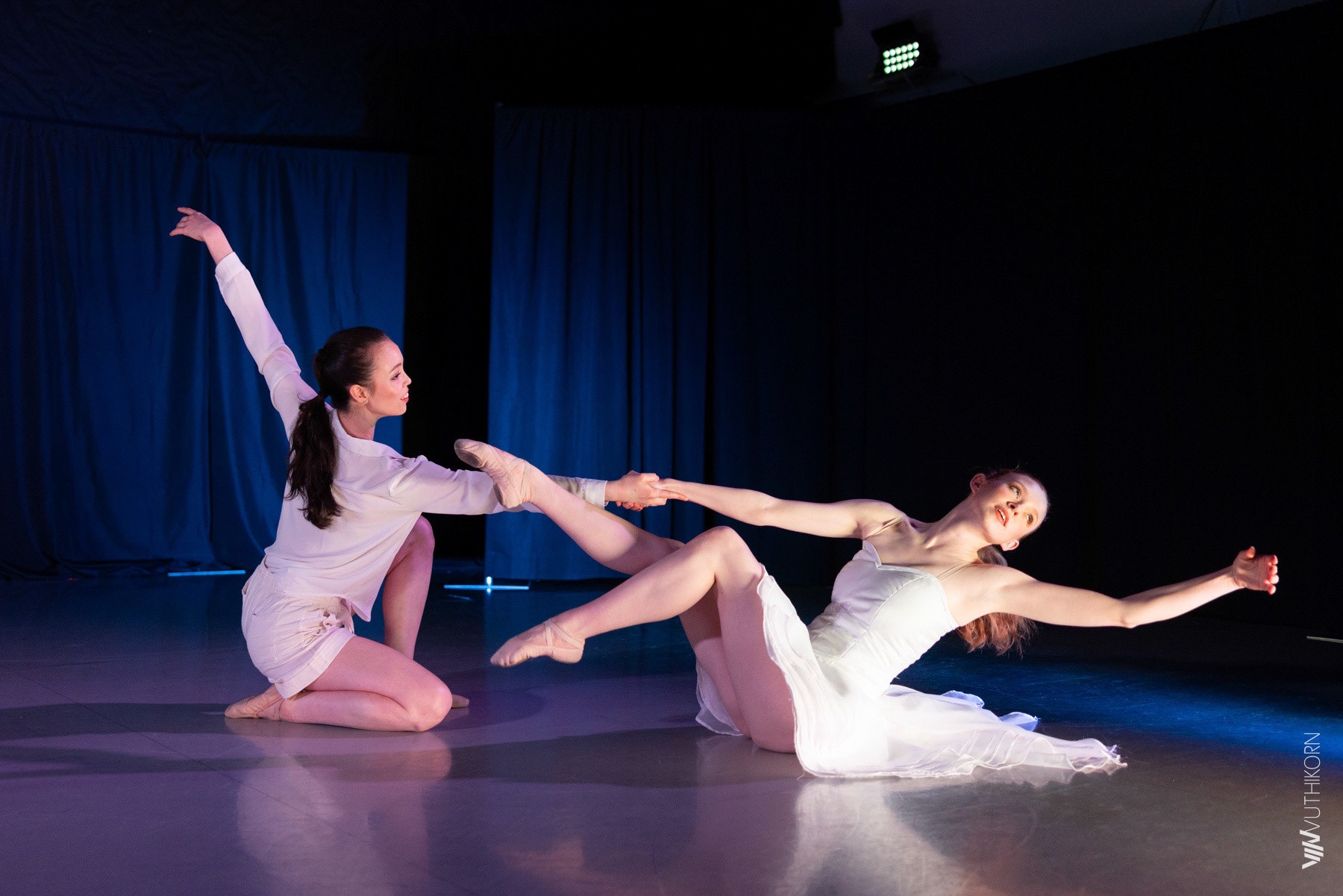
The Lake, a dance film originally choreographed by Vinnie Jones for Oceánica Ballet’s show EVOLUTION at Bay Area Ballet Conservatory in 2023 and then restaged in 2025, reimagines a beloved duet scene from the ballet Swan Lake for two female dancers: Patience Gordon and Rowan Williams. The seven minute piece blends the weight of the floor with the weight shared between them in an intricate blend of contemporary partnering and classical ballet, serving as the early work of a promising up-and-coming choreographer.
The interchangeability of their roles – Rowan as swan-turned Princess Odette and Patience as Prince Siegfried – is particularly striking, as if each dancer becomes the other inside their lifts and curricular trajectories. With costume design and construction by Edgar Lepe and Joshua Ugarte, the dancers both wear silky white garments of the same shade, contributing to the message that their roles are fluid and that none of their connected shapes have any strict relation to their gender. Instead, their touches at the wrist and torso configure a morphing swan that flows vigorously through Tchaikovsky’s famous melody.
The duet features a dynamic playfulness in several lifts that originate from the floor and then transition to the upper space, the dancers’ limbs often entangled at first and yet very organised and efficient in their carry-through. One lift – a backwards arabesque promenade where Odette rotates around the Prince while holding hands – I found to be compelling in its physical challenge and sculptural complexity. There is a careful construction to how the dancers separate and then orchestrate the space to return to one another’s pathway, usually in a delicate counterbalance or rotating lift.
There is a tendency in the weight-sharing to find unique points of contact, like a foot pushing against the back or a hand holding the neck, contemporising traditional pas de deux and introducing a fresh architectural aesthetic between the two dancers. These weight shifts also allow for inventive transitions, like a roll into a précipité from the floor or a lean-back into a développé pas de bourrée, and set them up for more elaborate partnering like Odette’s pas de chat over the Prince’s back and the Prince’s subsequent rond de jambe layout over Odette.
In the few bits of unison that are countered with mirroring and moments of cannon, the dancers turn to parallel and extend their arms and fingers straight, as if briefly resisting the curves and embroidered edges that define the classical form. Inspired by the Prince’s initial dive into the floor, Odette follows soon after, both of them maintaining an elegant extension through the arms and legs while blending into the horizontal plane. Their comfortability with the floor, as well as the detailed movement patterns that keep them intertwined, are a few examples of how Vinnie’s choreography transcends repertory ballet and thoughtfully bends the expectations of pas de deux today.
To learn more, visit @vinniejones_dance and @oceanicaballet on Instagram.