Words by Karly Benson.
Last month, Rogue Wave made their international debut at the Union Theatre, performing Bouquet and (my battery is low) and it is getting dark. The New York-based company is led by artistic director Katie Messina, who, alongside her choreographic work, holds a Master’s in psychology with a focus in neuroscience. This background in psychology is central to Rogue Wave’s creative process, with scientific concepts forming the foundation of each work and evolving through the personal experiences of the dancers. By using scientific themes that are deeply human and universal, Messina aims to move away from contemporary dance as an esoteric form, instead creating work that allows audiences to find a piece of themselves within it.
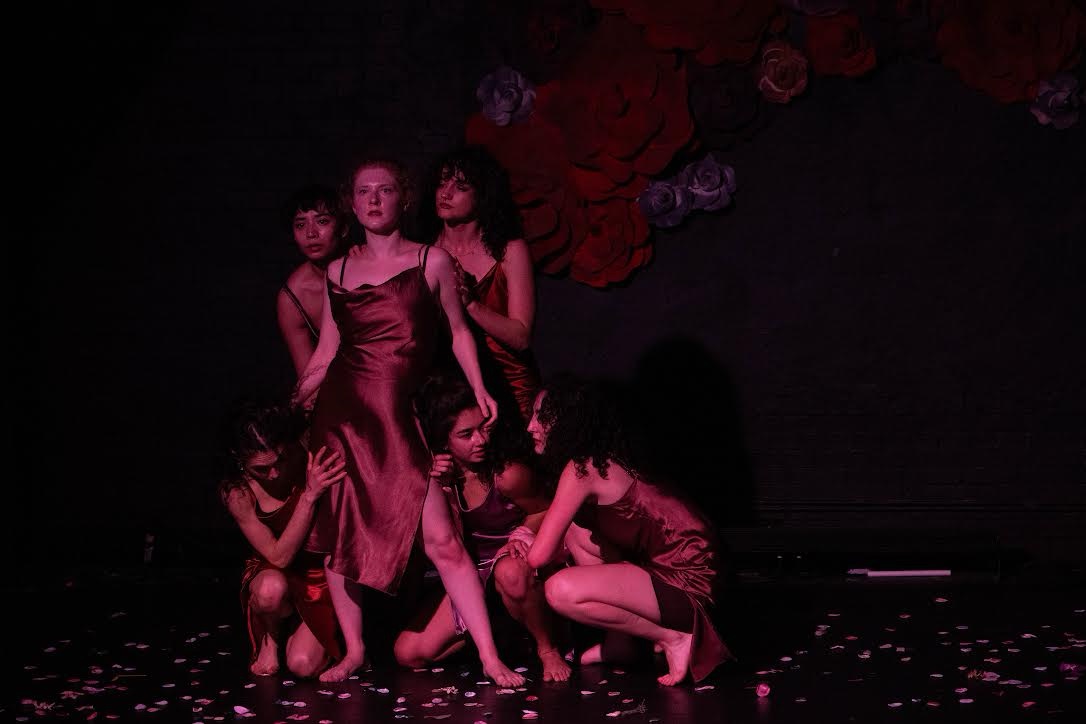
The performance opened with Bouquet, an exploration of the idea that personality types can be categorised by a type of flower — dandelion, orchid, or tulip — and how these types interact, manipulate, and work together in their ‘garden’. The second piece, (my battery is low) and it is getting dark, explored death in a more abstract way, linking the increase in the brain’s gamma-wave activity before death, to the image of a star growing larger before collapsing in a supernova.
While markedly different in concept, the pieces complemented one another. Where Bouquet explored individuality through the lens of personality, (my battery is low) and it is getting dark focused more on death and grief as a universal human experience. Together, they offered two distinct perspectives on what it means to be human, resulting in a double bill that felt nuanced and thoughtfully connected.
Despite sharing traces of each other’s choreographic language, the two works created distinctly different atmospheres. Bouquet presented a mosaic of individual experiences, with dancers pursuing their own trajectories before reconnecting with their wider collective ‘garden.’ In contrast, (my battery is low) and it is getting dark was shaped by a more cohesive emotional arc, with the performers inhabiting a shared world and collective experiences.
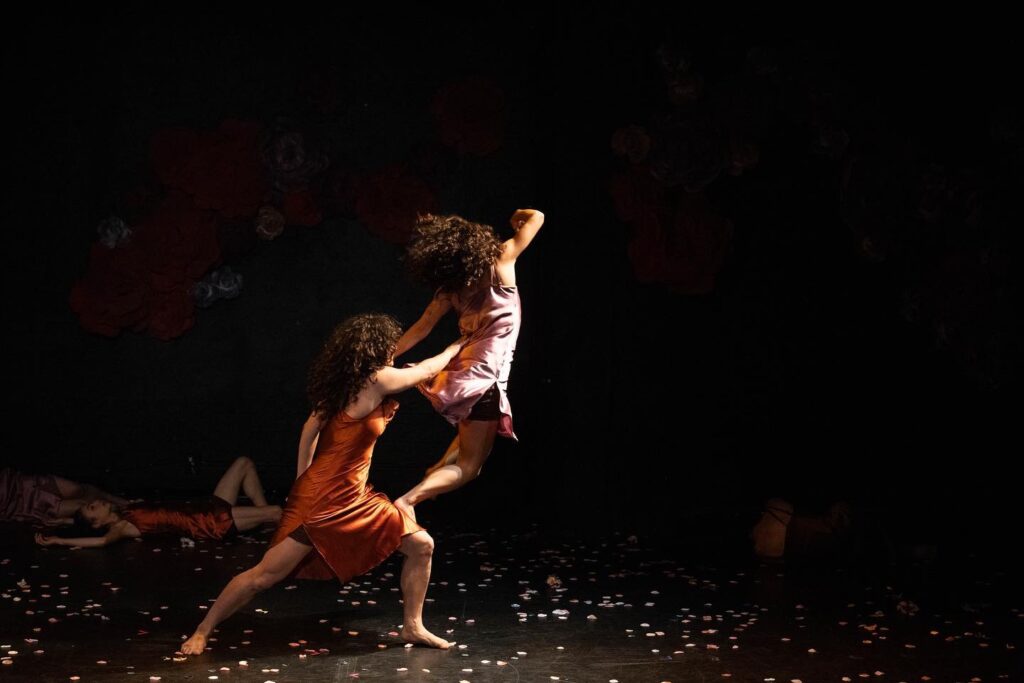
Yet, both works were grounded in a rich choreographic vocabulary that balanced highly physical and intimately gestural movements, combining intricate partnering with full-bodied floor work. Amidst this movement, the dancers remained onstage and in motion for the entirety of both pieces, a testament to both their stamina and Messina’s interest in fatigue and how it can be used effectively, rather than concealed. Each performer was entrusted with the same breadth of movement — lifting and being lifted, moving between floor work and gestural phrases, and contributing to the ever-evolving themes of the work — creating a sense of shared responsibility and balance throughout the piece.
However, for works so deeply concerned with shared experiences and how they bring people together, the performers often appeared to move alongside one another, rather than with one another. Although they frequently partnered, lifted, and physically supported each other, moments of tenderness, sustained eye contact, and intentional touch sometimes felt fleeting amid the constant flow of movement. As a result, the choreography’s physical closeness did not always translate into the intimate human connection at the heart of the work, at times making the pieces’ intentions unclear.
By exploring questions of personality, mortality, grief, and belonging through scientific frameworks, the pieces brought scientific ideas into dialogue with dance, bridging what can often feel like a significant gap. Yet without a stronger sense of connection on stage, those ideas sometimes felt clearer in concept than in performance. At times, the sheer volume of movement, imagery, and bodies on stage seemed to compete for attention, and the choreography was most effective when it allowed a single image or idea to linger, rather than moving too quickly onto the next.
Even so, Rogue Wave’s commitment to tackling ambitious and deeply human questions remains compelling. By drawing equally from scientific concepts and lived experience, the company offers a refreshing approach to contemporary dance that feels both intellectually rigorous and exciting in the way it introduces new ideas to the form. In doing so, it creates work that lingers beyond the theatre, inviting audiences to sit with its questions long after the performance has ended.