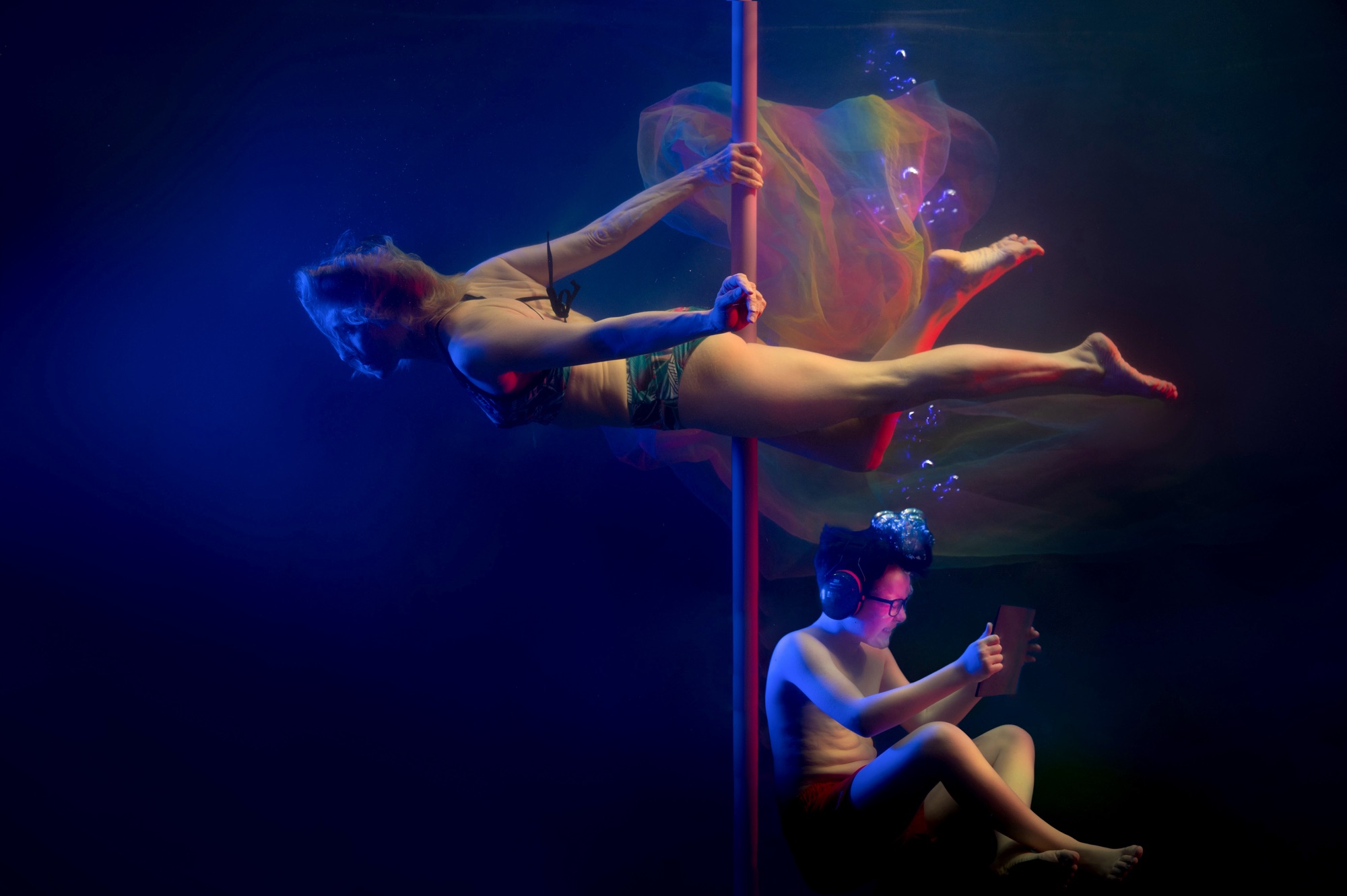
British-Arabic physical theatre performer Tamsin Shasha together with director and dramaturg Helen Tennison, videographer, Xiaomin Fan, creative technologist Lucy Wheeler, and sound designer Matt Eaton, present Forgive Me, an autobiographical pole show about a mother (lately diagnosed with ADHD) navigating the relationship between her son’s ASC (Autism Spectrum Condition) diagnosis and his love for gaming.
We caught up with Tamsin to find out more about Forgive Me, which comes to Edinburgh Fringe next month.
Q: Tell us about yourself?
Hi, I’m Tamsin Shasha – I am a 59 year old Brighton-based theatre maker, activist, and Artistic Director of Actors of Dionysus. I’ve played many Greek tragic roles (including Antigone, Medea, Clytemnestra, and Dionysus) and my nickname is the Face of Tragedy or FoT for short! It was taken from an article in the Yorkshire Post, where the company used to be based before we relocated to Brighton in 2003. I love making theatre and using my body expressively to tell stories and hopefully weave some magic for an audience. I also like to make work that connects with current issues and trends – work that makes people think about a subject in more depth and with more nuance.
I’m politically active and really care about where the world is going and stopping the spread of lies and disinformation. I believe that we have the power as individuals to change the wold for good, and that we need to counter false and hateful narratives. To that end I’ve recently created a short political pole dance act (working with Ursula Martinez) called Disunited Kingdom (starring Nigel Farage up a pole!). I also love running, swimming, and gardening.
Q: What is your work about and where did you find inspiration?
At its heart, Forgive Me is an unconditional love letter from a mother to her son. It’s a navigation of understanding neurodiversity and what that means for both of them. It’s inspired by my son’s autism, his love of gaming, and (more recently) my own late ADHD diagnosis. When my son was diagnosed in 2020 I found myself looking for answers. I’ve always been fascinated with psychology and anything neurological. I signed up for an Introduction to Autism course offered by the NHS and it really helped in my understanding – I began to think about the dramatic potential that such a story might yield. I’d made intergenerational work before (Everything I See I Swallow, which won an Edinburgh Fringe First in 2019) but nothing so personal and nothing so raw.
I’ve had quite a lot of experience playing ancient Greek roles – notably Antigone, Medea, Clytemnestra and Dionysus (with Actors of Dionysus) – and love the reinvention of ancient Greek drama. Such powerful roles for women. My own freelance work has taken me in another direction, supported by Actors of Dionysus, including an exploration of the use of circus in narrative storytelling. I trained in physical theatre with Philippe Gaulier and also at the National Centre for Circus Arts; I love telling stories organically with my body and soul. Music has also inspired me, I love singing. In Brighton I sing with a choir called Slavic Voices and we sing a mixture of folk, traditional, and holy music including from Ukraine, Russia, Romania, Belaruz, and Poland. My pole work came relatively late, but I love the community of pole dancers at the Pole Lab in Brighton where I train. It’s such a supportive and empowering community. It’s really fed into my work. And I decided to put that medley of things together….and from that we have Forgive Me!
Q: What would you want the audience to take from experiencing your work?
I’d like there to be a wow factor – like, “Wow that old girl does some pretty cool things on a pole”! That would make me happy. It’s important to me that I don’t apologise for my age and that I make older women feel empowered, to maybe to take up pole dancing themselves; to maybe tell their own stories. The show is a bit of an emotional rollercoaster for me and I would like the audience to experience some of that, to go some way into understanding the mother’s journey in navigating her son’s autism and her own ADHD. I’d like them to know a bit more and to feel empowered by the subject matter, and I’d like to shine a positive light on neurodiversity and the nuances therein. I would really like to interact with the audience (some of them may quite literally be gaming in the show!) and for them to feel engaged. Most of all, I’d like them to laugh and cry – be provoked and challenged, to really enjoy themselves.
Q: What made you create a work bridging pole, interactive gaming and performance? What do these merging of disciplines offer to you as a performer?
I am always looking for new ways to play with form and connect with what’s going on in the world right now. When my son was diagnosed with autism I found that I wanted to document it and my journey of understanding, especially to see what the correlation, if any, was between ASC and gaming. I realised that the virtual world offers predictability and in some sense safety for my son. It’s reliable and something he can control. I wanted to explore the disconnect between a mother who loves swimming and gardening and a son who could quite easily spend 24/7 in his bedroom on his tablet if he was left to his own devices. With the impending ban on social media, ‘screen time’ has become such a toxic issue and I wanted to present something that hopefully offers a more balanced perspective. Yes, it can be bad, but there also needs to be nuance…
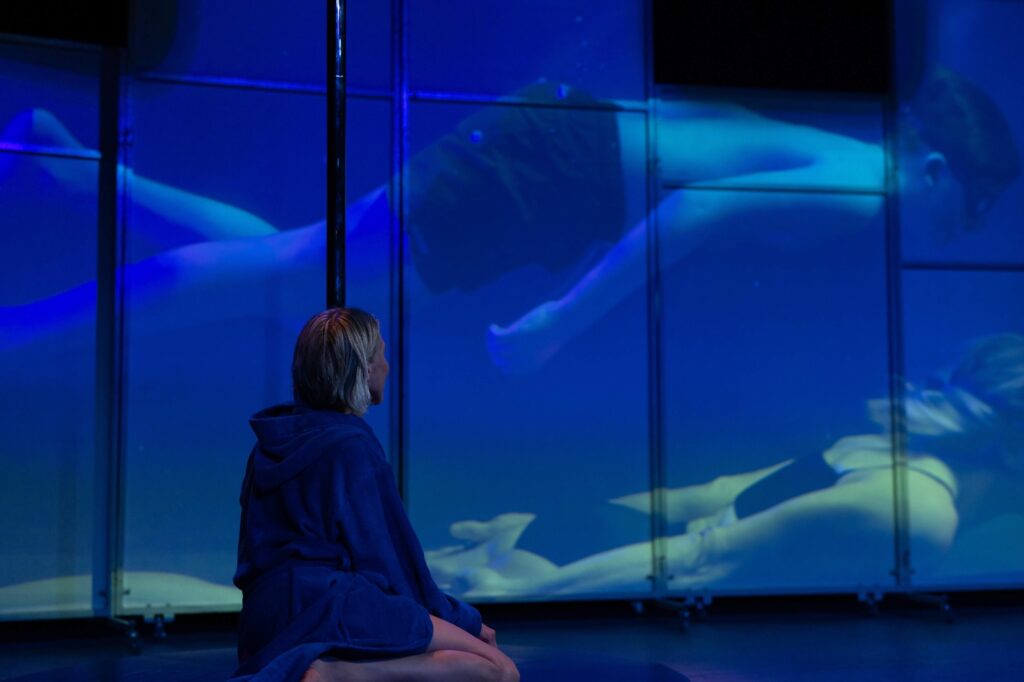
As a physical performer, I was looking at ways to use my skills as a pole dancer to explore the fractured state of my mind during my son’s ASC diagnosis and also the scattered mind stuff connected to ADHD. The mother loves wild swimming and she’s constantly being thwarted in her attempts to go swimming – that became a running gag in the show. I try to use the pole as organically as possible to tell the story. The physicality of it, especially when it’s spinning, really spoke to me. An older mother – who’s trying to answer the phone, whilst she can’t find her keys, or her glasses! – all the while spinning on a pole has comic impact. Projection is used to support and heighten the show’s storytelling. Interactive gaming is, in a way, the final piece of the puzzle in the mother’s understanding of how important the virtual world is to her child. She has to go on that virtual journey to really understand what it means to him. Gaming (and along with it screen time, and so on) and neurodiversity are such huge, resonant factors in the 21st century; and if I can shed any light on these subjects within the context of the show, and in an interesting/informative/quirky and innovative way that incorporates all of these elements, then I think – job done!
Venue: Summerhall, TechCube Zero
Dates: 7-31 August (No performances 18, 26) | Time: 13.20 (60 mins) | First review date: 6 August (preview). Book here.