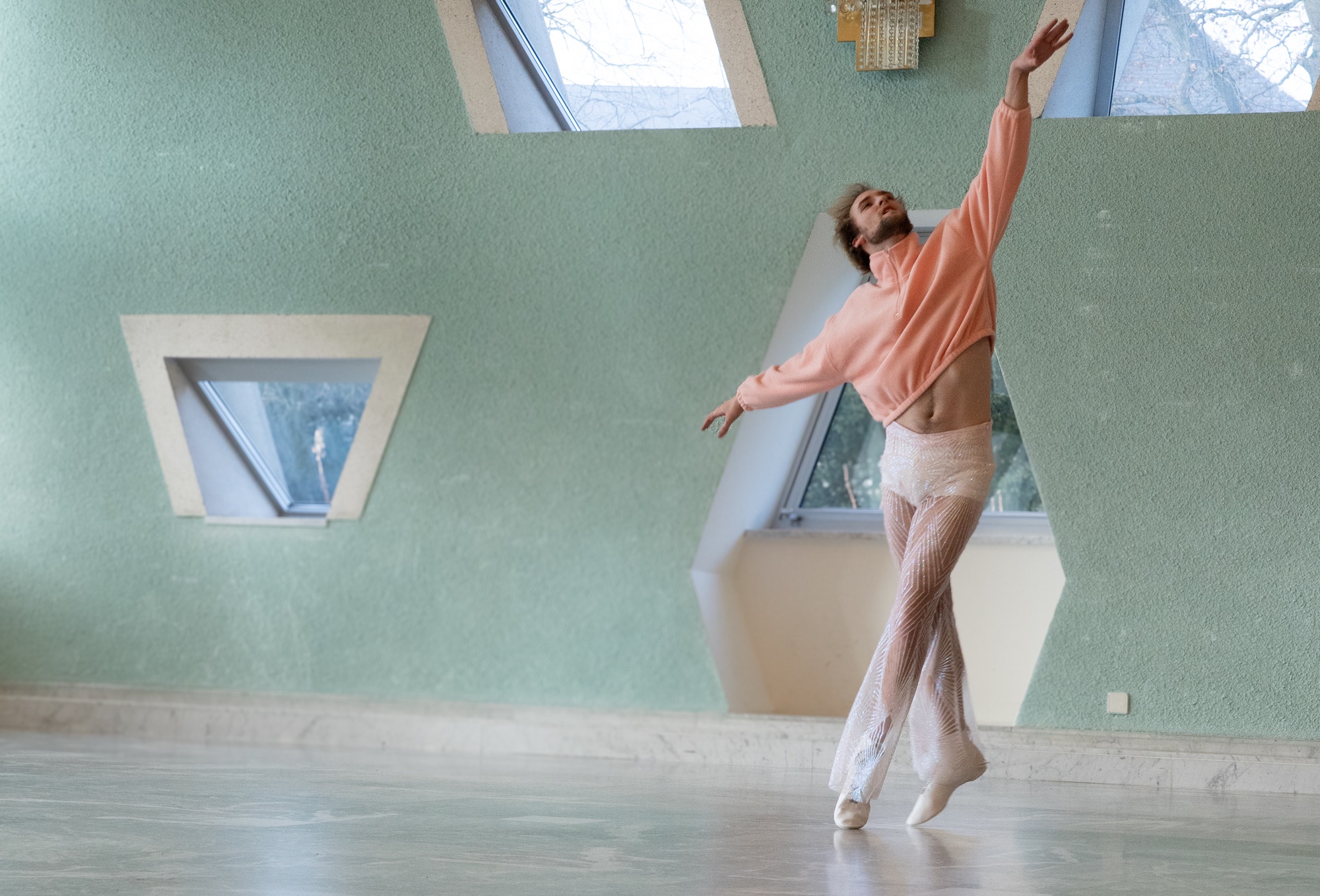
The famed enfant terrible of contemporary folk dance, Mr Chevalier, Artistic Director of the Ballet National Folklorique du Luxembourg, arrives at Edinburgh Fringe to celebrate the company’s origin story and the great traditions of Luxembourgish dance.
The company presents The Great Chevalier, a piece that celebrates the 50th anniversary of the company’s iconic Pigeon Dance.
We caught up with Mr Chevalier to discover more.
Q: Tell us about yourself?
I am the Artistic Director of the Ballet National Folklorique du Luxembourg, a position I pursued with unwavering clarity for most of my life. This role carries with it great responsibility; I am here not only to preserve what we have inherited as a company, but to ensure that it continues to speak with urgency to our current situation. Here is where the world meets Luxembourg and I accept this challenge without hesitation.
Outside of the Ballet National Folklorique du Luxembourg, I am a fashion designer and musician. I also cultivate a small vineyard in Provence. All of these passions help me to continue my lifelong pursuit of artistic excellence. One feeds the other. Of course, I am a Director and Choreographer first and foremost, but I prefer to think of myself as a custodian of cultural momentum.
I do not wish to speak of my personal life a great deal, but my childhood was very ordinary in many ways. I was born in Arles to honest parents in a simple family home on the banks of the Rhône. My mother was an artist, who painted charming watercolours of the river that my father sold at his boulangerie in the old town. I trained at the Paris Conservatoire from the age of 10. My connection to Luxembourg is lifelong and sparked through the generosity of the distinguished Luxembourgish industrialist Baron Alphonse-Géraud von Hollenfels de Wiltz. I owe my career and my life to the Baron. May he rest in peace.
Q: What is your work about and where did you find inspiration? What kinds of questions do you ask in the performance?
What is life? I see no point in striving to answer anything less than this. My work exists at the hinge of mythology and identity, between the nation and the individual. The work must strive to a fundamental truth about who we are and what we stand for. There can be no half measures, no abstraction or prevarication. We must mean what we say; I believe that audiences are tired of soft hands. Yes, they – rightly – demand beauty but they also demand answers, they demand truth. My goal is to be the iron fist in the velvet glove of folklore. Within the context of my oeuvre, these considerations emerge repeatedly. My inspiration comes from many sources; but I have spoken before of my great-great-grandmother Josette who, according to family folklore, was the woman to whom Vincent van Gogh offered his severed ear in Arles. I have spent my entire career attempting to capture the beauty and honesty of this gesture.
Q: What would you want the audience to take from experiencing your work?
A renewed respect for sincerity. Contemporary culture often mistakes irony for intelligence, abstraction for acumen. I am interested instead in conviction and force of intention. I would like audiences to leave feeling that they have witnessed something unapologetically committed to its own vision. Completely at ease with itself. No questioning. No ambiguities. This may leave them feeling disorientated, but this is natural when you only ever hear of a culture of relativism. So, if they leave questioning the nature of artistic authority, cultural identity, or even their own relationship to belief, or even to themselves, then I am satisfied. If they leave wanting to learn the Pigeon Dance, I am equally satisfied, but of course it would be impossible for them.
Q: What are some of the characteristics of Luxembourgish dance and how important is it to show its history to Edinburgh Fringe audiences?
Luxembourgish folk dance is distinguished by discipline, collective precision, grounded physicality, and a profound sense of communal rhythm. There is strength and exuberance within it, but also restraint. This is why the horse is so important in the legend of the Ballet National Folklorique du Luxembourg. The energy and memory of the wild must remain in there, a flicker behind the eyes, but it is controlled.
It is very important to show this history to Edinburgh audiences – because of course they are part of that story. This year marks the 50th anniversary of a tragic and formative moment in the company’s history. The founding sisters of the Ballet National Folklorique du Luxembourg – Josephine and Claudine Bal – maintained close ties with the city. During rehearsals for the 1976 production of Josiane, the Country Girl at Edinburgh Castle, the Bal sisters’ prized stallion, Claude, was involved in a tragic stampede accident, rampaging down the Royal Mile. Claude required emergency surgery at what is now Summerhall, historically the Veterinary School of the city. His life was only barely saved. And three stagehands were killed. Claudine Bal later described the event as “the most psychologically transformative incident of my artistic life.” So, as I am sure you can appreciate, this is an important moment for everyone.
At the same time, I do not look back. We must not view folklore as a museum object. History is not something we preserve behind glass, or wheel out periodically in the deserted, moribund concert halls of Liechtenstein. It is something we inhabit, challenge, and continuously reinvent. The dances performed at Summerhall are therefore acts of preservation and daring acts of creation simultaneously. This tension between inheritance and invention has defined my entire life. I breathe it daily and I am so looking forward to sharing this with the people of Edinburgh.
Venue: Main Hall, Summerhall. Dates: 6-29 August (not 11, 18, 25) | Time: 15:00 ( 60 mins ). Book here.