Words by Eoin Fenton.
In watching the iconic recording of Yvonne Rainer performing her landmark work Trio A, screened in the dark depths of the basement at the Tate Modern, you’d be forgiven for finding it to be a plain affair. Unadorned, danced in non-descript clothes, and deceptively pedestrian, it is not a work that seeks to astound nor impress. Rainer is, after all, probably best known in the art world for her “No Manifesto”, a treatise against spectacle and showiness that heralded the aesthetic desires of the burgeoning dance scene in New York’s Judson Church. In celebration of the woman and her seminal piece, which marks its 60th year, Tate Modern presents a durational performance of Trio A in collaboration with the Rose Choreographic School.
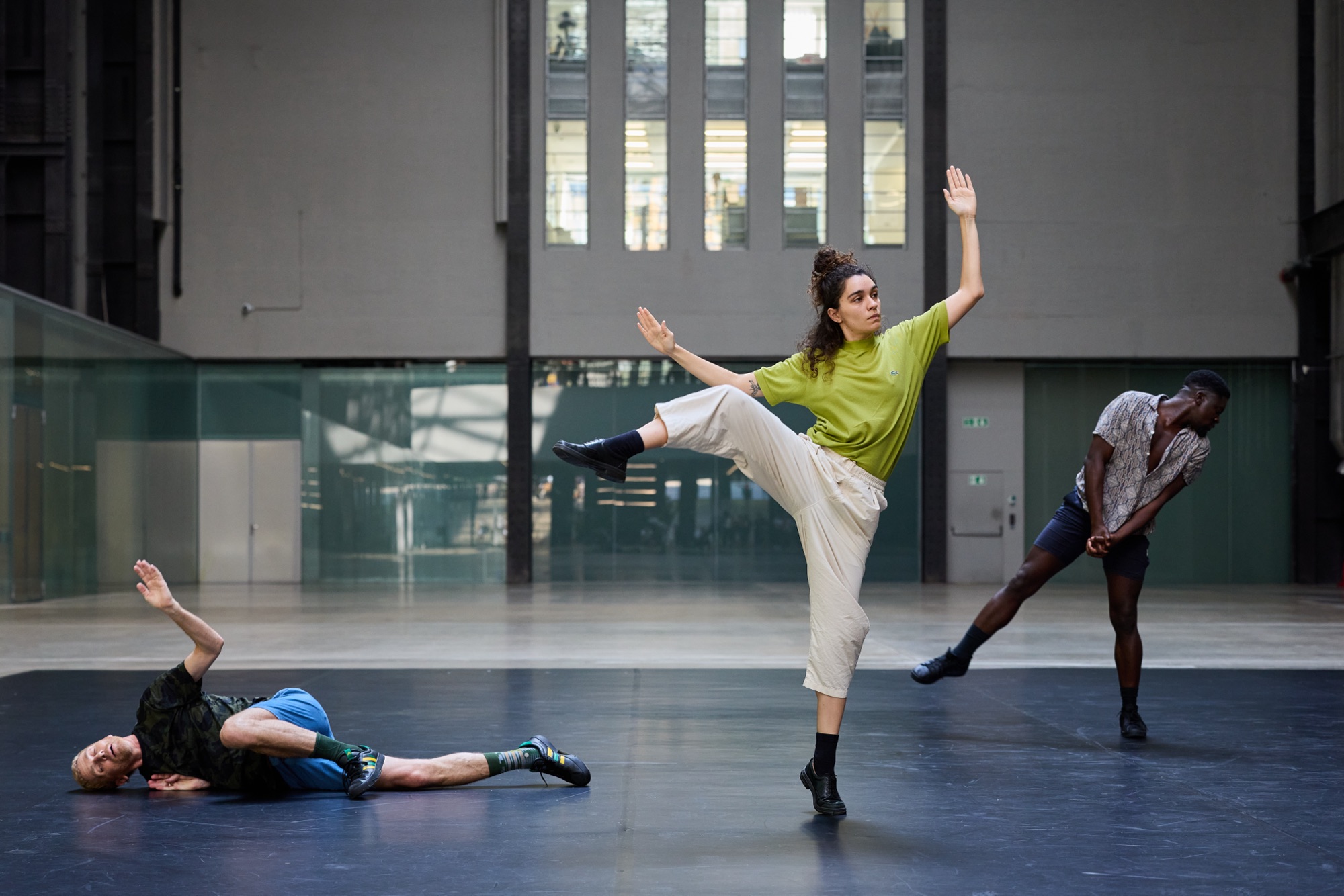
The dancers march from the back of the Turbine Hall to their patch of marley. The space is like a cathedral to sterility, grey walls of concrete and metal shoot infinitely upwards. The dancers are dwarved by their surroundings, tiny little postmodern ants. The choreography is relatively simple, composed of waving arms and wiggling hips, but the deception of Rainer’s design lies in its exactitude. Each step must be surefooted, each balance performed with an ease even as the centre of gravity shifts. The dance is usually performed by three dancers at a time who fall in and out of sync, each following their own rhythm.
When looking at the ensemble it is hard not to be filled with images and ideas. Sometimes they are odd storks baring their wings in a display, sometimes they jig, at other points the near clash of horizontal and standing bodies is reminiscent of tiptoeing out of an afters late in the morning. The artifice of the dancers as neutral (remember that “No Manifesto”) doesn’t conceal who they are as people, no matter how blank their expressions might be. Some are steadier, others are virtuosic, one bravely performs the work Doc Martins — ouch. Rainer has, in recent years, insisted that Trio A is to be performed only by trained dancers. Consequently, though there are minor variations, to the untrained eye the work is seemingly more about accuracy and imitation than embodiment.
For the uninitiated, Trio A might be harder to access owing to this insistence on the plain, but seeing underneath each shuffle and jump reveals something more human and common, something that folks on instagram reels might describe as brimming with “sonder” — the realisation that strangers comprehend the world around them in their own way. When you allow yourself to be sucked into the mindful trance of “Trio A” it can be an emotional experience. As a scenario in a museum space however, it is a little hard not to be made aware of it being another curiosity in the collection of the building. Something a little dusty and placed behind a velvet rope.
Pat Catterson, a “transmitter” of the work — essentially a stager — shares in an in-conversation with Rainer and heads from the Tate and Rose Choreographic School the story of her first encounter with Trio A. Performed in the late sixties as part of an evening of contemporary dance, the work was danced once by a group of trained dancers, then by non dancers, then altogether to a popular song from the time. Catterson mentions how the audience leapt to their feet, that this was a dance about shared humanity and access. Though this iteration fulfils Rainer’s recent desires in being performed by trained professionals, and it makes for gorgeous viewing in the lofty Turbine Hall, one wonders whether the solo has lost that democratic punch. What can not be denied is the impact of Rainer, whose daring legacy still packs in curious crowds.