Words by Luella Rebbeck.
It was one of those bright, sweltering London afternoons where the heat seemed to slow everyone down. My Overground train was delayed, and by the time I began the short walk to FUSEBOX in Kingston, I was moving sluggishly, almost reluctantly. But somewhere between the station and the venue my walk transformed into something else. It became a strut. Perhaps that was inevitable. Before I had even crossed the threshold, silhouettes in towering stilettos, fishnets, bras and neon tights were gathering outside, turning the street into an extension of the performance itself.
FUSEBOX’s stone arches and weathered walls created an unusual setting for the opening of Pride in Kingston. The industrial ruins carried echoes of history, their rough textures contrasting sharply with the hyper-feminine costumes and fluorescent fabrics moving through them. There was something almost archaeological about placing unapologetic queerness within an old ruin: a collision of past, present and future. It reminded me of Pride’s protest roots, of bodies reclaiming public space, whilst imagining new futures within inherited structures.
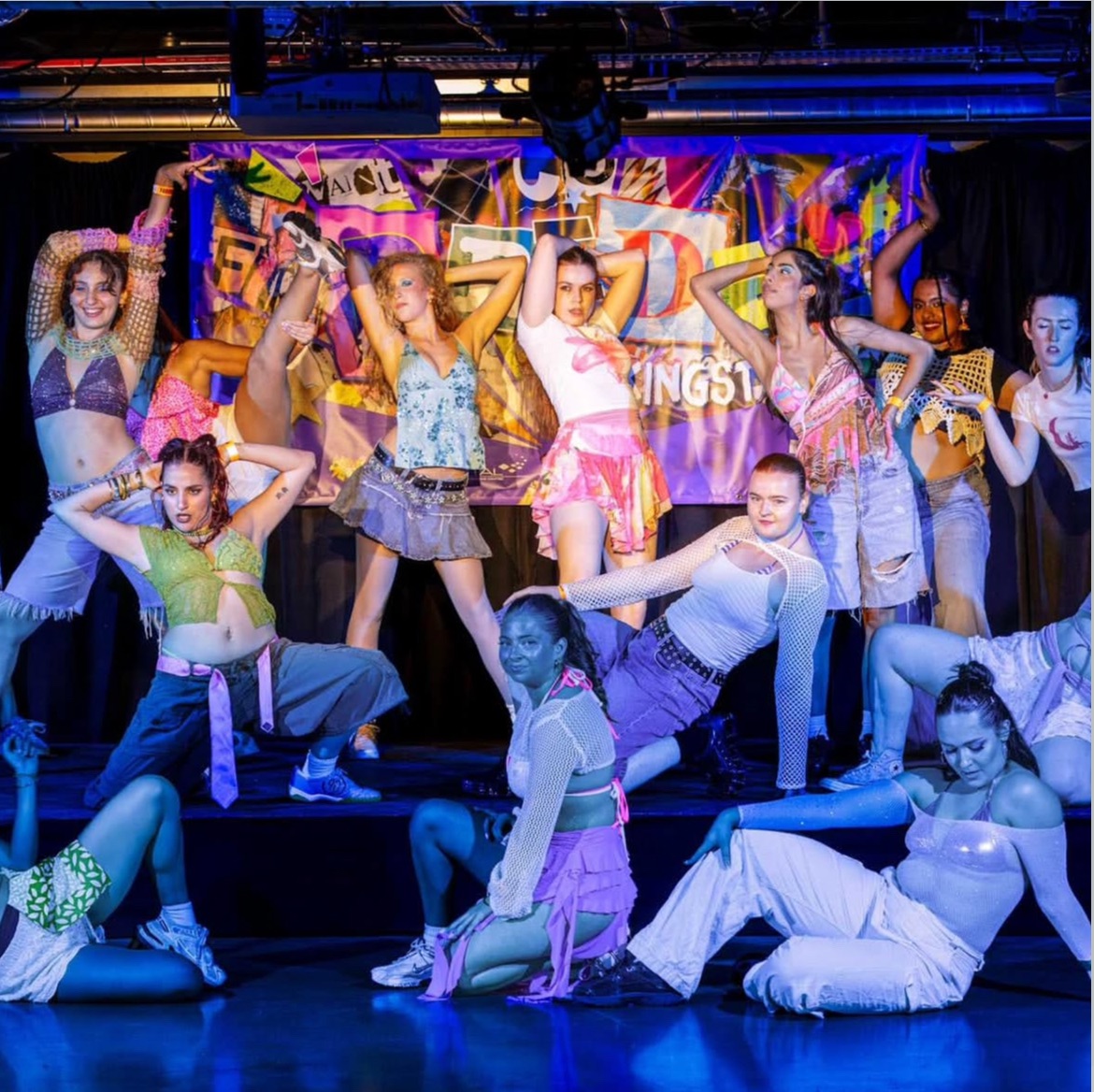
UNAPOLOGETIC Dance‘s work embraced this tension. Even before the performance formally began, dancers prepared their bodies in full view of the audience. Costumes were adjusted. Fishnets pulled into place. Makeup retouched. The performance refused the neat distinction between backstage and stage, inviting us into a process rather than presenting a polished illusion. Six performers drifted confidently through the crowd, their statuesque stilettos carving pathways between rows of seated spectators. As the title promised, there was nothing apologetic about their presence.
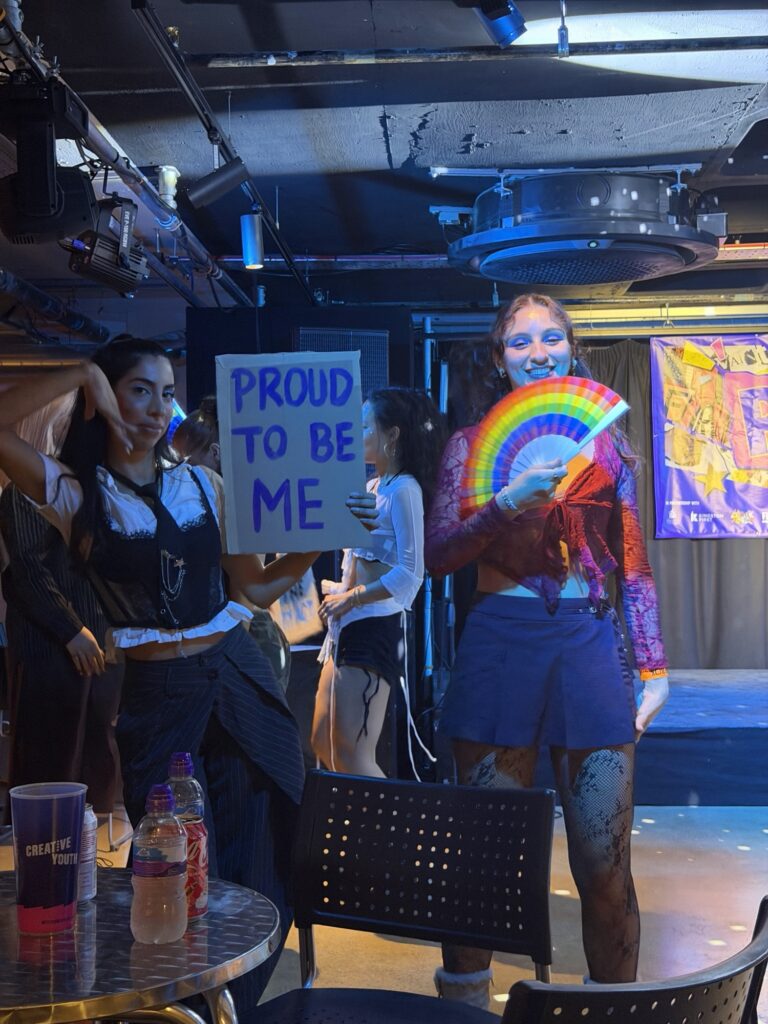
The evening unfolded less as a conventional dance performance and more as an expansive queer variety show. Singing dissolved into dance. Striptease became political gesture. Cabaret sat comfortably alongside moments of tenderness and collective celebration. Dua Lipa’s ‘Physical’ pumped around the cavernous space, rainbow fans fluttered through the audience, and flashes of rose-tinted lighting softened scenes that were otherwise bold, loud and gloriously excessive.
At times the work seemed determined to boycott the binary—not simply in terms of gender, but in its refusal to settle into one artistic language. Dance became theatre. Theatre became concert. Concert became drag. Drag became protest. The performance resisted categorisation just as fiercely as it resisted fixed identities. There was an infectious energy in that refusal.
One duet, the performers wrapped in clashing neon tights, balanced intimacy with theatricality. Their bodies intertwined in a sensual choreography that felt simultaneously playful and deeply affectionate. Yet from where I sat, my view was often interrupted by the audience itself. Between the gaps in people’s heads appeared fragments of bodies: a flash of fishnet, a glimpse of a bra strap, the curve of a buttock disappearing behind another spectator. Surprisingly, these obstructed sightlines became part of the experience. The teasing nature of the performance extended into the architecture of spectatorship itself. We were never allowed complete access.
The audience became as compelling as the performers. Looking across the room, I found myself watching smiling faces, blushing faces, liberated faces, confused faces and delighted faces. It was unmistakably intergenerational. Young people danced alongside older audience members. Queer people sat beside allies, families and curious first-time visitors. There was a palpable sense that people were seeing themselves reflected somewhere within the room—whether in the performers, in the audience, or simply in the atmosphere of radical acceptance being constructed for one evening.
That, perhaps, was the performance’s greatest achievement. It was not interested in manufacturing happiness or delivering neat conclusions. Instead, it offered possibility. It encouraged its audience to lean forward and imagine different ways of existing together. The work produced a quiet catharsis, not because everything was coherent, but because it made space for complexity, contradiction and joy to coexist.
There were moments, however, where the production’s ambition outpaced its dramaturgy. While the individual performances were committed and often exhilarating, the overall structure occasionally lacked cohesion. The powerful live singing showcased remarkable young voices, but I found myself questioning how some sections connected to the broader theatrical language being developed. At times the performance felt caught between immersive installation, dance theatre and variety show without fully committing to any of them. The striking venue itself also felt somewhat underutilised; while there may have been practical or budgetary reasons for this, the use of space and audience seating often felt a little haphazard, missing opportunities to more fully activate the environment and strengthen the overall experience.
The venue itself also presented unrealised opportunities. Hidden within one corner was what appeared to be a cave-like fabric sculpture resembling a vagina: an intriguing installation that felt strangely underused. It suggested another world existing within the performance but was never fully activated. Likewise, I couldn’t help imagining how differently the evening might have unfolded had the seating adopted a more cabaret-style arrangement. The rows of tables and chairs often felt restrictive, limiting movement and reducing visibility in a work that clearly wanted to dissolve boundaries between performers and audience.
Yet perhaps even these imperfections reflected the spirit of the evening. Pride has never been about polished perfection. It has always been about experimentation, visibility and claiming space. UNAPOLOGETIC Dance embraced those principles wholeheartedly. The performance was colourful, rude, kinky, generous, occasionally chaotic and deeply energetic. It celebrated queer bodies without sanitising them and invited audiences into a world where vulnerability and confidence existed side by side.
As I left FUSEBOX, the images that lingered weren’t necessarily the choreographic highlights but the atmosphere itself: stilettos echoing against stone floors, neon fabrics glowing beneath pink light, bodies weaving through crowds, and audiences smiling back at one another with a sense of recognition. In that moment, the performance achieved something far more lasting than spectacle. It transformed an old ruin into a living, breathing celebration of queer possibility.