Words by Stella Rousham.
I first met George Adams in January 2023. After a 5am train from London to the Northern School of Contemporary Dance, George’s enthralling introduction pulled me out of my sleep-deprived state. Born and raised in the East End of Glasgow, George’s experiences of police protection and financial barriers as a child continue to infuse his practice as a freelance dance artist. From training at Rambert, to setting up LPM Dance and working as an inclusive dance artist across Korea, Estonia and the US, George’s portfolio career is a complex choreographic score of cross-cultural collaboration, creativity and curiosity. At the core of his practice is the desire to enable everybody to experience dance as a performative, aesthetic and healing practice.
Stella: Would you like to introduce yourself?
George: I’m a dance artist and have been dancing professionally since around 2007, mostly self-employed with a few contracts along the way. Alongside dance, I trained as a dance movement psychotherapist and briefly worked as an osteopath, integrating these approaches through LPM Dance, a company set up alongside Helen Gould.
A lot of people and institutions shy away from the words “dancer” or “artist”. They’re loaded words, but politically important to claim. Being an artist means expressing a perspective and creating meaning, even if it doesn’t generate income.
Stella: Identity as a “dancer” can feel fragile as soon as you stop training or performing. Likewise, from teaching dance in schools, I’ve noticed dance is often only valued through transferable skills like economic contribution. Why do you think dance isn’t inherently valued?
George: Ultimately, dance is about bodies in space. Because of that, dance often intersects with other art forms, which is a strength, but also makes it easier to undervalue. It can be watered down or not taken seriously.
Stella: How do you retain dance’s collaborative spirit without watering it down?
George: What’s important for me is maintaining artistic integrity. I don’t believe in making work more digestible for audiences.
Over the years, I’ve taken part in — or shimmied around the edges of — countless initiatives designed to get people moving: flash mobs, TikToks, cheerful “let’s all join in” videos.
When I was approached about the Danceathon, I felt a flicker of trepidation. I had made a quiet promise to myself: to stay rooted in community dance, social health projects and inclusive practice, but never at the expense of my artistic standards. That promise nudged me toward a different approach — one that invited creativity rather than imitation.
Working alongside Dr. Deborah Thompson on the Danceathon, I created 21 short movement invitations, animated by Courtney McCarthy, which participants could interpret however they wished. Each invitation opened a door rather than prescribing a path, situated within three strands: collaboration, body awareness and exploration. My hope was that they could act as choreographic provocations, whilst also standing alone as accessible pieces of art.
Stella: I am struck by how far-reaching, yet deeply rooted, your work is. Can you talk me through some key collaborations and organisations in your network?
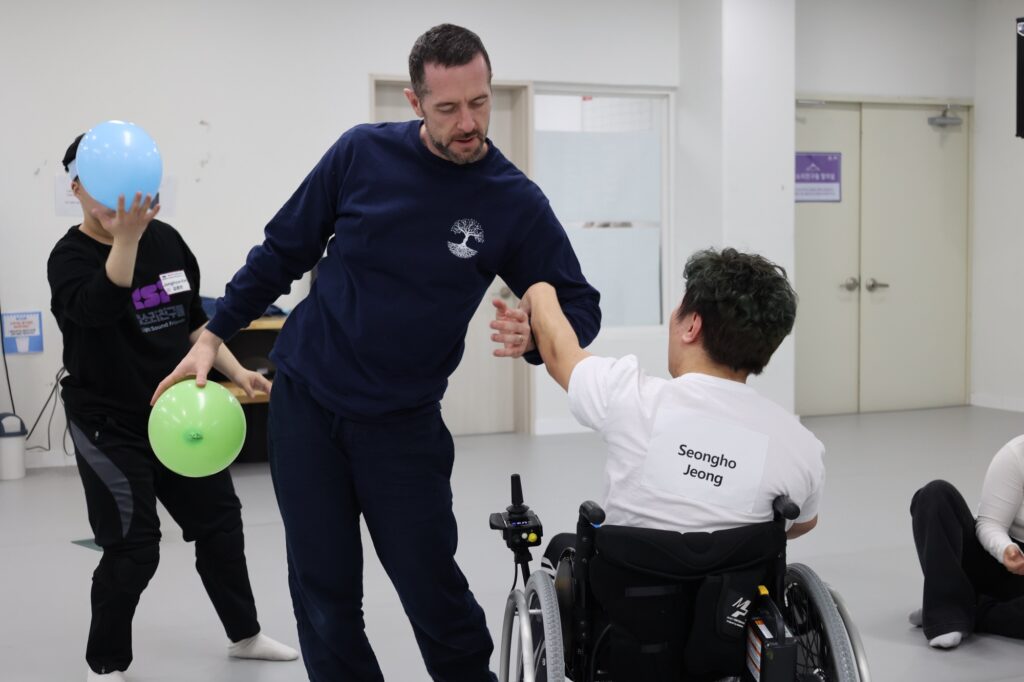
George: Over the past two years, whilst supported by Arts Council England’s Developing Your Creative Practice (DYCP) funding, I’ve been deepening my commitment to inclusive pedagogy through collaborations with performance companies. This has included working with Light Sound Friends in Korea, Tocotoco Dance Company in Japan, the Estonian National Ballet, Kinetic Light and the Limón Company in NYC.
Closer to home, I’ve continued my long-term work with LPM in Lancashire and Indepen-dance in Glasgow. Each partnership has expanded my understanding of how inclusive practice can sit at the centre of high-level artistic work, rather than being treated as an add-on or “outreach”.
Stella: Lots of artists and companies are using the term “inclusive”. What does inclusive practice mean to you?
George: Inclusion is complex — I’m not sure there’s a fixed definition. Economic factors are a major barrier; many people simply don’t have the time, space or money to engage with the arts.
My experience working with a dancer named Adam Sloan, who has Down’s Syndrome, taught me how inclusivity is an ongoing process of communication and reflection. When we first started working together, I realised I was influencing the choreography too much. I went away and developed a tool called metamorphic cards. These break the choreographic process into simple stages:
- Red (Stimulus): a starting point, such as music, an image or an idea
- Amber (Development): exploring relationships, dynamics or choreographic structure
- Green (Final): considering audience, costume or performance context
These cards allowed Adam, and other dancers with little formal experience, to lead the artistic process, offering structure without removing authorship.
Stella: What role does your more “traditional” training at Rambert play in shaping your inclusive practice today?
George: Dance is full of rules, and learning those rules can actually be liberating. For me, mastering technique — whether in ballet, Cunningham or somatic practices — creates a foundation that enables freedom.
Since around 2019, I’ve been working with the José Limón Foundation, introducing modern dance principles to a wide range of dancers, including disabled dancers and those without formal training.
What’s interesting about Limón technique is that it isn’t rigidly codified. It is based on principles such as fall and recovery, opposition and emotional expression, rather than fixed exercises. That makes it highly adaptable.
To quote Dante Puleio, Artistic Director of the José Limón Foundation, “the technique transcends barriers, obstacles and imaginary boundaries […] disrupting antiquated ideas of what it is to be a ‘dancer’.”
Working with Limón has taught me that inclusive pedagogy is fundamentally about adaptation as a creative, rather than “corrective”, process.
Stella: You mentioned training as a dance movement psychotherapist. How does this fit with your artistic identity?
George: Whilst completing a postgraduate diploma in Dance Movement Psychotherapy, I also worked in an osteopathic clinic, where I began integrating more touch-based approaches. Increasingly, however, the clinical structure — supervision, documentation and frameworks — started to feel restrictive. Whilst people do need professional authority to feel safe, I found that when I introduced myself as a dancer, they could relax more.
This led me to study yoga and Ayurveda in India, which focus more on lifestyle and self-practice than Western psychoanalysis and medicalisation. Over time, my work became less about fixed labels and more about responding to the person in front of me. In my own clinic, I included music, books, tea and sensory elements so that it didn’t feel like a sterile medical environment.
Stella: Can you share an example of a transformative or “healing” moment in your teaching?
George: I worked with a dancer called Maylis Arrabit, who uses a wheelchair and is now a professional choreographer. Early on, she questioned whether she could perform.
I gave her a simple task: to come on stage in her own time and simply be present in front of an audience. She sat there and, after five minutes or so, broke down in tears. Later, she said, “It’s about me, isn’t it? Just coming into space.”
Seeing her choreographic journey has been incredibly rewarding. That’s the beauty of teaching dance: you never know when a seemingly mundane task can entirely shift someone’s life.
Stella: I’m really drawn to the view of dance as an autobiographical tool, inextricably linked with self-development. How have you integrated dance across the life course?
George: At LPM, we make work and run classes for older adults and young audiences, including performances in nurseries. A quiet thread running through both is the use of simple, universal forms of play as a foundation for performance, improvisation and creative decision-making.
The approach draws inspiration — very loosely and playfully — from Piaget’s schemas in developmental psychology. It sounds clinical, but really it is about observing different forms of play — transformation, orientation, spinning and patterning — and noticing how these instinctive behaviours emerge through movement and art-making.
Stella: What’s significant for me is how you’ve harnessed psychology as a creative, as well as therapeutic tool through dance. How else have you been spending your time recently?
George: I’ve been performing again, including Marina Abramovi?’s, Balkan Erotic Epic. The work is profoundly vulnerable. As a durational piece, it is physically demanding — four hours without a drink or going to the toilet. Believe it or not, it is also the first time in my 20-year career that I have performed completely naked.
At 42 years old, it is powerful to return to performance again, not just with Marina but also with companies like Lila Dance and Indepen-dance. It reconnects me to that core identity of being a dancer.
Stella: What is on the horizon for LPM Dance?
George: We are continuing our Dance for Health programmes across Lancashire, working with people with Parkinson’s and other neurological conditions. Over the summer, we will be running Moves, a community festival bringing together professional artists, local performers and community groups from across Lancashire, Preston and Fleetwood.
We’ve received funding for three apprentice dancers on these projects. It is important that emerging dance artists have the opportunity to learn within a company setting and develop skills that can genuinely shape the sector, especially amidst continual funding cuts.
The world is such a mess right now. It feels more important than ever to connect international practice with local communities through a shared love of performance and dance.
George Adam’s upcoming performances and projects:
4 July — Fleetwood Moves, LPM Dance’s integrated community and professional festival
25 July — Pendle Witch by Aimee Williamson at Seek Out Festival
2–5 September — Gather Together, Inclusive Dance Festival, Glasgow
3–11 September — Balkan Erotic Epic, Ruhrtriennale, Bochum
14–17 October — Balkan Erotic Epic, Berlin
8–20 December — Balkan Erotic Epic, New York City