Words by Maxine Flasher-Duzgunes.
“When I’m with you, I’m with the whole world,” stated Lalah Simone-Springer to the solo dance of Sofia Nikiforova at Applecart Arts in east London. The extract Springer reads describes how it’s possible to channel the strength and beauty of the earth into one’s body while also staying pure from negativity. To the soundtrack, Nikiforova tiptoes in a lace gown between two white walls as the blurred glow of the afternoon sun streams through the back windows.
This segment, among many in Michael Mendones’ feature-length film (be)longing convey the warrior-like hearts of dancers as they struggle through an endless montage of questions about identity and its inevitable shadows. Micro-commissioned by Bethlem Gallery for its exhibition of the same name and running through July 11, 2026, (be)longing highlights neurodivergence and Mendones’ late autism diagnosis through the lens of contemporary dance and its countless misinterpretations.
Towards its beginning, every shot in the film seems relative to a wall – three dancers’ escaping limbs magnetising them to a hallway, a dancer in a grey hoodie twirling her back under the confines of a graffiti tunnel – which introduce the filmmaker’s sense of alienation from society and the perpetual burnout resulting from it. Text is often interspersed throughout the film to provide context to the narrative as well as a pause from the intensity of each movement score.
The film cuts to a flamenco dancer, gradually stripping the layers of her costume – her silk scarf and then her bun and headpiece – as if frustrated with the material ornaments that make her authentic. The following shot wildly contrasts the abandon in the flamenco with the ease of a pole dancer softly flowing and falling, flooded with light entering the studio. Taking a dark turn, the next shot exposes a young ballerina surrounded by a robotic ensemble of pointe dancers in black garments. Her off-center turns and divergent port-de-bras break their encroaching circle as she fights the urge to succumb to sameness.
In reference to his cultural heritage, Mendones calls attention to the “Filipino panopticon” as a form of exile and familial shame and the extensive grief that seeps from this experience. A black-and-white cavernous dance accompanies his account, the elimination of color blurring the distinction between the dancer and the background. The film transitions back to the three dancers in the hallway, however this time they’re lined up in a row, smiling like mannequins as Mendones describes the concept of “masking” or putting on a face to avoid judgement. This section, entitled “longing”, is followed by statements about the difficulties (as a neurodivergent artist) of recognising social patterns and signals: feeling like a liability and trying to reach out to the community but not knowing how…
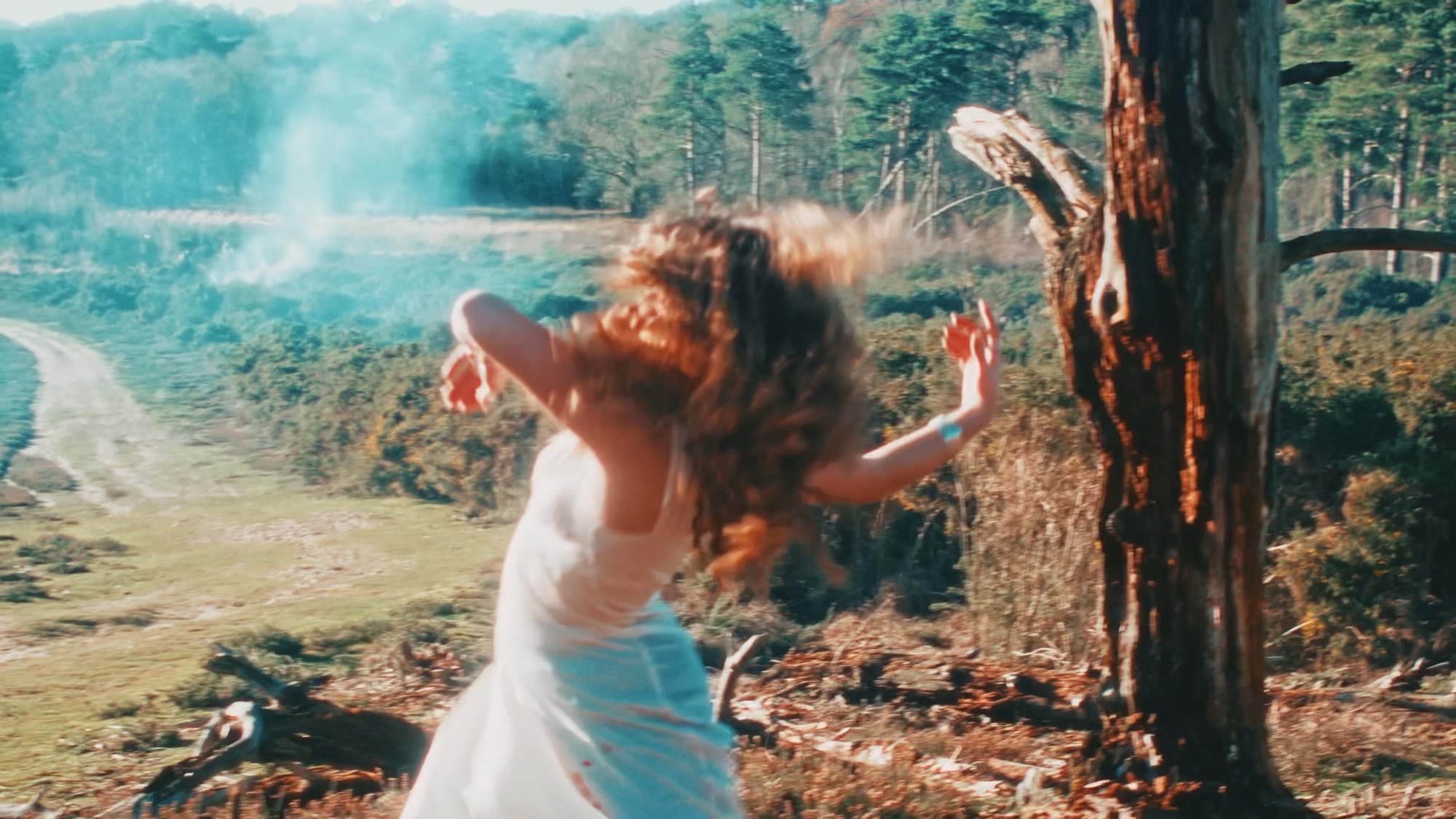
A dancer attempts to scale a wall, another duets with their shadow from behind a slitted sheet, each trapped within the abrasive conditions of their world and seeking a way out, or in fact, a way through. (be)longing reaches a climax when purple gunk begins to ooze down the face of a dancer in a business uniform as her doppelganger pulses and thrashes in a dramatic escape from a hospital-like room. The horror of this scene varies significantly with the next: one of the first glimpses of pure nature, where a dancer in a mesh blue skirt blows her arms ethereally in endless reed fields and woodlands, exposing herself to movement outside of confinement.

To kick off the last section of the film which is also called (be)longing, a dancer in a white dress seems to set herself free as she launches into a pond, lathering mud on her skin and clothes, splashing barefoot in puddles, utterly undeterred by the glorious mess she’s made. Following her luxurious abandon, Mendones makes it known that “some of us move in a different way” and uses the term “neurospicers” to describe, in his words, his tribe. Back in the studio, he’s warmly joined by what appears to be his dance family, all in brightly covered hair, shoes, bandanas, and sparkly jackets. Each of them jam in bursts of uninhibited joy and funky isolations to the song “Ancestors II” by Frequency.Fixer, as if they’ve always belonged in a space like this.
An overhead shot of an unusual spiraled plot of farmland zooms in to reveal Mendones sitting back to back with a companion, at peace among the same people who flow and fall through the tributaries of beautiful difference. (be)longing accomplishes a form of world-building I have never seen before, how it captures what perhaps every dancer has felt at some point in their lives and the generous community that’s been there in the mirror, waiting for them all along.
To learn more about Mendones’ work, follow him @michael_mendones on Instagram.