Words by Lizzy Tan.
In a small gallery in a quiet English town, a bright green sign on the pavement reads: METABOLIZER IS OPEN – COME INSIDE – DANCE – CHAT – DANCE – SIT – DANCE – CHECK OUT THE DATA – NO EXPERIENCE NECESSARY. Inside, past the necessary FAQs on GDPR is the demystifying clarification that ‘Metabolizer’ is not a job board but ‘technically a solo dance space’ – a phrase, the artist Julia Pond says, that ‘describes all work, even when co-working.’
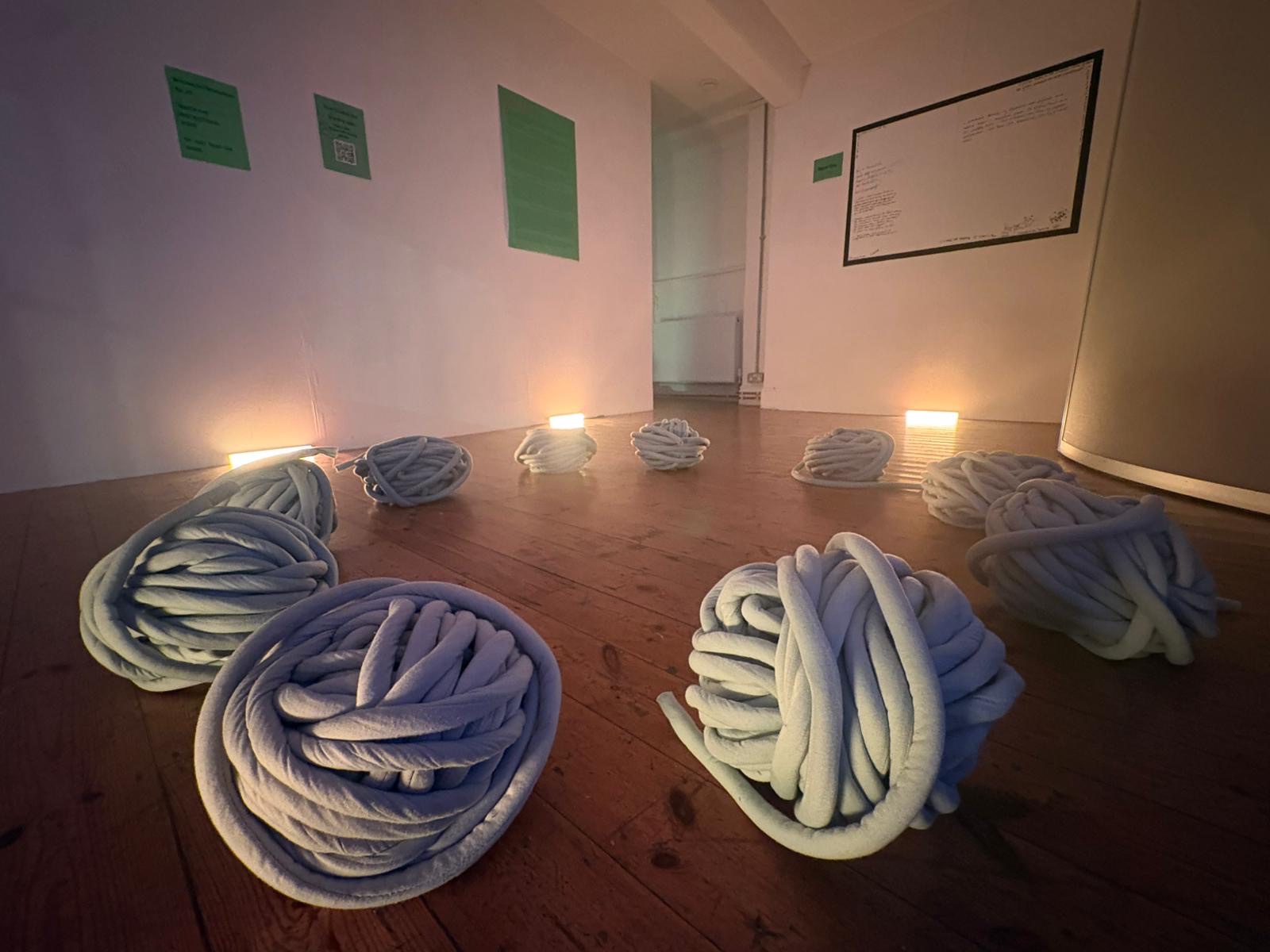
In the gallery, there is a circular chamber called the Pod. You go in. You put on headphones. You dance, alone, while a screen outside displays metrics broken down by body part (hips, spine, legs, arms, head, feet), by aggregate (time danced, total dance produced), and by rate (growth, dance). On the walls, lime-green A4 prompts oscillate between corporate-handbook commands (‘explore edges. Find the floor’) and koan (‘the value of my dance is that it has no value’).
‘Metabolizer’ sets out a systemic frame. The key performance indicator, or KPI – grow dance-time by 3 percent a day until you reach twelve hours – tracks a GDP growth target, likely the global rate; the US’s projected GDP growth rate is around 2 percent. It also tracks, as Pond notes, ‘the length of a sweatshop worker’s or cobalt miner’s day. The dashboard is built to evoke a stock tracker with its red-and-green tickers. The whole installation runs in the visual and lexical register of corporate pursuit: targets, dashboards, ‘Optimizer!’ evenings and ‘performance’ in the managerial sense.
It is this optimisation frame that I want, gently, to set aside. Jia Tolentino describes the late-capitalist condition as relentless self-optimisation – an outward, strategic effort of making oneself more efficient, of -maxxing. Optimisation is something you do to the body: an external project of augmentation. Metabolisation is the opposite: internal, automatic, involuntary. It is what the body does on its own to sustain itself. You do not optimise your liver – your liver metabolises you.
The Pod is the chamber where the optimisation is most conspicuously staged. The dashboard outside the Pod is the optimisation surface, where the dance is reduced to legible units that can be aggregated and accelerated – no matter what kind of dancing takes place. This choice, Pond divulges, ‘responds to my [her] transforming relationship with the value of [her] performing dancing body’ after chronic pain and two hip surgeries. What works well is the absurdity of the math – increasing 3 percent, period over period, is difficult even for so-called advanced economies.
But it’s not just math. The 3 percent always has to come from somewhere – from longer hours, from cheaper inputs, from extraction that threatens a liveable planet. The figure rising on the chart is only the visible end of a longer arrangement. The work gestures, in its title and footnotes, toward a Marxian metabolism: the co-transformation of human and more-than-human matter through labour. In Marx, capital opens a rift in that metabolism, severing the worker from what they produce and from the conditions of their own sustenance. Metabolizer’s dashboard sits in this rift – abstracting dance into parts and numbers while the dancer supplying the inputs is, presumably, somewhere between volunteer and tourist. There is no contract and no defined labour, no surplus to generate, no shift to clock out of – only the prompts on the wall and the willingness to follow them.
It is, instead, fantasy. The hard labour the twelve hours represent is mostly done somewhere else, by other people, producing the goods that make a post-industrial life possible. No one is making us dance, and so the dashboard becomes a game – the dopamine kick of watching figures rise as we move. This is the more interesting read of the work, I think. The infinite growth critique is well-established. Staging the recognition that we play along, and that the number going up feels briefly like enough, is an interesting and honest provocation.
Pond’s taking ‘virtuosity off the table’ in the dance is the real core of the work. The dance produces data, yes, but it also does the thing dance has always done, which is to transform the person doing it. The Pod becomes a refuge from the optimisation logic that shapes a dance career. Such a refuge can be therapeutic. But a refuge illuminates the thing it shelters from only obliquely. Metabolizer stages the format of labour under capitalism but stops short of the conditions which enforce it. The dancer in the Pod is free to leave. Most people, in the work that sustains their lives, are not. That difference is most of what labour under capitalism actually is. Metabolizer does not answer why this system holds, or what living differently inside it would take. Those are questions we all have to live with.