Words by Josephine Leask.
KWAM Collective’s double bill at Rich Mix is an ambitious and provocative evening in which three exceptional multidisciplinary dance artists investigate trauma, shame, violence and humour through text, movement, objects and cinematography. The result is a riveting and brilliantly performed programme that moves seamlessly between the grotesque and the farcical, while asking how the body stores, performs and resists damage and upheaval.
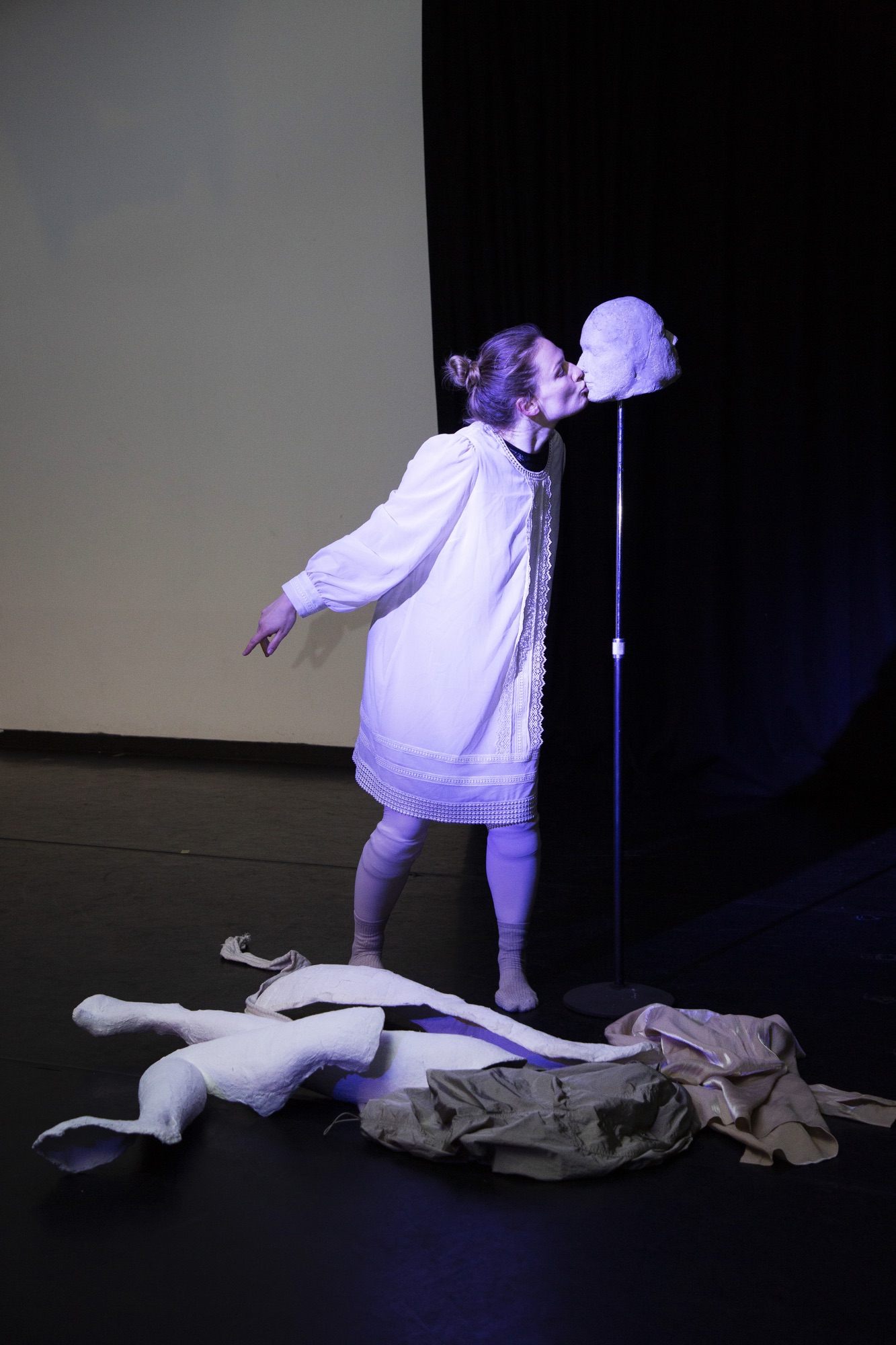
At the start of head bucket bed, Klaudia Wittmann lies on a stark metal bed, her body arranged in tormented positions, legs jutting out at awkward angles. Three sculptures of disembodied legs occupy the stage like threatening fragments of other performers while a white head sculpture fixes its gaze on her. Projected film footage shifts from an image of a wakeful child beside her sleeping mothersmiling at the camera, to repetitive scenes from the 1951 German film Die Sunderin, in which a glamorous blonde woman, an object of desire and plagued by amorous men, appears anxious and traumatised. From the outset, Wittmann’s work establishes a visual world of scrutiny, fragmentation and unease.
Wittmann rises and manipulates her legs by pulling at the long sock-like bandages that cover them. She tells the audience she has had a dream and that we were all in it. Addressing the silent, judging head sculpture, she shifts between compliance, irony andrebelliousness, infusing the solo with different internalised voices and gazes. That psychological pressure carries into the movement: dynamic, technically exact phrases are punctuated by exaggerated leg extensions and arched-back positions that bear the imprint of gymnastic training, before loosening into a more fluid contemporary dance language.
Through its interplay of sculpture, text, film and dance, head bucket bed confronts the institutional abuse embedded in gymnastics culture, drawing on four years of research and Wittmann’s own experience of training. What emerges is a feverish account of how young female gymnasts are judged, commodified and disciplined: valued as objects to be manipulated, sexualised, admired or discarded, yet never allowed to be enough. The recurring images of the bucket and the apple add textual depth to sharpen Wittmann’s critique. The bucket as on object on stage suggests entrapment; the close-up film of a red apple – desire, temptation and malice, especially when a voice-over instructs someone to eat it “naturally”, producing an image that is both comicaland disturbing.
During the section titled bucket, Wittmann balances in a headstand with her head submerged in the bucket while a voice anxiously asks how stuck she is and offers possible routes out. The returning close-up of a rotating red apple split open to reveal a blackened core extends her exploration of damaged surfaces and hidden decay.
In the final section, grounded and lush somatic movement gives way to a more commercial dance sequence in which Wittmann appears in a sparkly top, embodying a version of decorative femininity designed for display. Verging on the hysterical, pushing her body into distorted positions and dancing to the point of exhaustion, she juxtaposes archival film footage of competitive success with her live performance. The piece is hard-hitting and deeply unsettling, not only because it revisits a traumatic training experience in the past but because it exposes the mechanisms of self-surveillance, criticism and relentless striving that continue to shape the body in the present.
In One Without, Bea Bidault and Max Revell explore the rebellious body through contortion, mime, circus and clowning. Across a sequence of sketches, they test what it means to perform bodies that appear unruly, disobedient and beyond conscious control. Bidault is repeatedly flung from a chair while speaking philosophically about bodily desires; Revell, trying to light a cigarette, finds his own arms swerving away from the flame. While their work is comedic, beneath the surface lies a more disquieting question about agency.
The pair build a series of fictional landscapes in which apparently unrelated actions unfold with dream logic. Their performance slips between the absurd and the violent through eloquent text and sharply executed slapstick. While Bidault delivers composed reflections on how the body responds to different stimuli, Revell repeatedly dashes across the stage behind her, then disappears, turning her calm philosophical register into a backdrop for bodily chaos and disruption. When she is finally pushed from the chair by some invisible force and lands in a broken shoulder stand, the piece crystallises its central tension between articulation and collapse.
Snatches of a difficult relationship surface in the duets. In one, Revell arranges Bidault’s motionless body face down across two chairs before confronting her as though she has committed a crime. In another, she affectionately describes what she likes about him while he stands with his back to the audience, wearing his coat as though it were the front of his body and tipping his bald head beneath a cap until it resembles a blank face. The image is uncannily effective, and his responses to her touch become a performance of bodily distortion and emotional inadequacy.
What is most compelling about One Without is the performers’ ability to make the body seem both expertly controlled and strangely autonomous. Even when the accompanying texts are thoughtful, it is the bodily deception—the sudden contortions, refusals and derailments—that holds attention most powerfully. Like the best mime and clowning, the work articulates how slapstick is rarely innocent: here, comedy is edged with cruelty, and that tension gives the piece its bite.
Header image by Asimina Giagoudaki.