Words by Lizzy Tan.
Tiegan Doyle’s Is This Bliss
In Is This Bliss, suited figures stand in for an ambiguous, systemic force pressing in from offstage. Rapid hand gestures – alternating between friendly and threatening – accent a recorded voice. The detached monologue suggests these performers are part of a greater whole: ‘We cannot be blamed for what we do not understand… we are a symptom, and symptoms belong to a body.’ But whose body is it? A kinetic, propulsive movement vocabulary – Doyle’s strength – energises the piece’s vignettes: eyes open wide; finger guns press to heads; ties, hats, and coats are patted and smoothed. There’s a rebellion brewing, though Doyle is not forthcoming about who or what these disaffected figures are fighting against – the corpcore styling is left to do the heavy lifting.
Clara Selberg’s Embodied
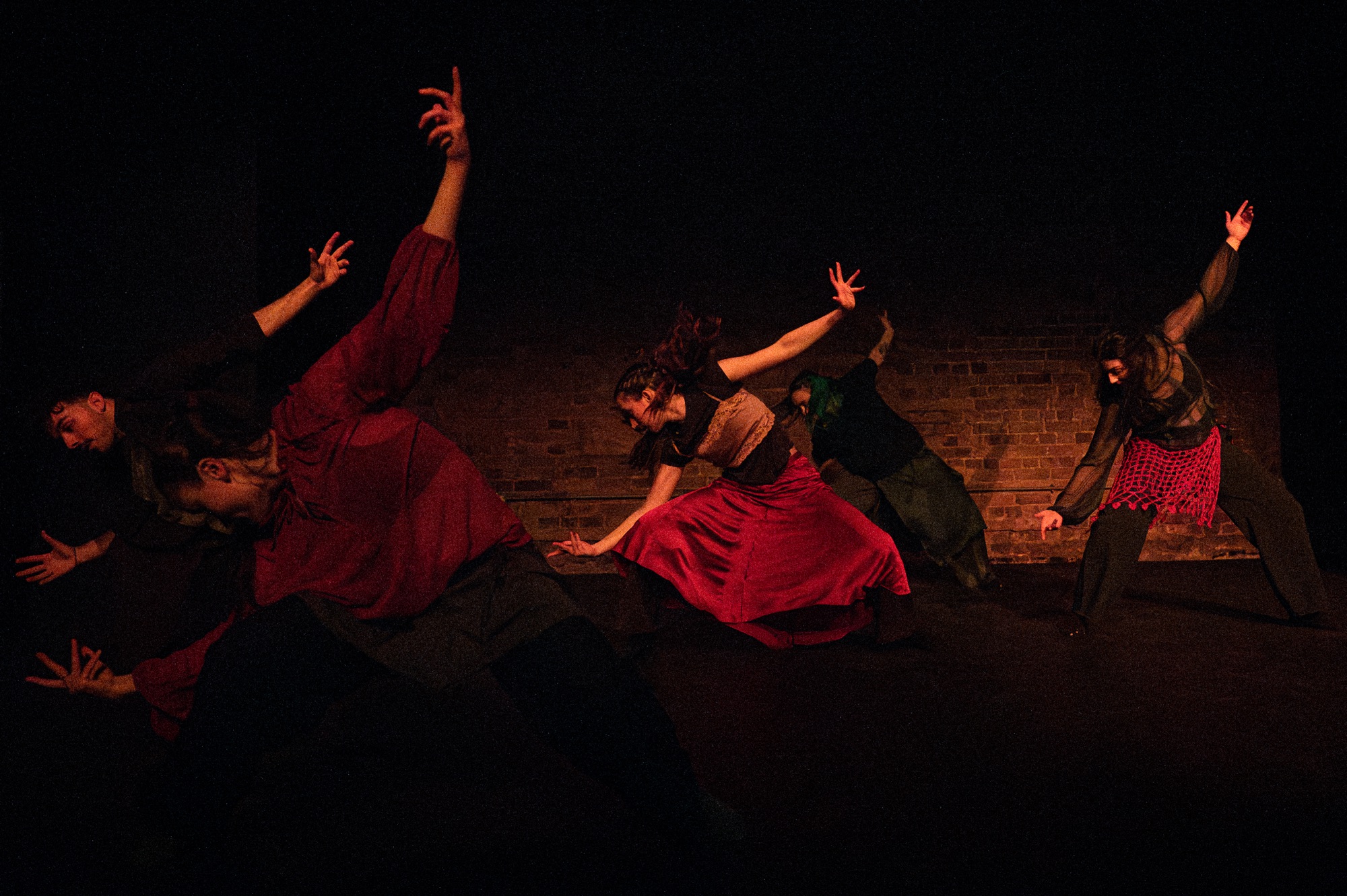
Embodied begins with a soloist under a spotlight, circling slowly, hands tracing her body. Four other performers join in, their bodies pulsing, swooning and crumbling over each other – rippling movements accentuated by baggy, layered styling. The ensemble moves like a school of fish, rippling in and out of the floor like salmon auto-propelling upstream. Understated sound design makes the dancers’ intensifying breathing an audible and intentional part of the ambience. A dramatic shift into more urgent, grounded floorwork – rapid descents and tightly controlled turns – is well-executed by the performers. Later, performers cup their hands and air slips through their fingers. We leave with the sense of a significant change, though the work’s emotional register stays somewhat abstract.
Nadine Elise Muncey’s Sweet Time
Whipping through a medley of pop group choreography, dreamy, distant-sounding chart-toppers, and the kind of dancing we do alone in our bedrooms, Sweet Time doesn’t take itself too seriously. One by one, dancers in tracksuits go through the motions of a backstage prep routine. As the beat picks up, they are swept up into a fast, whirling phrase – but one gets the sense it’s the enjoyable kind of being carried away. The four performers (or shall I say, the girl group) launch into a punchy unison, hips swishing, then unravel into languid, mermaid-like stretches. Muncey remixes main character energy, balletic lines and club-floor abandon – ingredients that could read as a larger idea: all kinds of dancing make for a sweet time.
Finleigh Zack Dance’s everyone alive wants answers
In everyone alive wants answers, two dancers come together and apart like slow-orbiting comets. They begin spaced apart; one turns away as the other approaches. There’s an avoidant tension that evolves – the duo circle each other, bump into backs and twist around the other’s touch. Hands clasp hands and bodies share weight in literal acts of having one another’s back. Toward the end, the performers button their shirts together – an image of commitment – which feels earned after persistent untethering from each other’s attempts to connect. Dancing in and out of their union of shirts, the two end in an embrace. It’s a satisfying close for the star-crossed pair. Zack keeps the focus tight on two bodies and their tender, straightforward negotiation of closeness – a contemporary nod to the classic pas de deux.
Header image by Eloise Frey.