Words by Katie Hagan.
This week, artist duo Rohan Ayinde and Tayo Rapoport will present the audio-visual work emi: freedomsong*.
Made in collaboration with curator Zarina Rossheart and in dialogue with bell hooks’ ‘All About Love’ and Camille Sapara Barton’s ‘Tending Grief’, emi: freedomsong invites audiences to find the courage and language to transform their individual and collective grief into a culture of love and radical change. We sat down with the artist duo to discover more.
Q: Tell us about your new work emi: freedomsong?
A: We were invited by the Barbican to imagine emi: freedomsong (2025) as a live performance. Initially realised as a 20 minute, 2-screen artwork, the version for the Barbican is a 75 minute audio-visual performance featuring six vocalists, Oud, percussion, dance and poetry. We always wanted to transform the work into something that could be experienced live, so when we received the invitation from Tobi Kyeremateng it felt serendipitous. For us, the work is about creating an energetic force that refuses to accept the authority of anyone who seeks to silence criticism of Israel and its genocidal campaign against Palestinians. For us the work is about adding a voice to the chorus of resistance that spans the last 75 years and more, and which seeks to make connections between the many powerful voices who have stood up for justice and humanity despite the risks associated with their position.
emi: freedomsong is the second in a suite of five films that we are making that reflect on, and make audio-visuals landscapes out of, our engagement with the black radical imagination. In freedomsong we were thinking about Palestine and the importance of using our voices as a form or resistance to the logics of racism and imperialism that continue to define so much of the world we live in today.
Q: How can grief be alchemised as a form of protest or resistance politically and socially? What can it also teach us about loving one another?
A: We were interested in the relationship between personal and collective grief, and specifically in how debilitating it can feel when it feels like there is nowhere to put your grief. For us the question of transformation into protest or resistance is about learning how to let grief move through your body in a way that allows you to become unstuck and, thus, enabled. Acknowledging where the grief lives and what it makes us feel is the beginning of being able to turn it into something active. In the process of making the film, we had Camille Sapara Barton lead two days of workshops for our vocalists to be able to process their grief collectively while also thinking about love and how to move through both emotional states. What we learned in that process was that sharing and understanding and listening to the various ways in which people are experiencing grief can create a sense of love and possibility and openness that is the seed for radical forms of relationality.
Q: What made you tell this story through audio/visual/movement?
A: This work is about how we can speak to one another. It’s about refusing to be silenced, and it’s about the necessity and importance of art in an economy of radical change. As a duo who have been working together for a number of years, the work that fuses together both of our interests feels like it needs to include all these elements. We come from film, poetry and movement backgrounds and are deeply embedded in a community of sound-makers. Our collaborators are our friends, and our friends are the people who help to shape and inform our practice. What you experience is the product of countless conversations that take place in a range of mediums – from dance circles to group hums to family dinners.
Q: Could you explain the Yoruba concept of ‘?mí’ and its role in this work? And also the role of the current crisis in Palestine?
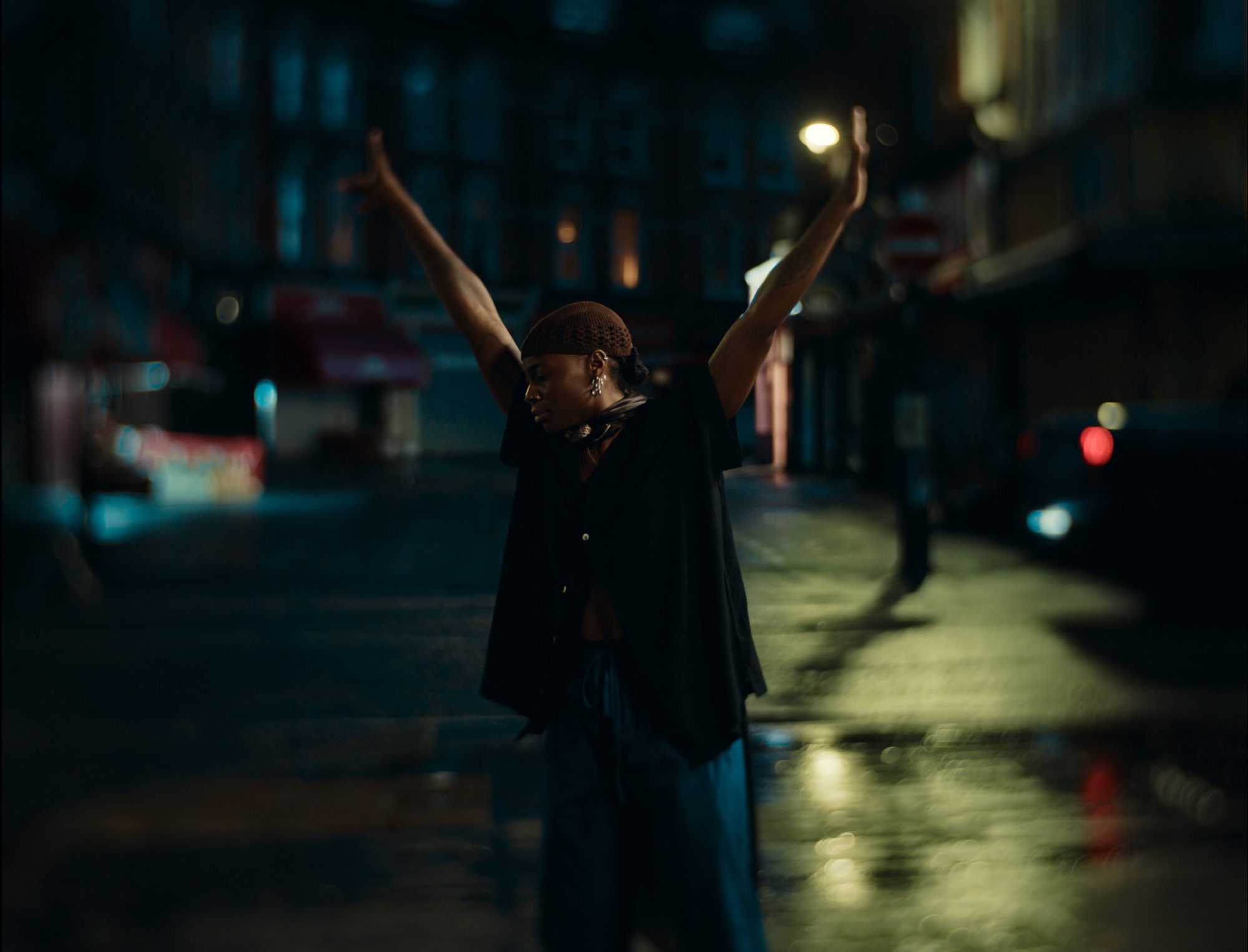
A: This is the third film we’ve made together. All of them have Yoruba titles. We decided to do this because of the connection between our names. My name Ayinde is Yoruba, Tayo is also a Yoruba name, and our friend Yewande YoYo Odunubi, who has been a key collaborator and muse across all our films, is also Yoruba. As such, we have been interested in calling in the linguistic and diasporic serendipity that brings all three of us into one another’s orbit. Each of the titles have added meaning and depth to the story of the work, allowing us to draw on Yoruba cosmology and steep our work in a kind of ancestral uncovering. ‘Emi’ is a Yoruba concept for the breath that animates life. This work is so much about the connecting spirit of truth and resistance and how powerful it is to recognise and build on the voices/breath/power of people with whom you share a commitment to justice, truth and love. For us, the hum at the centre of the work was akin to ‘emi’ – this force that moves through bodies to give them life. The hum that the six vocalists root all the songs through is a call to action, a call toward justice and a call to stand with the people of Palestine whose voices have been ignored consistently. This breath is the breath of life, and it connects us across ancestral heritages, giving us access to something deep and sustaining.
Q: What do you hope audiences will feel/experience by watching this work?
A: We want people to feel energised. We want them to feel able to speak out. We want them to feel connected to each other and to the possibility that speaking can and does mean something. That their voices can and do mean something when they’re raised in chorus with others. But we also don’t want to prescribe a feeling. This work is about refusing to be silenced and so we’re also interested in what it means to be given permission and what that permission does as it moves through people’s bodies.
Book here. Runs from 19-21 June. Image features Yewande YoYo Odunubi.
*Please note that the proper use of special characters in the word ‘emi’ haven’t been used in this article as our website currently doesn’t support the use of special characters.