Words by Qiao Lin Tan.
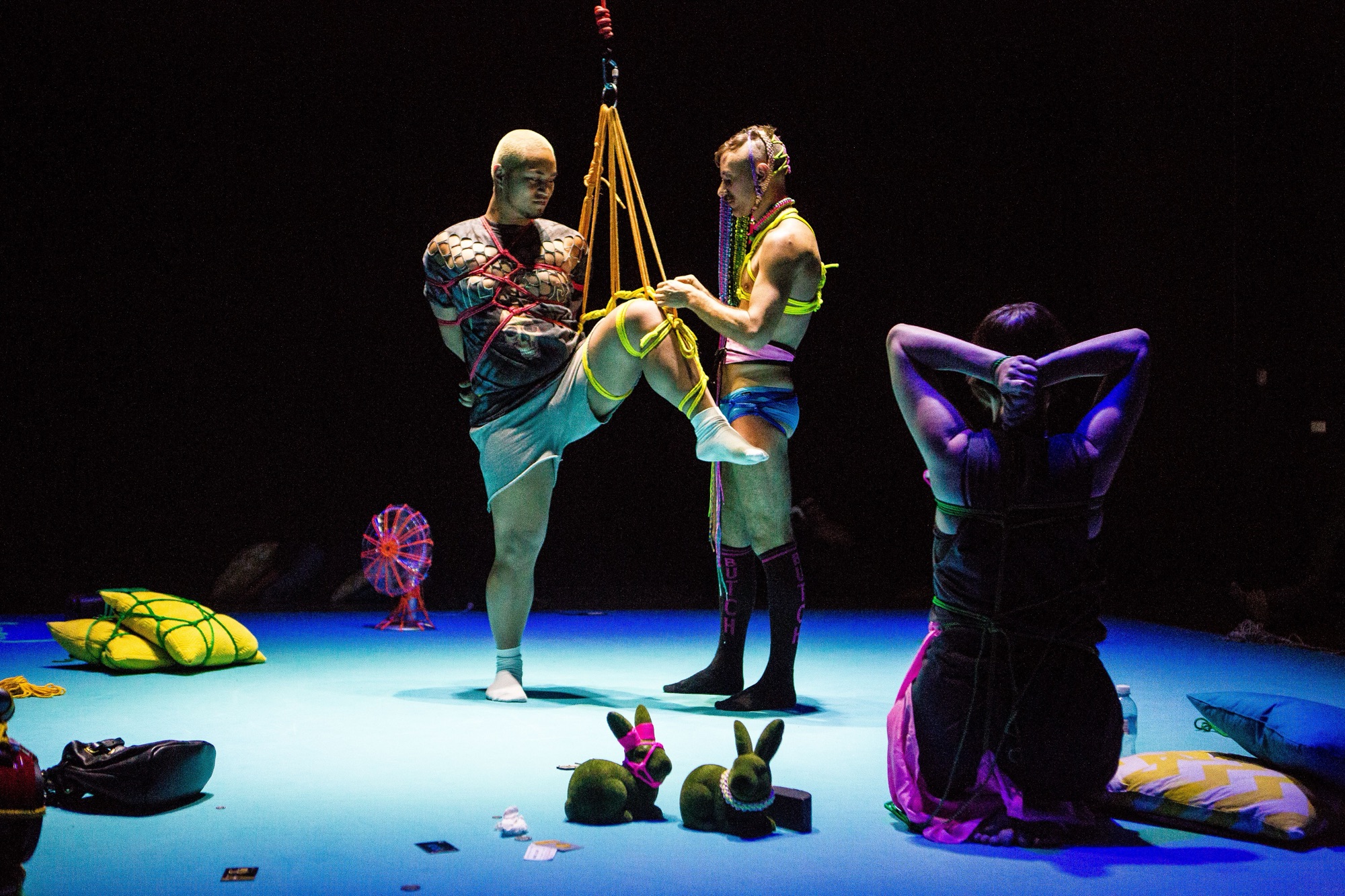
A tie is already happening when you enter the space at Battersea Arts Centre. Performer Luke George is working on a rope around fellow performer Daniel Kok’s wrists connected to a rig tied to the ceiling. As we file into the room George works on the rope around Kok’s body, tying and pulling until one good lift of the pelvis and that’s all it takes. Kok is then floating, rotating slowly in the air as he hangs suspended from the ceiling.
The practice of bondage, shibari and rope tying are central to the work Bunny, the title of which refers to a term in bondage practice for the person being tied up. From the off, colourful rope – revealed later in the performance to be a fun glow-in-the-dark – encases inanimate objects dotted around the space like a vacuum cleaner, a fire extinguisher, a table, a music player, and (hilariously) a Miffy bunny doll. In popular culture, bondage is usually portrayed darkly and seriously, but in Bunny, what might seem at first glance to be a grueling two hour performance to sit through is actually held together by a delicate balance of tension/relaxation and reverence/tongue-in-cheek humour that makes the time fly by. The bright neon colours and the criss-cross of the ropes remind me of a climbing jungle gym, a playground for adults. Funky, romantic 70s music kicks into gear as we all stare at Kok spinning lazily in the air, prompting some laughs. There is a moment later on where Kok, having caressed and ran his fingers over a tied-up fire extinguisher as if it were another body, releases a large puff of fire extinguisher smoke in a way that makes it look and sound as if he’d let out a huge fart whilst straddling it (HILARIOUS).
The aesthetics of bondage practice aren’t the only things turned on its head. Whilst the work starts out clearly with George as the rigger, Kok as the bunny and the audience as third-party observers, these roles start to shift and transform as we make our way through the work. It starts with small audience involvements, like George asking an audience member to tie his hands up or inviting someone to enter the space and keep a suspended Kok spinning. By the end, at least four audience members have been tied up (one of them is also rigged up and suspended from the ceiling), two people have used a whip on Kok’s bottom, someone else has been leading another person around the room by a rope, and four audience members work together to lower Kok from the top of the rig four metres high after he’s climbed his way up. The audience members being asked to participate inadvertently become performers in the piece as well. Some of them become riggers who find themselves with the task of navigating someone else’s body and the care that is required to do that. Others become bunnies where they surrender control and put their trust into someone else. Certainly not the expectation when it comes to a casual night out at the theatre.
What about the rest of us who remain audience members? I found myself transformed. As Kok spins lazily whilst floating in a tie, all eyes are on him and we are spellbound. On the surface, he’s tied up and passive, but my attention is absolutely hooked on him, both subject and object of our attention. With every tie the performers place themselves or others in, the more immobility there is onstage, the more I’m tied into the piece as well. I’m no longer just a third-party observer. The potential for participation in the work means I am always on the cusp of being a performer. The room is dimmed but not dark, and whilst I can see everyone – performers and audience members alike, that also means everyone can also see and perceive me. Whilst I’m not physically bound by rope, I cannot help but notice how I am bound to my seat by other forces – my obligation as a reviewer for danceartjournal and the unspoken social contract we’ve all signed as audience members within a Western society where our agreed role is to be there and spectate. It’s neither negative nor positive, just an observation of how we are all bound to each other and how Bunny as a work heightens and brings attention to it.
I think the draw of this piece is the push-pull navigation of a constantly shifting and unstable relationship between performer/control/activity and audience/yield/passivity. The traditional performer-audience relationship is completely brought into question, until the lines are blurred and we are all to a certain extent performer/rigger and audience/bunny. Seeing and being seen, participating and spectating, making things happen and letting things happen. What does it mean to be a performer and what does it mean to be an audience member? Are they mutually exclusive roles, or are you always both, or are you sometimes one or the other? What does it mean to be the rigger? What does it mean to be bunny? The piece is constantly questioning and negotiating, and everyone holds a multiplicity of roles that are constantly shifting.
Beyond the question of the performer-audience relationship, I suppose it’s also a piece about life as well. What we mean and who we are to others. How do we navigate and negotiate other people and other bodies? How do we act when we give up control, and how do we act towards others when we have control? What do we owe to each other, and how do we treat each other?
At the end, it’s almost like coming out of a stupor. The audience member who was rigged up and suspended from the ceiling is slowly untied (the tying and the untying, the doing and the undoing…). The undoing of the knots, as if releasing us from the performance, from this moment in space and time, and from each other.
Image by Chris Frape.