Words by Paula Catalina Riofrio.
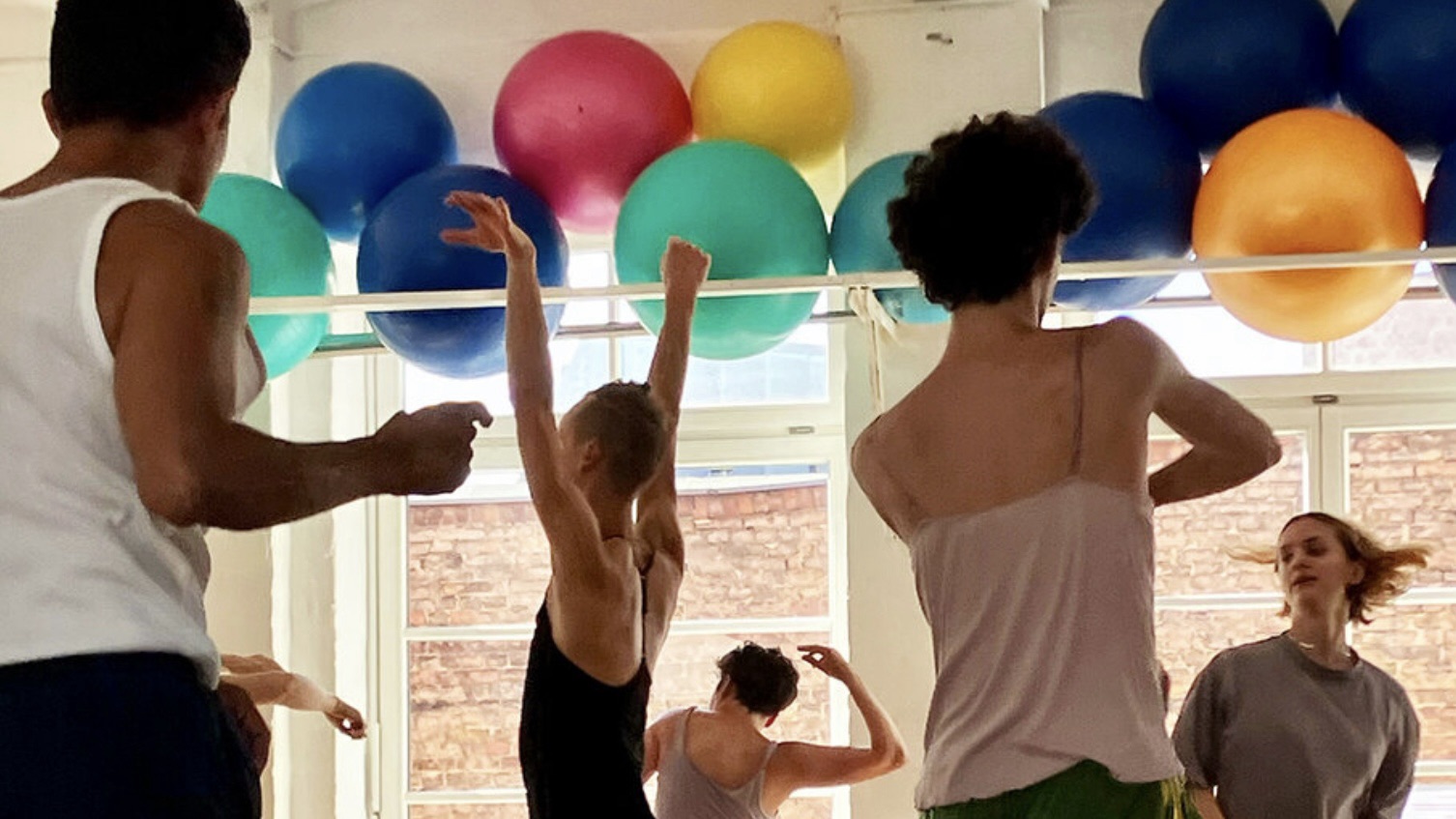
The doors to the studio had unusual shapes. Wood floors, two pillars holding the space, small white rocks surrounding them. I had stumbled into Tanzfabrik Berlin during their OsterTanz workshops without quite knowing where I was standing.
This building in Kreuzberg, Germany opened in 1978, when a collective of dancers, choreographers, musicians, visual artists and biology students took over what was once a lamp factory and began asking what dance could be when experimentation becomes the methodology for technique.
Nearly five decades later, that question is still important, informing the company’s programming in particular.
Summer/ing — a five-week series of workshops interwoven with daily classes and conversations built around the idea of the vibrant body — takes place at Tanzfabrik from 27th July until 30th August. It is open to everyone: first-time movers and working professionals. The weekly programme spans professional training, morning and evening classes, performance projects and somatic research taught by artists still active in their own practices.
To understand more about the magic happening between these walls, I spoke with Gisela Müller, who has led Tanzfabrik Berlin as Artistic Pedagogical Director since 2004, and with Christa Flaig — the former curator of the workshop programme and the person behind finances.
Flaig describes Tanzfabrik Berlin not as a school or a venue, but as a place where sharing, teaching and performing come together into the same practice. It has always been home to “lots of people and opinions, styles and tastes, all united under one roof.”
“Experimenting means getting into something you don’t yet know,” said Dieter Heitkamp, one of Tanzfabrik’s founding choreographers. That spirit still hums through the building beating at the heart of Kreuzberg. Müller resists easy labels when describing Tanzfabrik. “I don’t want to use the word holistic,” she says, laughing. What she means is something integrative: a space of access — to movement, to community, to different ways of knowing the body. For Müller, a complete dancer is defined not by style but by anatomical awareness, curiosity and lived research. “It’s more than dance,” she says. “It’s also a community.”
That community is deliberately intergenerational. “Dance venues often make older people feel like they cannot go there,” Müller notes. “It makes me very happy when generations can meet here.” Beginners share space with professionals, locals with short-term visitors, twenty-year-olds with dancers in their sixties. The mix is not incidental. It is structural.
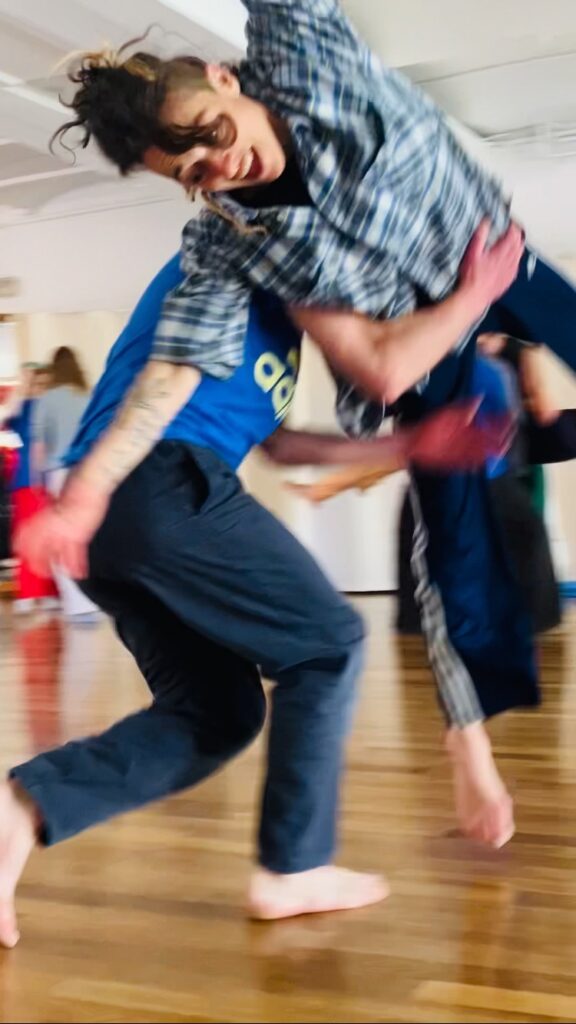
This openness traces back to Tanzfabrik’s foundations. The collective that gathered in 1978 introduced Contact Improvisation to Germany while living and working together in the factory — performing, teaching, building something that had no clear precedent.
Where It Came From
The founders carried the legacy of Mary Wigman’s break from ballet’s hierarchies alongside Contact Improvisation practices arriving from the U.S. What they created was an open house — one of the first places in Germany where someone could begin dancing as an adult without being turned away. “Even in the 90s,” Flaig recalls, “we still got phone calls from people asking: can I come? I’m already 27.” Dance here is not only for the young or the already-trained. It is for anyone who is passionate about movement.
The path that followed was not smooth. After the fall of the Berlin Wall in 1989, funding cuts forced constant reinvention. West Berlin lost its status as a heavily subsidised cultural island. The institution shifted from a producing company to a platform — more open, more flexible, less fixed in form. “To keep going for 50 years without proper funding,” Flaig says, “there must be a very strong spirit.” She calls it a discussion spirit: not a fighting spirit, but an institution of artists who disagreed productively, who turned friction into momentum rather than fracture.
Where the World Comes Together
There is a moment Christa Flaig will never forget. Two dancers — Elsa Wolliaston, rooted in African movement traditions, and Susanne Linke, a student of Mary Wigman now in her nineties — were sitting together at one of Tanzfabrik’s forums where artists speak openly about their practice and their lives. The conversation turned to how the body relates to the earth. Linke jumped up from her chair — she had to jump up, she said — demonstrating the upward pull of the Western body, vertically upwards, the dancer’s eternal reach toward heaven. Wolliaston remained seated, perfectly still, and asked simply: “Sure, but can you carry something on your head?”
This, Flaig explains, is not a difference in technique. It is a difference in philosophy. In the West, the energy is directed upward — toward heaven, away from earth. In other traditions, it moves downward, toward the ancestors, toward the ground that holds. “If you direct your energy into the earth,” she says, “you get something out of it. An impulse that lifts you up — but you get lifted. It’s not a jump.” It was this conviction that drove her, across decades of curating, to look beyond Europe and the U.S. “I always want to have an open focus on what stands in the world,” she says.
When she later participated in a performance that asked the audience to move through both impulses — downward into the earth, upward away from it — she felt, perhaps for the first time, exactly who she was. “I am the Western one. This is my normal way of walking through life. I knew all these words and all this thinking. But in one moment, walking through that studio with twenty or thirty other people — I felt: that is what I am.” Knowing it intellectually was one thing. Inhabiting it in a room full of moving bodies was another, entirely.
Summer/ing
The Summer/ing programme brings together Berlin-based teachers who are usually too busy touring or performing to commit to regular weekly sessions, alongside artists arriving from across Europe and beyond.
The curation is wide by design. Alessio Castellacci and Lee Méir explore rhythmic identities and coexistence in a workshop called Carriers of Chaos and Harmony. Maya M. Carroll investigates the dancing body’s relationship to time, musicality and listening through improvisation and set composition; she is bringing her partner to collaborate with live music. Yotam Peled offers Surrendering into Movement, a practice of release and attention. Previous summers have gathered teachers combining contemporary dance with butoh, martial arts with contact, flamenco with contemporary technique. This year, the kick off week starts with the topic of “vibrant body” exploring diverse methods, with all invited teachers approaching it from their own angle.
A community forms, briefly and intensely, around a shared experience. Before and after the workshops there are moments of exchange woven between all participants. For a few weeks each year, Tanzfabrik becomes a point of arrival — a place where people passing through Berlin find each other, take classes together, and carry something back with them. It is at once a professional training ground, a community space, and something harder to name: a place where dance’s utopian impulse becomes real, palpable, practicable.
The question Tanzfabrik was founded on is still alive here. Summer/ing is, in many ways, the whole argument made into a programme. Come feel it.
Summer/ing at Tanzfabrik Berlin: 27 July – 30 August 2026. Möckernstraße 68, Kreuzberg. Book here: https://www.tanzfabrik-berlin.de/en/summer-ing-2026