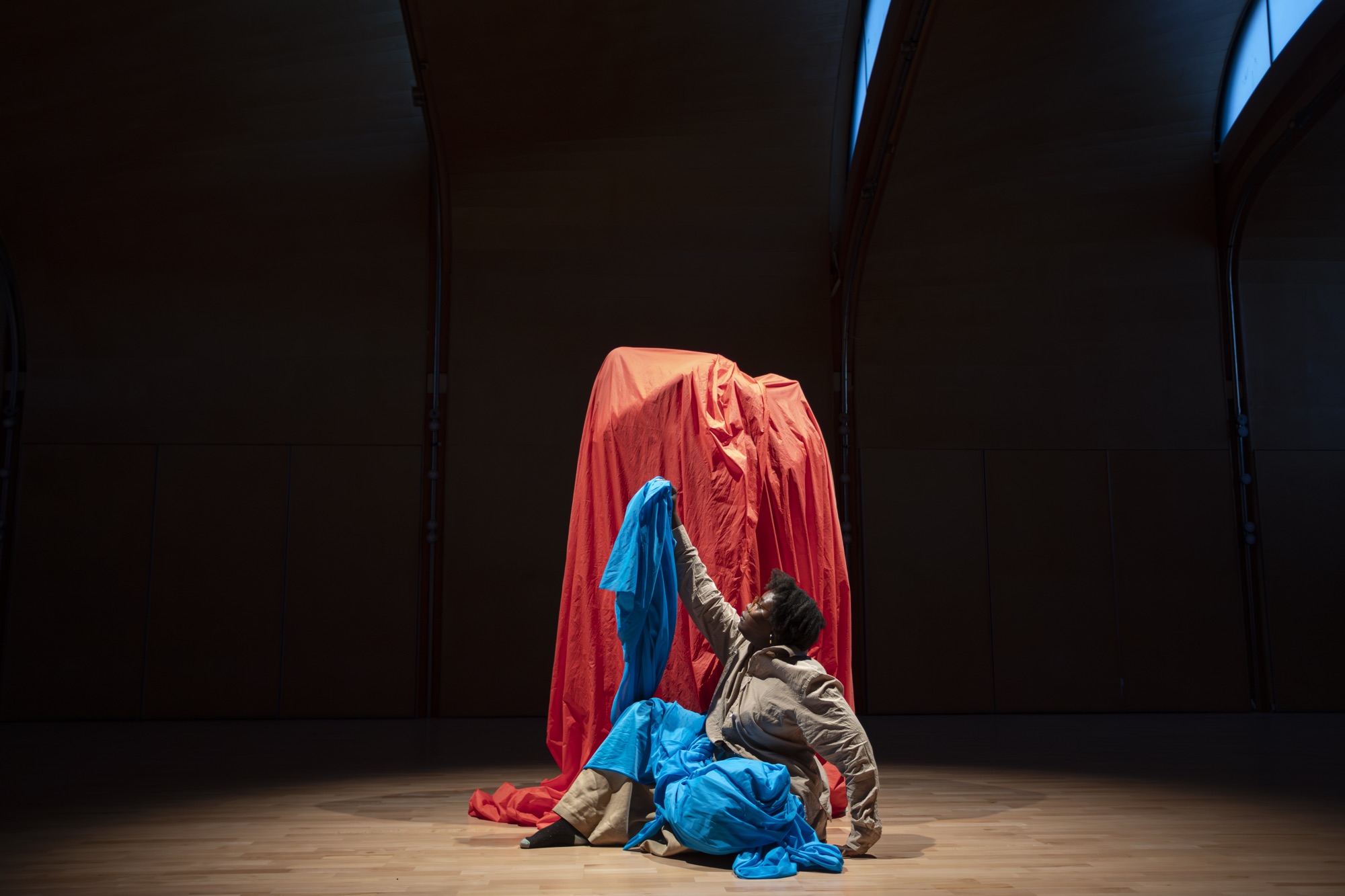
Words by Rachel Elderkin.
NEXT Choreography by Siobhan Davies Studios is a six month programme for anyone aged 18-25 with an interest in exploring and experimenting with dance and choreography, regardless of whether or not they have formal dance training.
This opens the programme to participants from a range of creative fields and backgrounds, inviting a broad perspective on what a choreographic practice might look like. The programme culminates in a festival self-directed by the participants. Bringing together an eclectic array of works and performances, this year’s event felt a fitting embodiment of the diverse and open nature of NEXT.
The sheer breadth of ideas explored is one of the most striking impressions this festival has left with me, alongside the sense of warmth, positivity and support that felt present among the programme participants. In itself, that feels a promising approach to choreographic practice.
Spread across the multiple floors and spaces of the Siobhan Davies Studios building, there seemed an endless selection of works to watch and encounter. Performances popped up under the stairs, outside in the fading light of the courtyard, tucked away in the library for a few audience members at a time, even in the changing room showers. No space was off limits, which only added to the inventiveness of this cohort’s choreographic explorations and to the intrigue of what you might discover next.
In the reception area, Majo Arango offered a solo performance, Bolero. Folding and unfurling her body fluidly upon the floor, Arango adeptly incorporated the architecture of the space around her in a way that allowed the work to be viewed from close by or looking down from the mezzanine above. While focused and introspective, Arango’s performance still felt warm and inviting towards the audience gathered close around her, her dance energised by the varied Bolero tracks to which she performed. As her performance drew to a close, Arango pulled towards herself two large plaster hands and with this the piece seemed to shift from its solo space into one of invitation; a yearning, perhaps, for connection.
In the same space the audience were drawn into an entirely different encounter with Tristen Zijuin’s Time for a change. Bold, fun and in your face (sometimes literally) Zijuin took to the floor dressed in a shirt, oversized tie and nappy – an unsettling hybrid of businessman and baby. Offering a playful satire of today’s political figures, Zijuin chatted directly to his audience, his performance larger than life, silly and provocative as he ridiculed the ‘big babies’ that hold power. The lighthearted and unabashed expression of Time for a change belies its serious undertone.
As you wander around the building there is always something to encounter. Every work is completely different to the next, presenting its own questions, provocations and approach to performance and choreography.
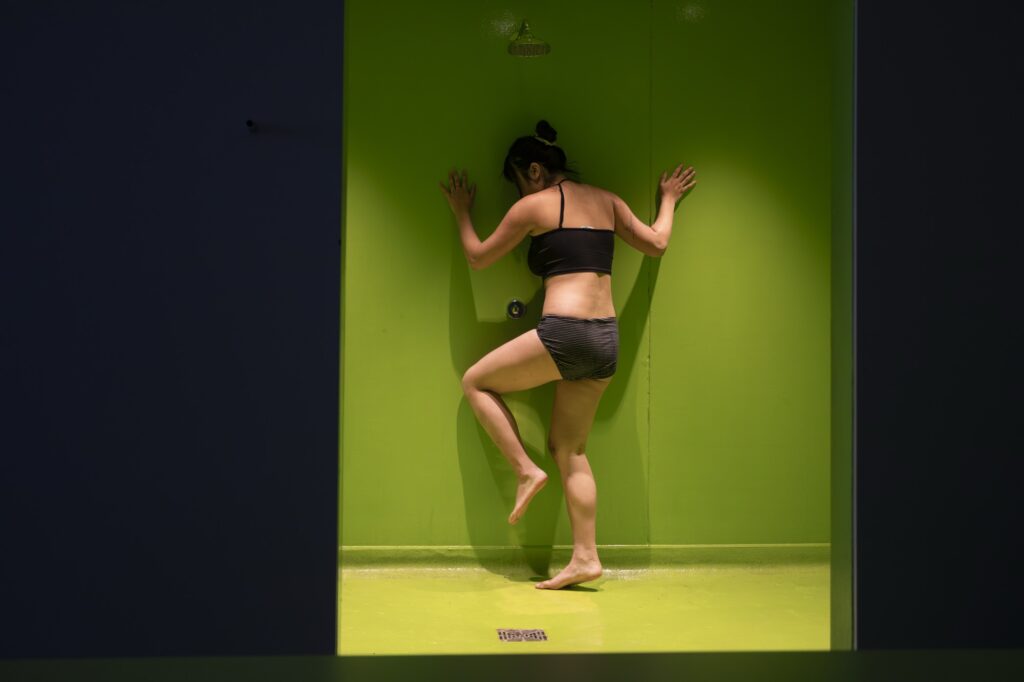
Up on the first floor, in the Green Changing Room, Bri Wong presents Is THREE An Even Number? Novel and engaging, Wong’s performance is built around the act of taking a shower. I catch Chapter 2, performed by Wong with a dry, comic timing that lends its own charm to this work. Framed by the entrance way of the shower room, Wong’s performance unfolds in vignettes of action that appear and disappear, playing between the knowledge of being watched and being seemingly unaware.At times the movement is frenetic, a hint of distress surfacing; then the distress is dropped as abruptly as it arrived. Is THREE An Even Number? presents a unique and engagingly practical encounter among the evening’s events, held by Wong’s matter-of-fact performance.
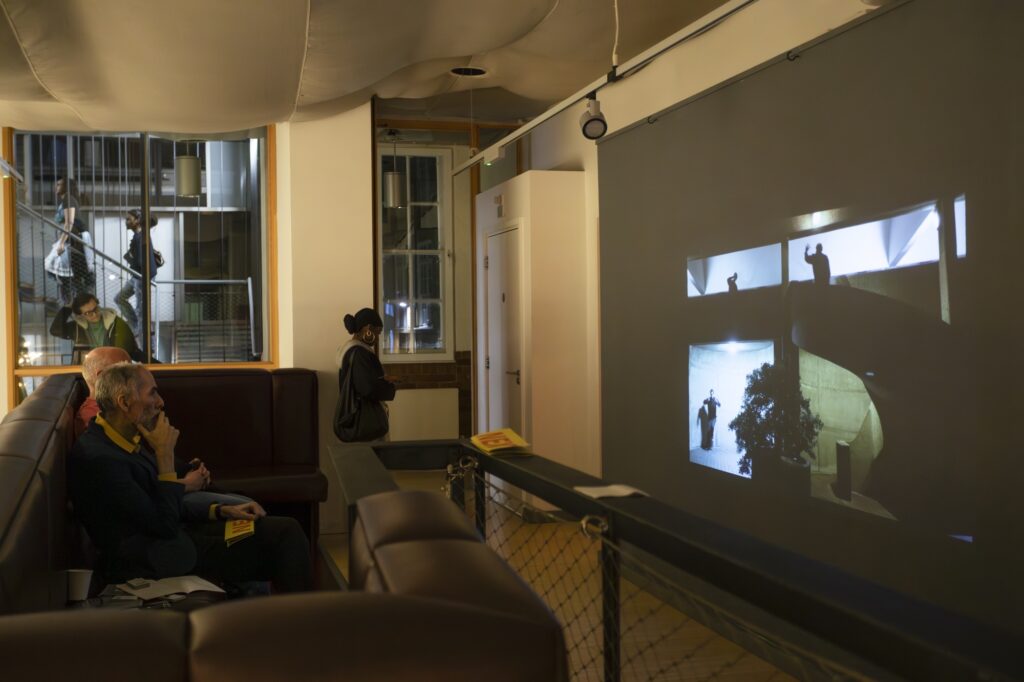
Offering a space of respite within the live performance programme, the lounge area on the mezzanine shows a selection of films on loop that invite a moment of breath; a chance to sit and pause. Alkmini Mavrantoni and Rebecca de las Casas’s film flits between two main scenes; a flickering, fragmented image of a dancer upon a chair surreally situated on a country lane, and a striking visual of silhouetted figures atop a hill, their outlines dark against the sky. It’s a quietly captivating film, the subtle changes of each loop lulling you to stay and watch.
One of a number of works presented in the research studio, Wild Swimming by Esther Carr is a detailed and layered piece mixing writing, dance and film. It begins with a film projected on the studio wall; a rapidly changing visual that shares the multiple pieces of text and writing that initiated the project (and which you could spend more time reading in a pocket-sized zine) before switching to a film of dancer Tiggy Jones, shot in the roof studio. The choreography that Jones performs is filled with details that evoke images of water and swimming, from its wave-like fluidity to the small playful gestures reminiscent of paddling and splashing. Later Carr performs live, dancing alongside Jones projected behind her. Her movement becomes an echo of, and conversation with, the choreography we have already witnessed. Wild Swimming is a playful, charming exploration, and its multiple elements bring a thoughtful and personal touch to this piece.
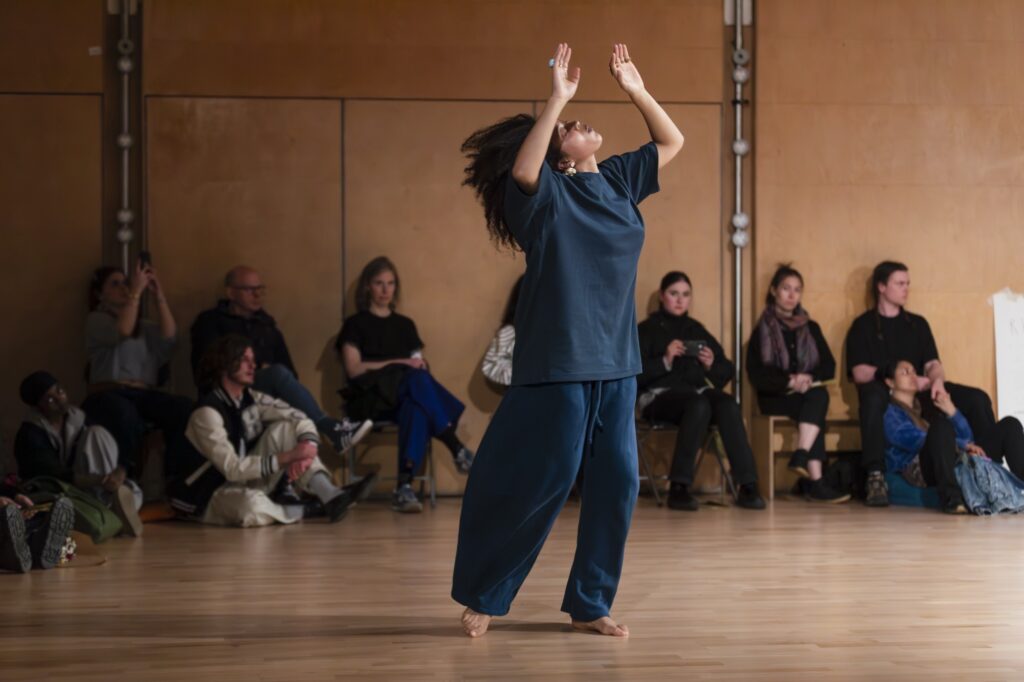
At the top of the building the uplifting space of the rooftop studio provides an open, relaxed environment for the works shared there. This includes the finale for each evening of the festival, (a)Live, choreographed by Zinzile, which brings together the entire cohort of NEXT 2026. In (a)Live, Zinzile combines live music and dance to create a semi improvised performance that allows each performer the space to show their individuality while remaining part of a collective – and connected – ensemble. It feels an apt and celebratory end to the festival programme.
The warmth and enthusiasm with which the works across the festival are presented and shared speaks strongly to the connection between these participants, and to the freedom of choreographic expression which the NEXT programme cultivates. While each participant explores entirely different creative approaches to dance and choreography, there is clearly a shared interest in questioning what dance and choreography can be, how and where it might exist, and the forms it can take. More importantly, it is done with a spirit of openness and generosity towards this ever-fluid art form.
All images by Jemima Wong. Header image of Joy Miracle’s work.