Words by Josephine Leask.
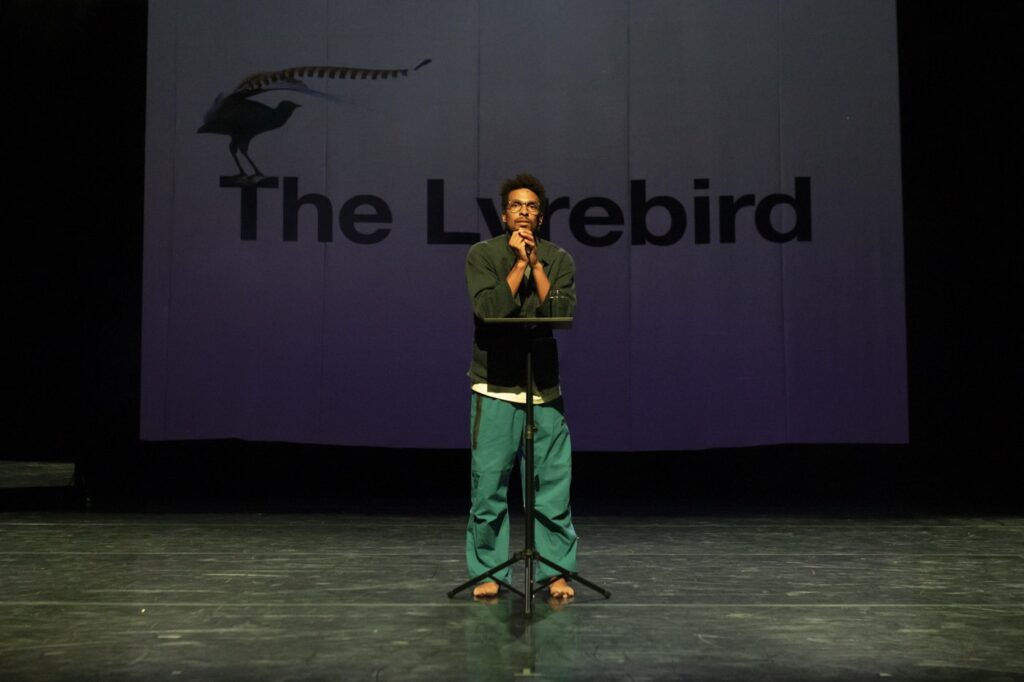
Liam Francis, looking scholarly in glasses behind a lectern, delivers an informative account of the Australian ground-dwelling Lyrebird’s extraordinary vocal habits, particularly its ability to mimic a variety of natural and artificial sounds from its environment. In creating Lyre/Liar, Francis identified with this unusual bird and its almost human ability to mimic others, feeling that, after eight years dancing repertoire with Rambert, his own magic power was to imitate the performances of other dancers and choreographers perfectly.
The result is a hybrid of lecture and dance performance in which Francis discloses his desire to dance solos performed by great dancers such as Gus Solomons in Merce Cunningham’s Rainforest and James O’Hara in Sidi Larbi Cherkaoui’s Faun. He moves effortlessly between rich, textured movement sections to witty, informative texts, questioning how, in his obsession with mimicking the work of others, he might be seen as both a fraud and liar.
Following his astonishing performance of Lyre/Liar at The Place in May, I spoke to Liam about his fascination with the Lyrebird and how it resonated with his own interest in performing the work of other dancers and choreographers.
JL: How did you come to fixate on the Lyrebird as the central theme of your solo, and can you tell me about the process of building a show inspired by it and shaping the narrative structure?
LF: I found the Lyrebird a few years ago when I was making a different work about birds of Paradise, and its extraordinariness has stuck with me ever since. When I started making the solo last year, I had 30 minutes of material in which I performed sections from Rainforest and Faun, followed by talking at length about the context of each, but I struggled to find ways of opening up the solo. My mentor Ben Duke asked me what I would have wanted to be if I wasn’t a dancer, and I replied, “A zoologist.” He then said, “Write a lecture about a creature you know lots about,” and I talked about the Lyrebird. Through the safe mask of the Lyrebird, I question authenticity, honesty and my own vulnerability in endeavouring to perform the roles of inspirational dancers.
As I love discussing dance with other people, performing short dance sections followed by narrative lectures seemed very natural. I feel very charged after dancing and when I get up to talk in the show I feel fully embodied, so there’s no reason for physical hesitation. This is my first narrative-based work since forming my company a year ago, following two recent works which were abstract and totally movement-based.
JL: As with dancing and talking, does humour come naturally to you?
LF: I’ve been working with Ben for about a decade. Learning from him, I’ve been able to develop humour in the work and understand the essential role it plays, as well as the skill and timing required both in speech and movement. The other collaborators on the project, Hannes Langolf, Maya Carroll and Jethro Cooke are also very funny people. Making the show within this network of people meant different interpretations of comedy naturally seeped. Working with this team gave me permission to find what was funny in my obsession with wanting to dance like certain performers. For example, frustrated at not being able to dance Faun as well as James O’Hara and in my shame, I embody a ridiculously comical character based on Mr Tumnus (from Narnia), and stagger stupidly around the stage on imaginary hooves, shouting.
JL: In one of your lectures, you describe dancers’ bodies as living archives of choreographers’ work. Can you say more about the dancers you emulate, and what it feels like to perform a version of them?
LF: My training in hip hop, ballet and contemporary dance, and my search for a language that synthesises all three, has been influenced by Kate Prince and Teneisha Bonner (ZooNation), Merce Cunningham and Sidi Larbi Cherkaoui. Teneisha has had the greatest influence and sits close to the heart of the show, although I don’t mention her directly in the work. I asked Kate Prince, the Cunningham archive ‘Dance Capsules’, and Sidi Larbi for permission to perform extracts from specific works. Watching versions of Rainforest performed by Cunningham dancers between the 1970s and the 1990s, I became fascinated with Gus Solomons’ performance, and with the many other dancers who danced that work, because they seemed to become living archives or capsules for Cunningham’s choreography.
In the show I talk about what it feels like to become consumed by the dancers I want to emulate, in reference to O’Hara’s rendition of Faun, and about the incredible emotional attachment I felt to the movement as well as the terror at not living up to the choreographer’s expectations. I talk about wanting to become the perfect copy of these dancers in the show, about the sensual experience of being in O’Hara’s body, of inhabiting the body of someone I have adored, and the feeling that I’m going to be everything I ever dreamed of. This section is followed by my frustration at not being a perfect copy. Allowing my ego to take over I erupt in a dramatic, sulky outburst, and it feels as if I’m left in my room screaming my name as I confront myself in the mirror.
JL: What were the main challenges in making the work, and which parts did you most love performing?
LF: Originally I wanted to make this work about code-switching and the difficulties of performing in that way, both on stage and in life. I intended to question why I have always loved copying other dancers, why it has been such a compulsion, and how I’ve wrestled with it over the years. I felt the work and the narrative should be about this. However, my team felt there was greater potential in the work that I wasn’t accessing. They felt the work was taking on an identity of its own, finding its unique personality, and that my strict focus on code-switching was hindering its blossoming and ability to connect to a wider audience.
I therefore had to learn to hold my personal desires close whilst also letting the work breathe and grow of its own accord. Here I learnt the meaning of ‘Hold on Tightly and Let go Lightly’ an adage I had heard Shelley Maxwell use years ago, but only came to understand in this process. This way, my core intentions could permeate this porous work and I was not trying to control how the audience perceive it. The process of making the work, being consumed by the dancers, then moving through their bodies and letting go of them, was hard yet cathartic.
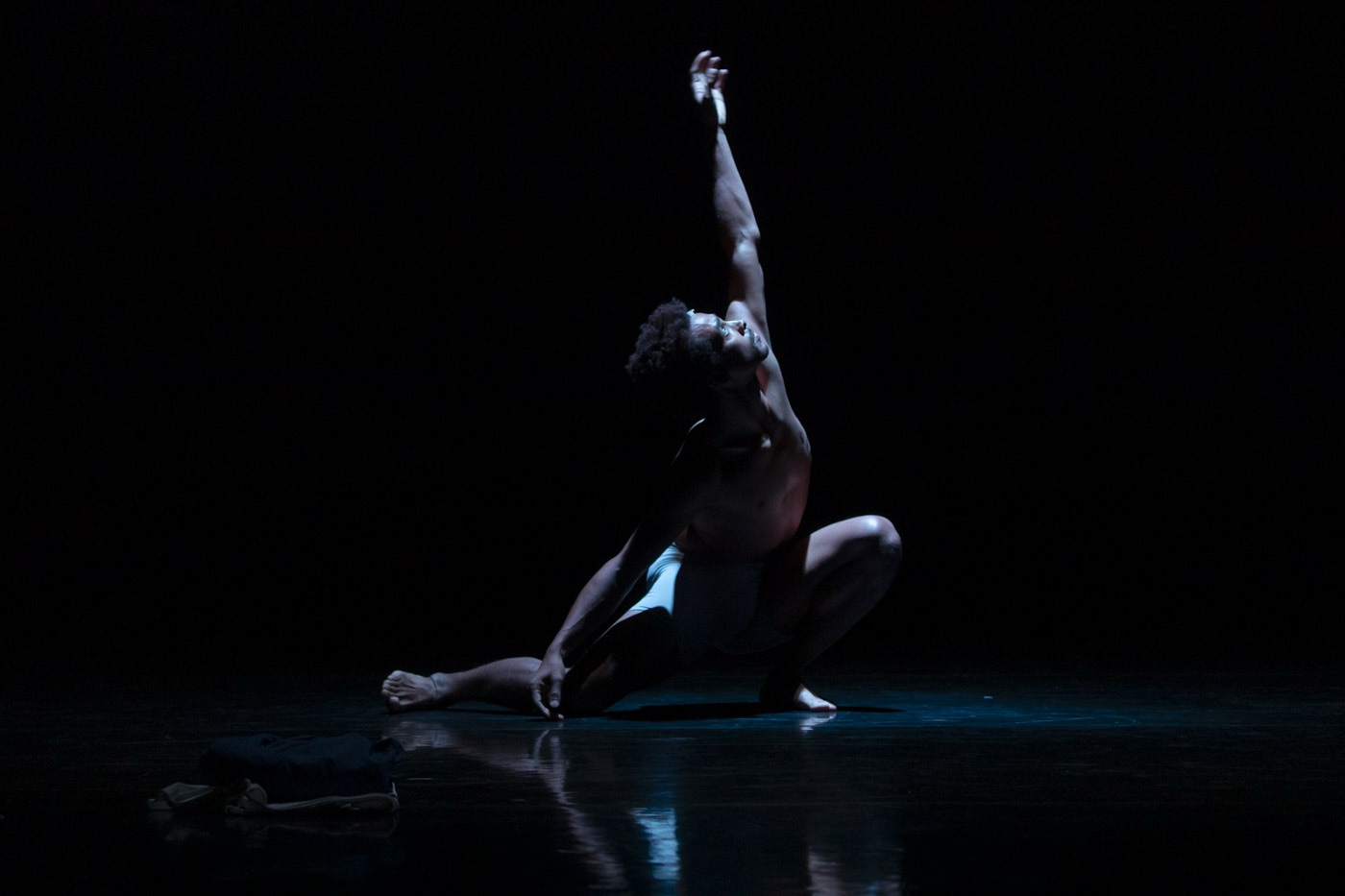
My favourite bit, which I initially found very difficult to perform, was having a rant on stage after performing Faun as O’Hara – metaphorically kicking him off stage and shouting my name at the top of my voice, wearing only my pants. It felt difficult and egotistical to shout my name on stage. But it exposed something ugly about dance: that you want everyone to love you and shout your name. I had to learn how to show and acknowledge this vulnerability so I could move on.
JL: In the opening and ending, as you dance to Massive Attack’s Teardrop, you seem at your most vulnerable, which feels very important to the work. Can you say more about how that felt?
LF: At the beginning I’m facing upstage, back to the audience, on the diagonal, staring at myself in a mirror. Here, looking at myself, I’m at my most vulnerable. This opening solo is Kate Prince’s, from a piece called Teardrop Breakdown, where it was originally performed at the end of Into The Hoods by an ensemble of more than 20 dancers. Doing it feels really exposing, and I get a knot in my stomach thinking of the task ahead and the weight the choreography holds. But it also feels like a wonderful way to honour those dancers I watched perform in 2008, who inspired me to dance. Performing the solo at the beginning of Lyre/Liar, before I imitate other people, felt very grounding.
I struggled with the ending because initially I wanted to make it feel resolved. The Dramaturgical Director, Hannes Langolf, questioned why I needed to convince an audience that the problem was solved, so I perform something that feels messy and ugly, my body draped with all the layers of clothing that I had gradually shed throughout the show. Instead, this feels right as a process of letting go.
JL: What does success look like for you in this work?
LF: Success for me is creating a solo with enough authenticity and honesty that I can continue performing it. The work needs to be porous enough for me to keep engaging with it and discovering new avenues and pathways each time, so it never feels as though I’m trying to act, but rather offering a very honest depiction of how I have felt. It also needs to open enough for an audience to understand, find their own way in and connect with the human spirit that fills dance.
The conversation has been edited for clarity.