Words by Georgia Howlett. Trigger warning: mention of suicide.
Unnatural Harmony: Sounds of Lee Alexander McQueen kicks off Multitudes, the Southbank Centre’s multi-disciplinary arts festival with classical music at its core. The credits list is lengthy and the calibre high. Directed by Elayce Ismail, the ambitious performance is a tribute to the life and creative vision of the trailblazing fashion designer. House of McQueen were in no way involved, though John Gosling, who worked closely with McQueen on the music of all of his shows, co-creative directs alongside Robert Ames of London Contemporary Orchestra.
The repertoire is a wild melange of genres and unfolds like a playlist indecisive of its direction. McQueen’s musical influences scale a spectrum of classical, pop, rock, electronic and film scores. What persists throughout is a pervading sense of foreboding, and a lingering melancholy, always present despite a briefly riotous outburst of Nirvana, the insanely loud bass of Witch Doktor, and the serene albeit eerie Frosti by Björk. It cannot go unmentioned that McQueen was lost to suicide, and the tragedy of this end finds its expression in more ways than one.
Blakey feels like the natural choice for this collaboration, given her extensive work in movement direction for high fashion. With Sari Mizoe and Willow Kerensa Fenner’s initial entrance, I fear dance may be an expendable addition to a busy stage, but the pair ultimately captivate and bring heightened awareness to resonances in the music. They wear matching shirts, grey tracksuit shorts and garish orange ‘half’ skirts.
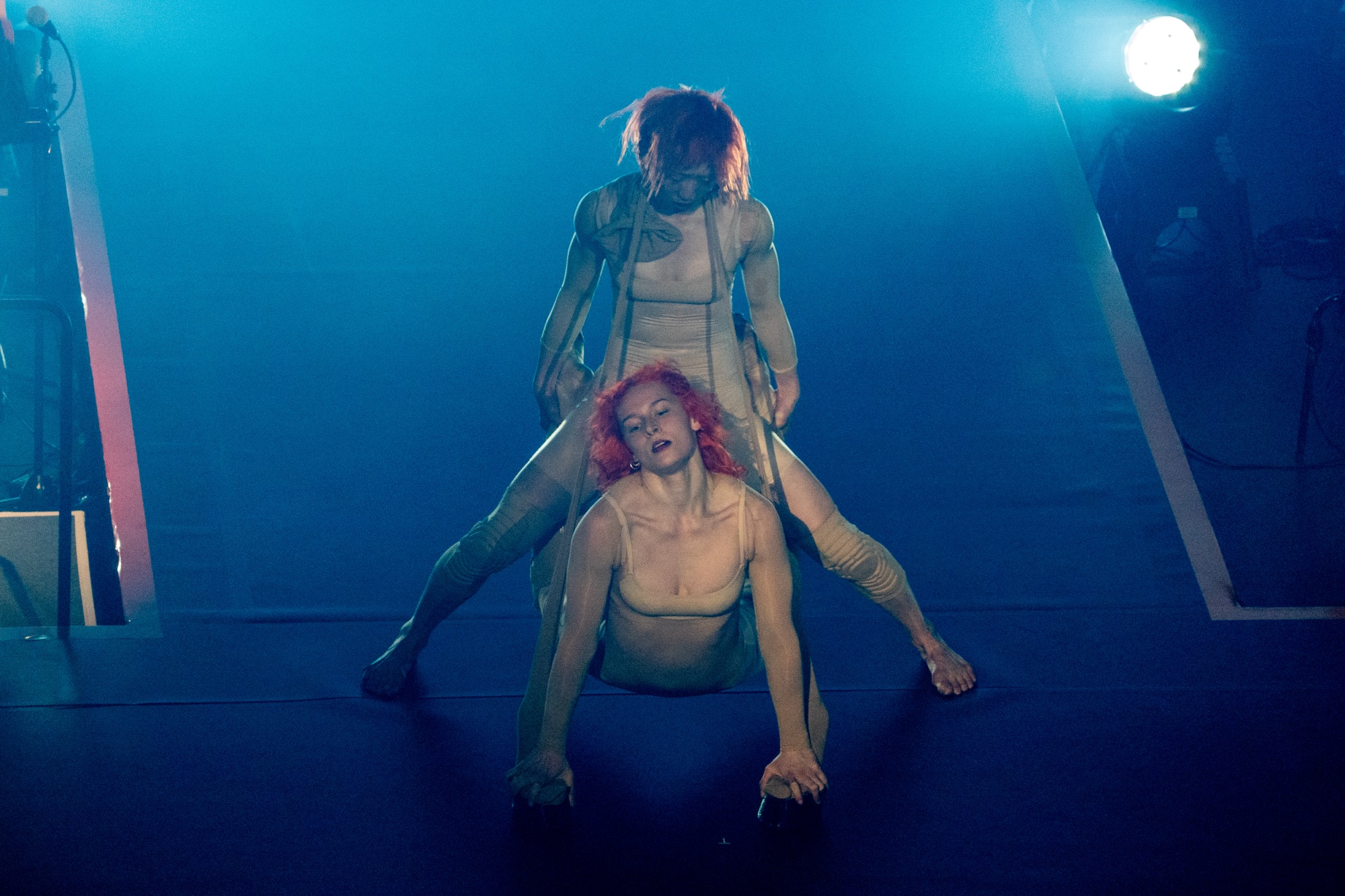
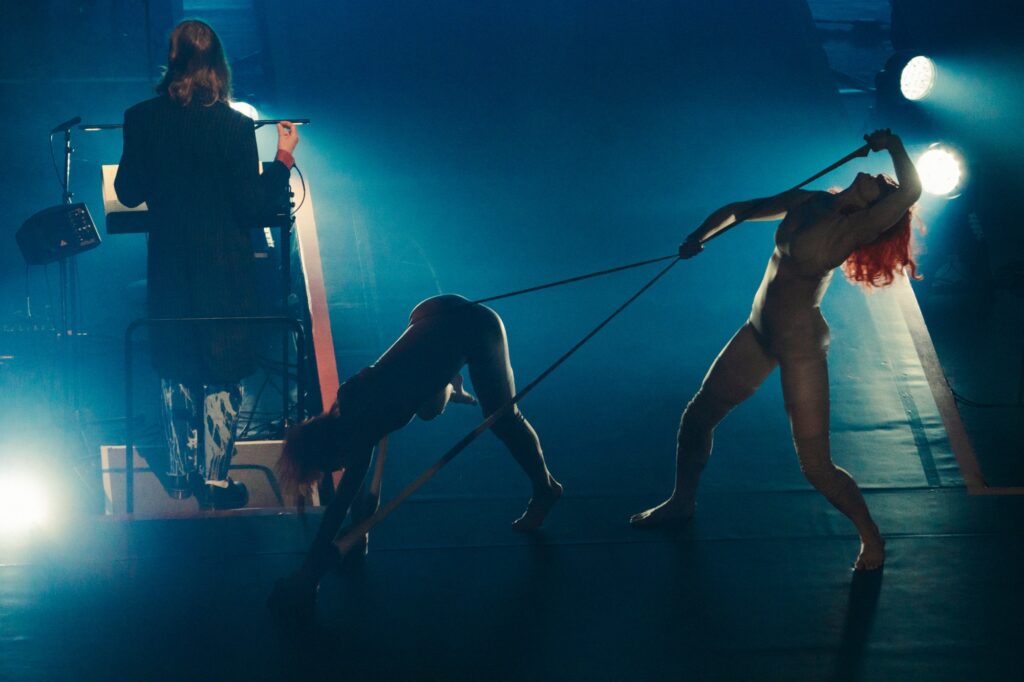
Doing well to manoeuvre three narrow corridors of floor space with challenging partner work, Sari Mizoe and Willow Kerensa Fenner don’t sacrifice physicality. They are intensely intimate. Are they bickering sisters or obsessive lovers? They push each other to the brink and yet never fail to catch the others’ fall. Blakey’s choreography is gestural, immediate, intricate and reckless. The pair, hair dyed neon orange, form a compelling, if not – fittingly – inharmonious visual against a shadowy, structured, 50+ piece orchestra.
Blakey was drawn to McQueen’s tendency to divert expectations and destabilise form as it was known. Her choreography is indeed full of surprises, but it ultimately serves the sounds: shrill and dissonant strings of Penderecki speak to the horror of grief, and Mozart to the loneliness.
Reminiscent of McQueen’s shows, the dancers return in racy, alien form. The Armadillo shoe, a high fashion platform pioneered by McQueen, is evoked by Fenner who dons a similar kind of shoe on her hands. Her arms and face are encased in nude tights with freaky, translucent effect. Mizoe morphs into the shape, creating a stretchy blend of dancers, fabric and parading hooves. With McQueen’s often supernatural fashion shows in mind, this moment avoids feeling gratuitous and is instead a visceral way to embody his macabre creative vision.
Live choreography shares the film with two dance films by Eddie Whelan and Douglas Hart, choreographed by Michael Clark, a friend and collaborator of McQueen. The first film reincarnates the designer as a young boy claiming a pair of white wings, and blends shots of flighty choreography with dreamlike quality. The second film illuminates the clean, placed and understated lines of the Cunningham technique, performed beautifully by Simon Williams. Jules Cunninham also makes brief appearances, donning dramatic hats that cast striking silhouettes on the large screen. Against the more frantic live dance, the second film especially elicits a stillness akin to purgatory.
Between the dance portions of the performance, we hear a brief but impeccable violin solo by Gayla Bisengalieva, two appearances from drag star Le Gateau Chocolate, and a tear jerker rendition of Phillip Glass. Throughout, London Contemporary Orchestra prove they can excel regardless of the repertoire. There is at least a sound for everyone, even if the moment is fleeting and soon diverted by something else, but the overall effect feels diluted by the fact that no element is given more weight than another.
That said, there is deliberacy in Unnatural Harmony’s structure and too much critique of its restlessness risks missing the point. Conductor Robert Ames describes the work: “Each mood gets broken open by the next. Out of that, a portrait starts to appear not tidy or complete, but alive.” The performance therefore does not set out to convey any sort of cohesive life. Instead, through a multi-media reimagining of McQueen’s creative vision, we traverse its glamour, intensity, romance and deep sorrow. Whether or not this tribute does McQueen justice, it desires to remember him without shying from the darkness that underscored his life and ultimately proved fatal.