Words by Qiao Lin Tan.
Daniel Kok and Luke George (Singapore, Germany, Australia) bring their work Bunny to Battersea Arts Centre from 4-6 June for its London premiere as part of Queer East Festival 2026. The term “bunny” refers to the person being tied in rope bondage practices.
Q: For people unfamiliar, can you share more about the practice of bondage, and the experience of being bound?
Daniel: It’s quite a broad question and there’s many ways to respond. I can start by saying that it feels like there are more people who are curious about experiencing shibari and rope bondage. Straight people, gay people, queer people – people are increasingly comfortable with speaking about it and registering their curiosity and interest. I think instinctively, a lot of people are curious about the feeling of losing and surrendering control. That seems to be the thing that gets picked up on most often. Conventionally, you would think about the person doing the tying in a more dominating role of control, and the person being bound in a position of surrendering. But what we’ve found is that the opposite is also often true. So much of rope bondage seems to do with listening to each other and taking care of each other. There is a responsibility that each party has over the other, so much so that the person doing the tying – the rigger – is often also in service to the person being bound. From the perspective of the rigger, I often feel like I’m offering a service. For the person being bound, the best way to experience shibari, in my opinion, is to allow oneself to be quite relaxed, and allow themselves to exhale and breathe into the experience. The experience can be as sensuous as it can be intense.
I find that in answering questions about bondage these days, I’m often responding to what I suspect are preconceptions that someone might have, and it’s often useful to respond to that preconception. In the case of bondage, I get asked very often, “What do you do to someone after you tie them up?” And that tells me that, for many people, the imagination hangs around the state of being tied up. I point to the fact that more often than not, it’s about the process of interaction between two people, such that the tying to the point of them being tied, and then the untying itself, are all part of that experience.
It’s often improvisational as well. Although I might plan to do a certain tie or the bunny might voice their desire for a certain experience, the rope itself is somewhat unpredictable. I like to talk about how the rope is a very fascinating material. It is soft, but it can also be really tough. It’s a material that is very open, a bit like water. It has texture and character, but it’s not a fixed thing.
The practice of bondage requires a lot of attentiveness to the current moment. Along the way, we might discover something in a session that we didn’t expect. A rope session would require both parties to have a sense of openness, and we try to take that into the performance of Bunny itself as well. Even though the performance has a fixed score, Luke and I have had to be very alert and responsive to what might be happening on a particular day, particularly when there’s so many people in the room and they might all be reading a particular moment in a different way.
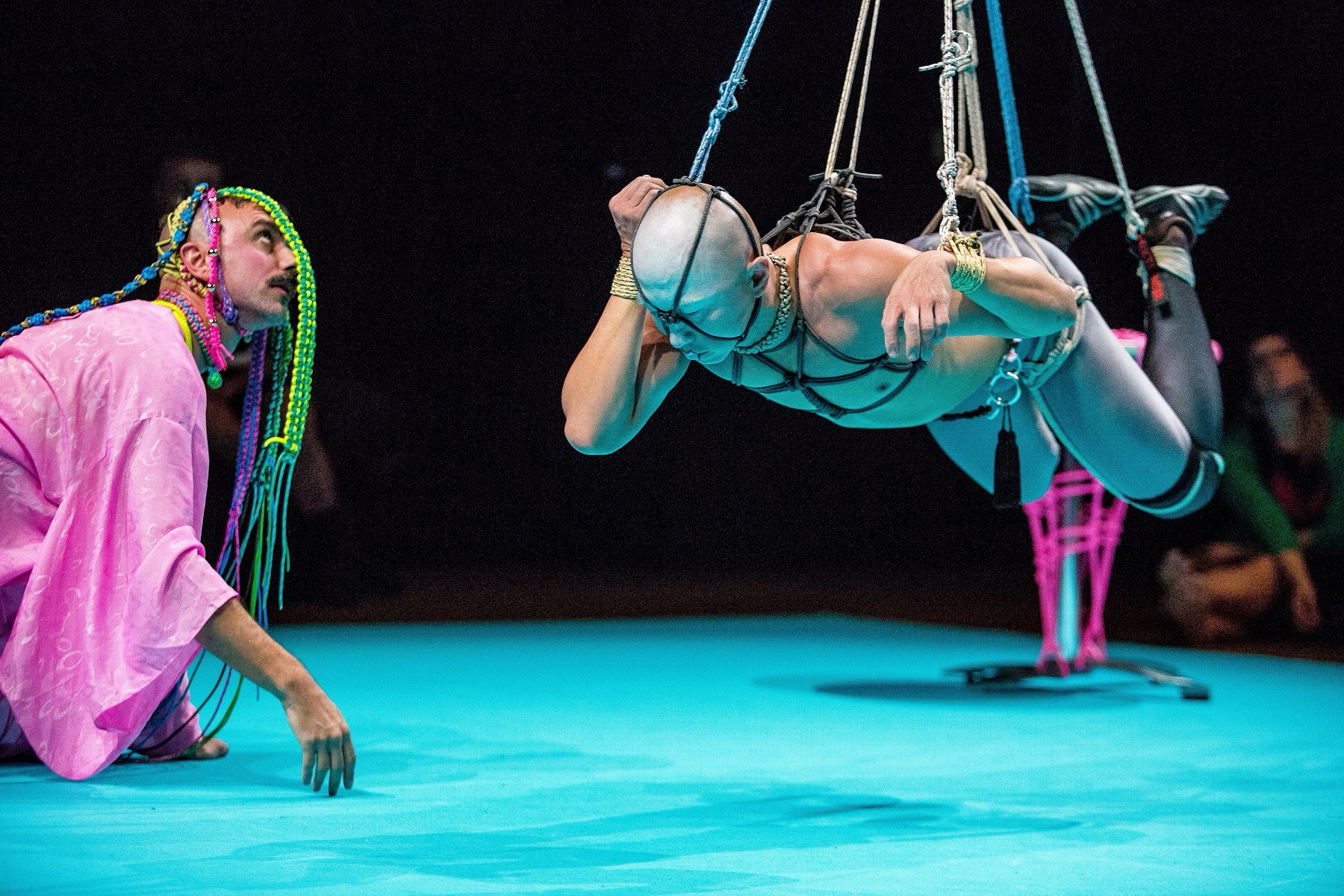
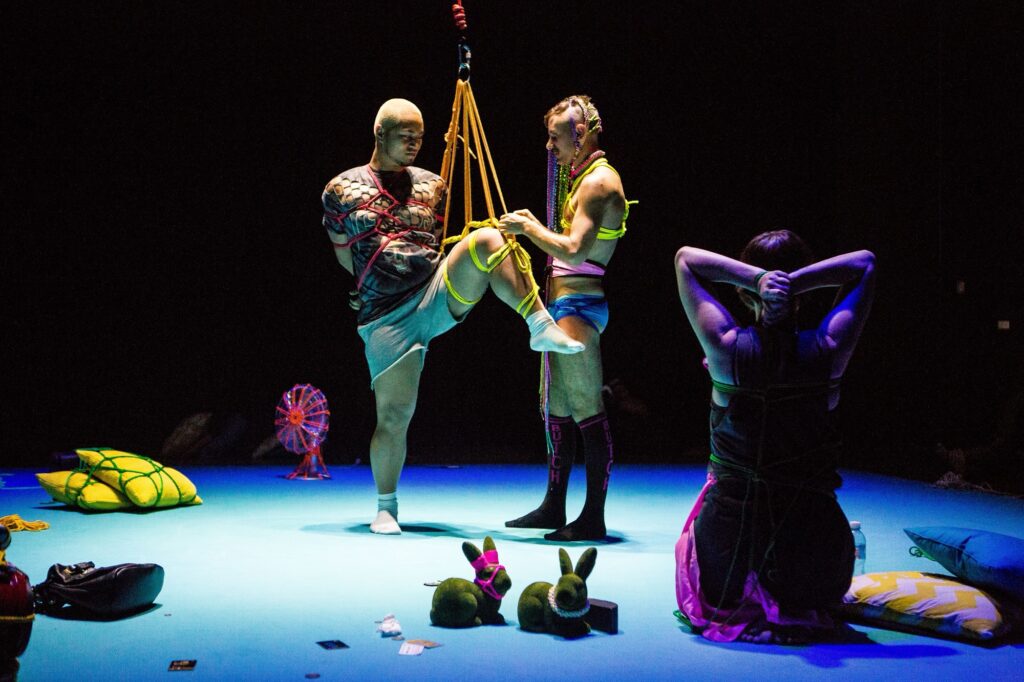
Q: When I was looking at the production photos, I was struck by how beautiful the rope work was and I felt a strong sense of craft and handiwork. You’re using macrame, sailor’s knots, Chinese knots etcetera in the work. It’s interesting that these are all ways of tying things but for quite different purposes. What was the process of researching these different knots and were there any insights that came with that?
Luke: There are hundreds of different knots in the world that span cultures and applications. You can really nerd out and endlessly learn so many knots. Early on in our collaboration, we noticed there was a real crossover – this knot that we use in bondage is also used in sailing, or this decorative knot has been passed between China and Japan over time and has come into Western bondage practice. To map this kind of socio-geographical movement of knots and information is pretty interesting.
At the start, we were looking at a lot of bondage performances, how it’s done, the aesthetics, the mood and the tone. And we noticed a certain kind of way that it was happening. We knew that there was a lot of bondage performance already happening in the world and have a lot of respect for it, so what were we doing here with Bunny?
We wanted to tie people. We wanted to tie up a vacuum cleaner. We wanted to work with bright colors. We wanted to make it quite irreverent, playful and camp as an approach to mixing things up. What does it mean to come from a queer ideology of not necessarily repeating the tradition in the pedagogic way that has been handed to us? What if we mix things up and blur things?
D: As you’ve mentioned, the tie is quite beautiful to look at. There’s something fascinating about bondage being at once something to look at as well as something to experience. In bondage, the way of doing things entails both this aesthetic experience of something being viewed, as well as something being felt. And I think that’s what’s been really fascinating for us in this practice and keeps us wanting to discover and excavate more ideas.
L: There are definitely some essential ways that you can tie a body – to evoke different sensations, to restrain and manipulate the body into a particular shape, and finally to lift and suspend the body off the ground. While there’s a lot of imagination, there’s also certain limitations because the body can only do so much, and you have to listen to the bodies you’re working with about what they want, what they can do, and what the edges of comfort and discomfort are.
That is such a big part of the research – the learning and the exploration is between the giver and the receiver, which might be two or more people. What is the interest and what is the desire for that kind of experience? What are the edges of where someone is willing to gently tread into, and how to lean into those edges collectively through very deep listening, conversation and communication – both verbal and nonverbal?
Q: Within bondage practice, one person is the looker and the other the subject of looking. In the case of Bunny, there’s the additional layer of a whole lot of other people looking from the audience as well. Can you speak more about the comparison between audiencehood and the experience of being tied up, and how this suggests a different way to conceptualise audiencehood or performance?
D: This very much underpins our desire to make this performance. One of our curiosities very early on was, why is this something to watch? Our practice is about getting both the bunny and the rigger to a place of vulnerability. It’s so intimate and private, what does this have to do with other people, and their desires projected onto these two people they’re watching?
It’s complicated enough with one person watching, but a whole group of audience members, each one bringing their own histories and perhaps even traumas? We have to consider there is difference and individuality even within the audience itself, we can’t treat them as a singular, uniform whole. I often point out that in Mandarin, the character [zhòng] in the word for “audience” has three “people” characters. The idea of the audience being both singular and plural at the same time is quite fascinating, but how does performance deal with this idea that all performance is always for that singular-plural entity? It was a really interesting artistic question to explore.
What’s in it for the audiences watching and what does it mean for everyone to be Bunny? If you have everyone sitting together and we start to tie people up – by the end of the performance, everybody’s tied up to some degree, if not literally, but figuratively bound together.
The performance is a process of seeking some kind of acquiescence from each individual audience such that by the end of it, the hope is that everyone is able to surrender to some degree together and arrive at a point of like, hey we’re all together in this game we’re playing. We may not all feel the same way about it, but we all recognize that in stepping into a performance, we have signed some kind of social contract. We are in a situation together, and we allow ourselves to be in that state of play with each other. I think that’s the kind of terrain we’re working in.
L: If I was to apply the singular-plural audiencehood that Daniel was talking about to my role as rigger in the performance, I remind myself that I’m meeting the person who is being tied for the first time, even if it’s not for the first time. At that moment, I can’t make an assumption about who they are, where and what they come from, and where they’re at in this moment. Because we’re humans and we are fluid, dynamic, unpredictable and predictable at the same time. I have to turn up and really listen and see them, ask them who they are, what they need, what they would like, and be able to really absorb that. I also have to ask myself those questions as well, and really listen to where I’m at. It’s quite a radical process of listening and observation required when you enter into a tying moment with somebody, either in private or whilst observed by strangers like in this performance.
In Bunny, the audiences sit in the round and they can observe each other. The work is a two-hour performance – very spacious – we like to think that we’re tying time. We give a lot of space and time because it’s necessary in order to step into the experience collectively, through collective listening and observation.
Q: This work premiered a decade ago and has traveled to different countries over the years. How has the work and your experience of the work as performers changed or stayed the same?
L: Compared to when we started a decade ago working with rope and bondage, we can tell that things have really shifted. Maybe that has to do with the internet and people having access to further explorations of pleasure, sexuality and articulations around consent and kink. In terms of aesthetics, visual culture and art, we’ve also noticed kink dynamics, conversations and aesthetics entering into many different creative forms, expressions, and also mainstream culture.
We, naturally, are quite different people from ten years ago. We’re in our late forties now, and so a lot of life has happened. The pandemic has happened and we’ve grown into ourselves a whole lot. Speaking personally, things have happened that have made me more humble, sensitive, considerate, thoughtful. And so I’m still really curious about doing this performance ten years on. In some ways, I feel much more experienced as a human, as a person who does tying, as a performer and artist, and also much more open to possibilities. And that’s just through life lessons, performing the show and experiencing it in many parts of the world and all the kind of curly situations and possibilities and conversations that we’ve had from doing it. Yeah, I’m super excited to do it again.
D: This was our first work together. I remember in the beginning, the work came out of multiple long conversations about our personal lives. I remember we were trying to get to know each other and discuss topics around clubbing, sexuality, and our work. At that time, now looking back, it was almost like we were discussing theoretically those ideas of shibari practice and the things Bunny is about. Then, it was just a hunch about what bondage could be about and how it could be meaningful. Ten years on, it feels like the mystery or the secrets of bondage are only beginning to be understood by myself now, that I’ve only just begun to understand what is really at stake. It’s really only in recent few years that I felt like, oh my God, that’s what we were stepping into, and only beginning to understand what it wants from us right now. So I’m also very excited to perform the work again in London, because I’m curious about what it might give us on a personal level, even if it’s not apparent to the audience.
At Battersea Arts Centre from 4-6 June. Book here.
Images by Chris Frape.