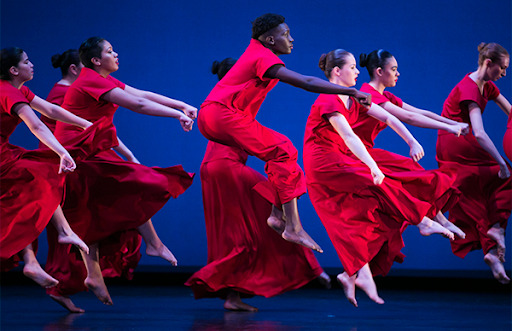
Words by Gus Hodgson.
Take a piece of dance and begin removing elements from it. At what point is it no longer dance?
Set and lighting design can go; so too can costumes and music, dance’s oldest friend. Even the audience can be taken away – the piece would remain dance. What cannot be removed is the dancer. Dance exists through them; it is the medium of the body. All those removable elements support (or counterpoint) what a dancer is doing.
Alexander Calder, the American sculptor best known for his kinetic sculptures – mobiles made of brightly coloured plastic disks – would, I think, disagree with this.
He made dozens of these mobiles. They’re wonderfully delicate things, moving without any obvious cause – celestial bodies shrunk down. They are constantly changing, new shapes appearing and disappearing organically.
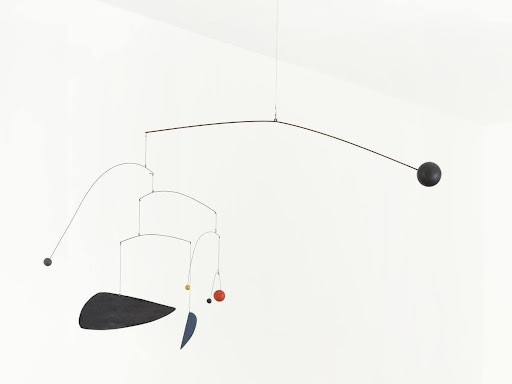
Throughout his career he wanted to make dancerless dances. He made “dancing machines”, small sculptures that could be blown by a fan to simulate dancing; and a “water-ballet” in four movements using the jets of a fountain at the 1939 New York World’s Fair. His most expansive experiment in making dancerless dance was Work in Progress, a performance made from huge versions of his mobiles moving on a background of changing colours, staged at Rome’s Teatro dell’Opera in 1968.
Alexander Calder was almost a very important person in the history of dance – that is, dance danced by dancers. Remembered by his friends as a “dancing man“, he was well known for hosting dance parties that stretched on late into the evening. He was described by the poet Elizabeth Bishop, who was with him at the 1960 Rio Carnival, as standing unmoving for six hours and watching the dancing as if “made of iron like one of his own creations“.
There were a series of creative relationships with choreographers that almost worked out. In 1934, Calder was introduced to George Balanchine by Lincoln Kirstein, co-founder of the New York City Ballet. In his diaries Kirstein wrote that “Balanchine thought he might make fine décor for ballet.” Calder repeatedly watched rehearsals, even showing sketches to Balanchine. Balanchine ultimately didn’t work with Calder, feeling that the sets were too close to those made by Joan Miró for Léonide Massine’s Jeux d’Enfants. Later, in the 1970s, Kirstein describes how Calder and Balanchine had discussed a “ballet without dancers” – the piece that would eventually become Work in Progress. Balanchine didn’t think it was quite right for the New York City Ballet.
Calder was also lifelong friends with Martha Graham, but again that relationship seems to hold a history of creative near-misses. They worked together twice, on Panorama (1935) and Horizons(1936). It wasn’t meant to be.
Panorama is a piece for thirty-six dancers to a stern score by Norman Lloyd. It is a starkly modernist piece – Graham called it “a political call to action” and “an attempt to awaken social consciousness“. It begins almost like a military parade, bodies in unison tracing out neat shapes through the space, their movement fine and sure. A group breaks away, bodies moving separately – legato now – gently arriving into positions which they hold. It becomes a rebirth of sorts, or at least a dawn. The dancers move together now, no longer regimentally but easily, freely. Then the music becomes more sinister, the dancers moving in an uncanny unison, somewhere between frantic and mechanical. And then suddenly they are gone, the stage fading to black.
Calder designed a complicated mobile of primary-coloured disks that would rotate over the heads of the dancers. How that movement would have harmonised with Graham’s dancers we will never know – the mobile never functioned properly and was cut from performances. When Panorama is performed today it is on an empty stage.
For Horizons, Graham and Calder’s work did manage to make it to the stage together. Rather than treating Calder’s work as a conventional set, Graham thought of it as she might another dancer. In her memoirs she remarks that this felt “new in dance”, explaining, “we wanted to draw the attention of the public to the opposition between the role of the dancers and that of Calder’s pieces”. In the programme they were referred to as “visual preludes” to Graham’s choreography. Sadly, no archival photographs showing these preludes remain.
Calder did however seem to be getting close to realising his vision of a dancerless dance. His work allowed to be on equal footing with Graham’s dance, given space during the piece to exist on its own – to be given a solo, as it were. Except Calder’s contribution to Horizons did not mark the beginning of a new genre of performance. The reviews were unkind. The review in the New York Times read:
[Calder’s elements] were neither functional, atmospheric nor of any other visible usefulness to the dance. Miss Graham experimented with the idea of moving décor at the Bennington Festival last Summer, but was forced to abandon it for mechanical reasons. Now that she has actually carried it out, it is hoped that she will abandon it immediately for even more adequate reasons.
Two failed experiments would be enough for Graham – she and Calder never worked together again.
Why tell you this story of Calder’s almosts and what-ifs with two of the great choreographers of the 20th century?
It’s not so hard to imagine a world in which both these relationships proved fruitful; where Calder and Graham worked on dozens of pieces together, pushing forward Calder’s exploration of how sculpture and dance could coexist and crosspollinate and where he helps shape what Balanchine’s New York City Ballet would be.
The great artists strip back elements from their work to arrive at a resonant purity. For Graham this process arrives at the body. The body is the irreducible unit of meaning in dance – it is always legible, even when strange, even when abstract, because we read other bodies instinctively and automatically.
Calder thought he was escaping the body, but his mobiles are haunted by it. They move in ways that rhyme with bodily movement, depending on the same principles of weight and counterweight that a dancer depends on. They have balance and poise. Their movements, like a body’s, never feel quite the same twice – always mid-motion, caught in one endless movement; all that changes is where a spectator chooses to imagine a boundary where one movement ends and the next begins. He evacuated the body but couldn’t escape its shadow.
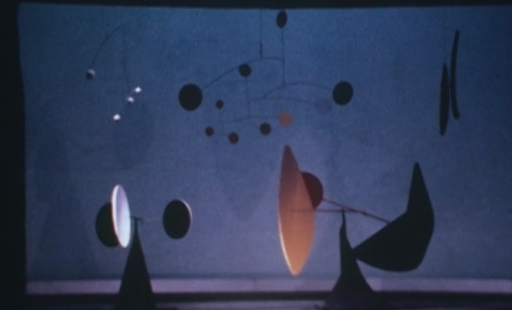
In a way, Calder and Graham are not so dissimilar – two artists asking the same questions and arriving at the same place, but in different languages. It is that unspoken closeness that made collaboration impossible. When the mobiles shared a stage with Graham’s dancers, the shadow met the real thing. The body’s legibility is total and automatic; we can’t help but read it. Calder’s abstract movement became illegible in the face of that process. It lost its allusions to the body by being too close to the object of its metaphors. It became just a backdrop – a removable element.
And yet Calder was always most himself in the almost. His sculptures never settle, never arrive – perpetually negotiating equilibrium, always on the verge of imbalance. Imagine a world where Panorama was a triumph – where the mobile worked, where the critics loved it. A finished thing stops moving. Calder and Graham remained lifelong friends precisely because nothing between them was ever resolved, the influence running both ways, quietly, without a stage to contain it. Two artists perpetually in each other’s orbit, never quite landing. Like opposite parts of a gently spinning mobile.