Words by Josephine Leask.
A small but powerful figure (Cher Nicolette Ho) emerges amidst the projected digital images of rain that pour down the four walls of the white box stage. She warms up slowly but purposefully with martial art awareness, seated in pigeon pose and gently circling her wrists. Suddenly she springs into more dynamic action with deep lunges and fast, slicing hand gestures. Picking up a Samurai sword with reverence, she fiercely cuts shapes in space. She is a ‘ronin’, the Japanese name given to a masterless Samurai, a loner, nomadic warrior. On cue with Ho’s changing actions, the digital landscape segues from light to dark, creating floaty phosphorescent bubblesthat replace the horizontal rain and transform the stage into a vibrant seabed. Next this shifting kaleidoscopic technology plunges her into a polar landscape, from where she seems to release icy-white concentric circles that magnify her sword-wielding power.
In RONiN, choreographer Yukiko Masui collaborates with digital artist Barret Hodgson to create a rich fusion of Hip Hop, Swordplay and contemporary dance in a stunningly sophisticated digital environment. Japanese born and London-based Masui draws on her own background of martial arts and multipl dance forms to reimagine what a female Ronin would be like. Other meanings of ‘ronin’ suggest a person who drifts through life, having lost their place in a rigid social hierarchy. As a female warrior, Masui’s heroine is perpetually in flight or fight mode, and even more of an anomaly, in a harsh, male dominated world. She journeys through seasons and across geographical landforms meeting a barrage of obstacles and danger along the way, challenges which are doubly compounded by her gender status. When encountering other ronins, (Jacob Lang and Nathan Bartman) she has to fight hard to win their acceptance and loyalty. While our heroine is an astonishing warrior, equally impressive in strength, technical agility and stamina, Masui doesn’t shy away from exposing her as human rather than superhuman. Mental health is another obstacle for this ronin as she struggles to survive. In one scene she rises early to practice her swordplay only to become frustrated, exhausted and disillusioned, falling over in sobs and groans. Ho is such a convincing performer that I’m as taken in by her moments of collapse as I am by her warrior prowess.
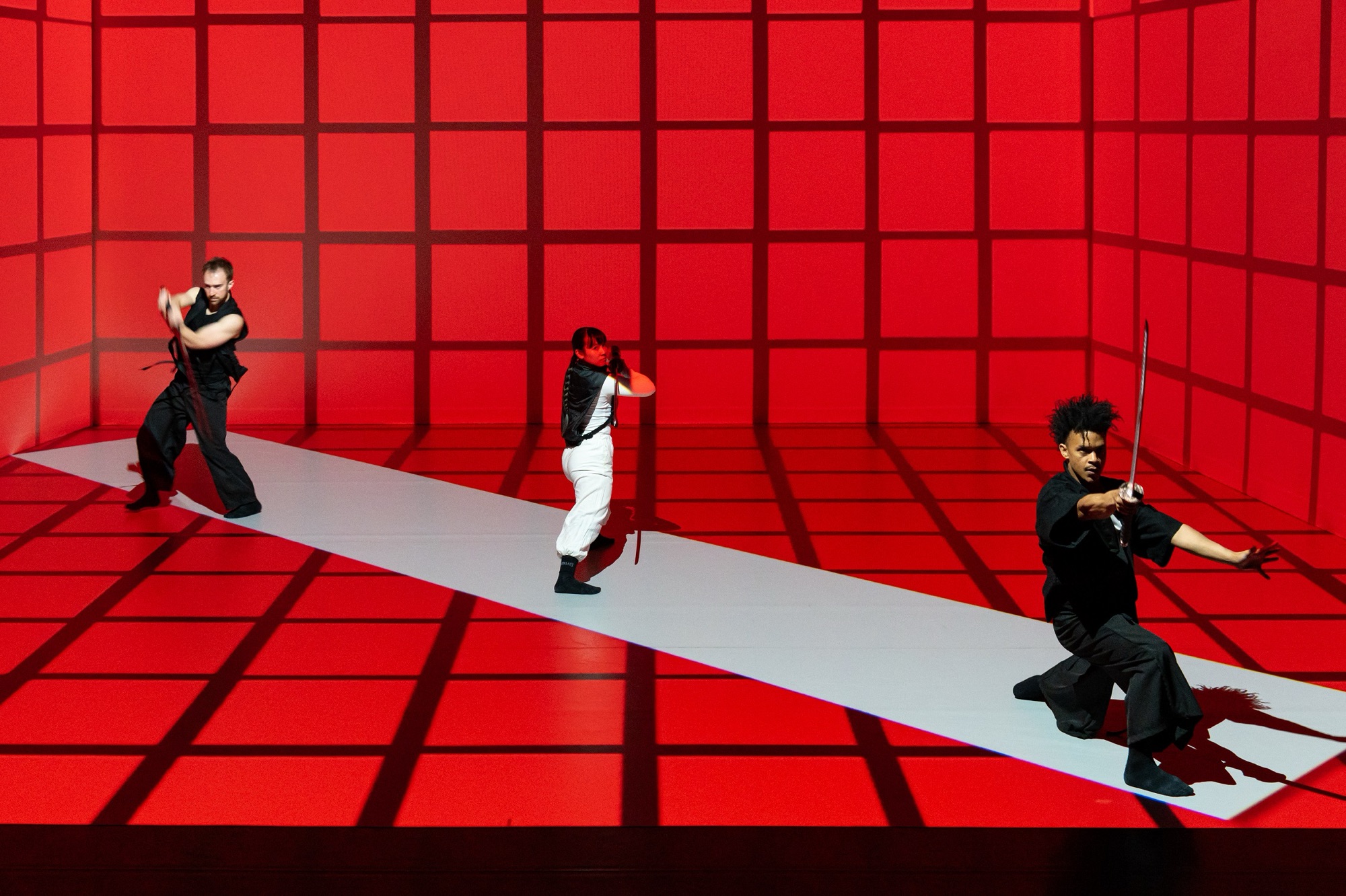
At the end of an action-packed act one, Bartman and Ho are attacked by Lang – a skulking intruder. Although able to hold her own, she gets injured by his sword. Following the interval and a rather confusing transition, she recovers in the second actand the three mercurial loners continue their journey together, their relationship ambiguous but their purpose clear. They cross mountain ranges and forests, moving through Hodgson’s exquisite digital projections of the Japanese seasons. Here, they engage in trios and duets, a choreographed cocktail of breaking, popping, sword technique and acrobaticdance. Technically versatile, with or without swords, all three dancers astound in their articulation of supple, complex steps and postures. Dynamically they are more playful and experimental when dancing without swords, giving the impression offreestyling across the stage, like carefree children. But with swords they have a steely edge, an urgency and focus that make them warriors.
The interaction of scenography, sound and choreography creates a massively sensorial, immersive experience: an anime-inspired kingdom that, with Ruth Chan’s super-cool electronic dance music, broadens the work’s appeal as it merges ancient Japanese traditions with modern visual storytelling. As the ronins reach their destiny—arriving at and entering a Japanese temple—it feels as though their story should continue.
Image by Daniel Phung.