Words by Sarah Lapinsky.
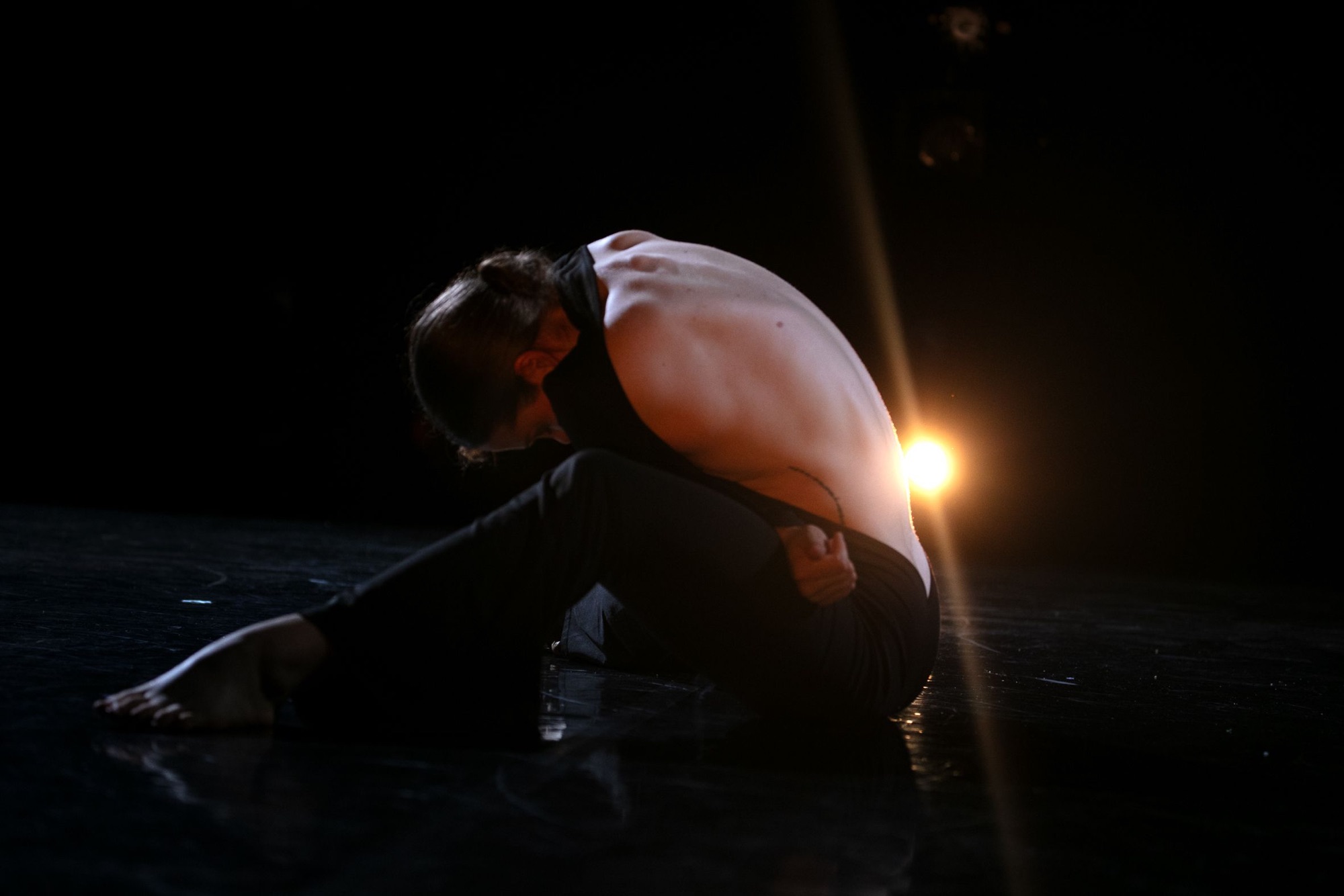
Antonia Latz is a contemporary dancer, movement artist, and choreographer whom I met with to talk about her latest work REM, created in collaboration with Luke Maher, musician, composer, and producer, which premiered at Resolution Festival at The Place in February 2026.
I was lucky enough to also watch a video of the work to see Antonia’s performance with live accompaniment by Luke on piano and Dom Ingham on violin.
I first asked about the inspiration behind REM:
Antonia described how the idea “simmered” in her unconscious for a few years and was developed through iterations as both a film and a site-specific gallery performance.
“One of the key inspirations for REM was a movement phrase that I had made in the course of my master’s research project, which was initially concerned with how various ratios of recognisable and familiar everyday movements, like pedestrian gesture, and then, on the other hand, codified modern and contemporary dance techniques, resulted in different emotional audience response.”
Antonia played with the question: “What can I do to these movements choreographically, to disrupt their conventional meaning, and the meaning-making that happens?” She describes a “sweet spot” to balance abstract and accessible. Within that, she used choreographic tools such as fragmentation, isolation, repetition, chance procedures, and notions of Butoh, which gave the movement a dreamlike quality. In this process, Antonia says she realised the choices she made about the movement disruptions and the way that she would play with them. She found this revealing and began exploring where this comes from, which gives the piece its layer of psychological questioning into consciousness, subconsciousness, and unconsciousness that invited an exploration of trauma’s resonance in the body.
The second question, “how did your process develop?” opened with a deeper conversation about the process of the collaboration with Luke Maher:
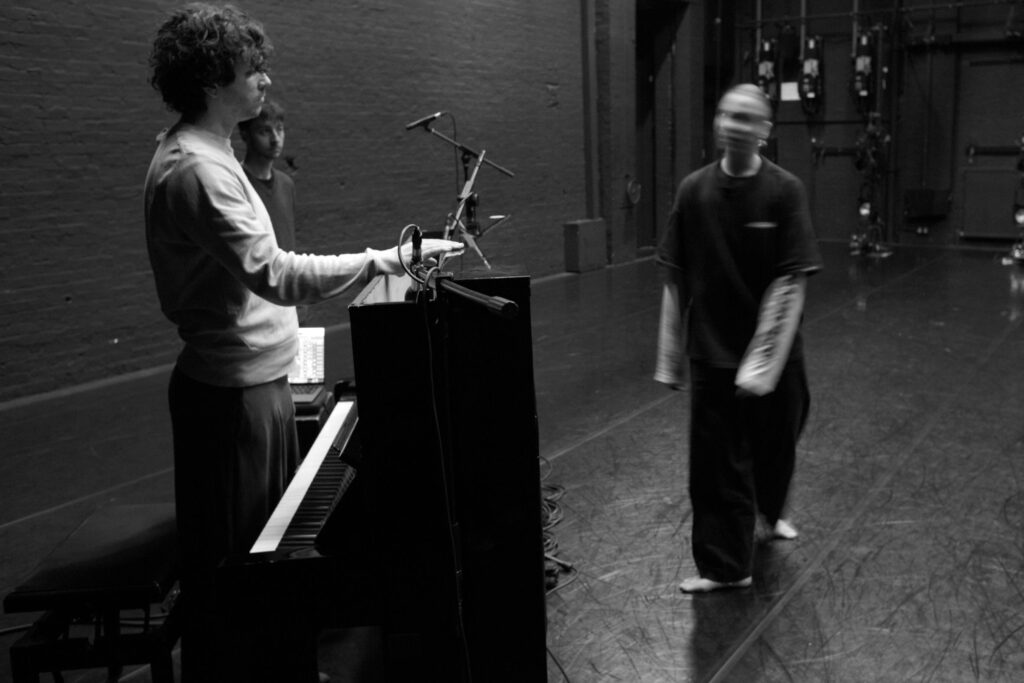
“Luke and I had worked quite independently, occasionally touching base and having points of exchange and crossing, then going away. We are really interested in finding a way of working, respecting each of our disciplines and creative agency, without falling into these kinds of hierarchical and known moments of like, now the movement leads the music, or the music leads the movement. We’re kind of finding these in between spaces in which our disciplines exist in their own right, but create a shared world.”
Antonia describes how this relates to her own process and philosophy of the work:
“As an artist, I do tend to give value to the process as much as an outcome. There’s an artist that is from my hometown, Kurt Schwitters, who really kind of enveloped this idea of the Gesamtkunstwerk. So the work of art that when elements come together is something else than the sum of its pieces. And when I work on something, it’s not directed towards a certain outcome; it forms itself as I work on it. Anything that gets pulled into this process becomes the work somehow. And the sound was one of those strands just as much as the music, as the movement, the space, the audience. So none of it would exist without the other.”
As Antonia was both choreographer and performer, I was curious how the collaboration with the musicians transcended the creation to sharing the stage in the premiere:
“Working with live music was so beautiful, not only because of the incredibly sensitive, intuitive, and enriching nature of Luke’s composition and the way that both him and Dom filled the freedom it maintained with such care and skill, but also because on the day of the performance, being the choreographer and the performer, my performer-self was so grateful for the live element, because it just tied me to the present so much. The score is set, the choreography is set, but both have scope to breathe, and any performance would be different from the other. And I think choreographer-me could have easily been really stuck with the subtext of the piece, the concept of the piece. So performer-me was grateful to feel this incredible connection to the space, to the present, which I don’t think pre-recorded sound could do for me. Having humans in that space to create this dreamscape together is an element of working with this dream that is about merging individual and collective imagery. What comes to you when dreaming is influenced by so many different things, so this idea of that collective was important to me, to have us all perform and uncover this dream together.”
Watching the piece, I had noticed a juxtaposition of the pedestrian and creature-like movements as Antonia described. I was curious how that felt to embody as a performer:
“From the performance perspective, the creaturesque form feels much closer to or revealing of the inner workings of a human than the more conventional counterpart. The more human form was interesting to play with because often when it’s the more human form, it goes towards more dance, codified movement, which in itself is not a very human thing to be doing.”
“I think that really led me to believe that just as soon as you’ve got a human’s head or face involved, you can identify a person. The moment when my face fully shows to the audience has been a very scary moment for me, or quite a vulnerable one. Choreographically, I am conscious that the longer I take the head away, the more there is expectation from the audience towards the moment where maybe something does get revealed. So the moment that this happens has so much weight. This is kind of intimidating to think of. And I was quite successful in distracting myself from this weight. And I did what felt right with the concept. That moment of vulnerability. I felt really translated to the people who were there live, from what I’ve heard, and it also didn’t feel confronting, which I thought it might do for me, but because earlier on during the piece, I had heard some laughter, and there was this clapping, and I felt the audience was with me. When that face was revealed, I felt very connected with everyone, like the musicians behind me, the audience in front, so it’s been both of these that have been very wonderful moments. I think that moment of reveal, that moment of being the human form, is something quite cathartic and fully embracing this energy from the audience as well. I would not have known what that would have been like without the audience. The audience really completes the piece in that sense.”
We spoke about a unique moment when Antonia began clapping, and surprisingly, the audience joined in! I had to ask about that from a creator and performer perspective:
“I think it’s the only note that I would have for myself: to clap so long until the audience stops, and then clap for like 30 seconds longer, because it does tie into this disrupting of signifiers and signified, which is something that informs my whole process. The clapping has an applause quality. I know that the audience had been primed by the first piece that evening to participate and clap. And it was interesting because it was almost a full auditorium.”
“I felt reassured that many people who did participate in the clapping actually found that it had felt really wrong to do so, that it felt quite brutal or violent, which was reassuring for me to hear in terms of where, content-wise and choreographically, it came from. Others, on the other hand, hadn’t perceived this. There’s something really interesting about this ambiguity and in starting to identify who these groups of people were, those who felt certain, versus those who held an apprehension towards that participatory moment. I do believe that the audience is the best critic. There’s definitely no right or wrong here, but it did teach me something about the group dynamic and about my choreographic narration.”
“This is something that I reflected on after…whilst performing I really enjoyed it. I really loved that the audience was clapping with us. Before we went on stage we had spoken about that strange phenomenon in Western culture, where we ask people to watch dance, but not join in. I just love that there was this moment of participation, because in the end, it showed that the audience was involved, that they cared about what was happening, whether they liked it or not, they still cared, and they were with it, and that’s all I could ask for.”
As this work premiered at Resolution, I asked more about that experience:
“It was a very important moment to show it at Resolution, in terms of myself and the work, it was a little bit of a test to see where to situate my practice and this piece in particular, to understand whether it could live in a theater space with a theater audience, which is a very different atmosphere from what we had in the museum. It felt a bit risky, because it existed in quite small spaces, and a lot of the gestures are quite minimal. I think it’s taught me again that REM can be very versatile without changing its essence. I think that’s really beautiful.”
“I’m incredibly grateful to The Place, and to the Resolution team that we had this opportunity. They have been incredibly responsive and supportive, for example when it came to figuring out what having live amplified sound meant for cueing light since we couldn’t rely on time codes for this. Sula Castle, who had previously joined me in a couple of rehearsals as an outside eye, had agreed to help with this so I am also very thankful for their help and expertise.
“It’s been amazing in the scope of what Resolution can give to participating artists. It’s been so useful. You’ve got your recording, you’ve got images. I don’t know if this was a new thing, but this time, you could get production photos ahead of the show, which has been great for marketing. The workshops will continue to inform things about my work, like logistics and practicalities of the self-production aspect that I previously would have figured out some other way. I think it’s a great springboard and it has meant a lot. There’s so much versatility and diversity in what is shown, and how many people are shown as well.”
We finished the interview with the classic question of “What’s next?”:
Antonia said that she plans to keep working with the subjects she’s currently drawn to with the hope that it can translate to a more completed form. Her interest in exploring consciousness, connection, and how movement and psychology reveal more about the human experience.
“I just love movement. I think it’s a massive connection point for people across so many borders. We all have bodies, however able, wherever from, and there is something about movement that is so incredibly connecting, and that’s something that I love exploring, and then the sense of the environment and how we are connected and disconnected from that.”
She also plans to continue working with interdisciplinary collaboration, building upon the Gesamtkunstwerk.
“Especially after Resolution and having had the experience of putting something on in a theater, I think, how do I carry that forward? What does that tell me about my work? I’m still discovering, and I don’t think I ever want to stop. It’s an interesting time when you’re emerging into something, and you’re like, ‘Okay, I’ve had this experience. What does that say? Like, what do I want to do now?’”
Antonia still has questions to research from REM, and I hope that I can be there to see its next iteration in person.