
Words by Inês Carvalho.
Music often offers an irresistible invitation to move: to connect with what’s within and around us, feeling our bodies in a wilder pulse. As someone whose dance has always shaped both my personal and cultural identity – from classes in studios to street parties with friends and family – I have been gradually disconnected from movement since I left home to start a new life in the UK.
Whilst my full-time occupation is in the dance sector, my body longs for the space and time for organic movement to happen, easily forgotten in the city rush. When I first arrived in M’hamid El Ghizlane for the opening day of Zamane 2025, I didn’t expect that the next few days would bring me back to the essence of collective movement. In this music festival, dance was the bridge between past and present, locals and visitors; a love letter to the transformative power of standing up, stepping forward, and surrender to movement.
Across three days, dance constantly emerged as an instinct and an open invitation to engage with the cultural roots of the programme. The fourth edition of Zamane Festival, organised by Joudour Sahara in partnership with Playing For Change Foundation, curated a line-up of local and international artists to tighten cross-border encounters between musicians, visitors and the cultural diversity of the region.
This year, the programme celebrated Ganga Heritage, featuring music echoing the ancestrality of Gnawa culture, an enslaved community that settled in Southern Morocco, and whose music is listed as UNESCO’s Intangible Cultural Heritage of Humanity.
Located in M’hamid El Ghizlane, on the edge of the vast Sahara desert, Zamane Festival has been championing music as a catalyst for positive change and social cohesion. In addition to the festival, Jourdour Sahara has been developing an extensive programme through a music school, engaging with over 200 students and more than 300 musicians across the Southern Draa Valley region, while reaching more than 6,000 local people through community engagement initiatives, that also include dance gatherings.
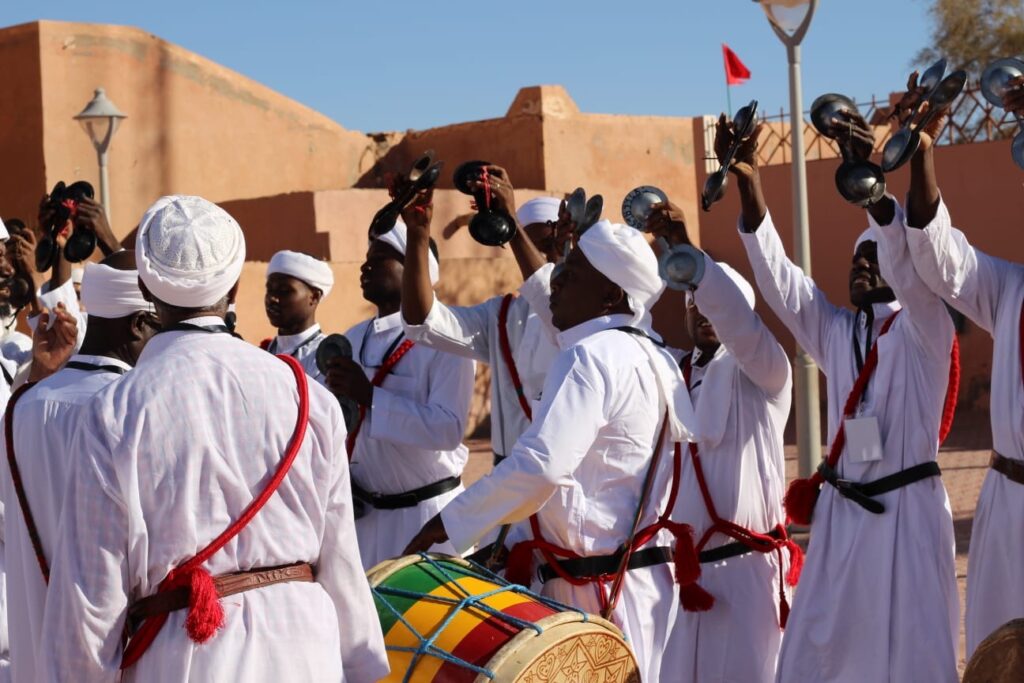
Indeed, this is a festival built by a community for a community. Under the burning sun and starry nights of Morocco’s southernmost oasis, dance erupted in all performances. As the first riffs of Aziz Sahmaoui and Vieux Farka Touré spilled into the dry air, movement took over the stage – and I couldn’t resist joining in. My steps were absorbed by other languages of movement, an exchange where something new emerged: a shared choreography, where spins, headbangs and skips were gradually introduced by locals and visitors from different ages and backgrounds.
As the sun started to set, music and movement kept unfolding. Majid Bekkas’ Moroccan blues and the fusion of Gospel and Afrosoul by Cameroonian Emmanuel Pi Djob saw solos and duets of audience responding to the multitude of sound landscapes, followed by the rhythm of audience’s clapping hands. Local headliners Daraa Tribes were warmly received with mosh pits and ring circles, building up a ritualistic experience.
I found myself fully drawn into the magnetism of this embodied experience, where music was the prompt for organic, co-created dancefloors to emerge. During my trip to Zamane Festival, I was reading the final pages of Emma Warren’s heart-warming book Dance Your Way Home, an ode to all the dancefloors that allow us to dance our own history, as well as our shared ones. I danced my history, even far away from home. I danced others’ histories, honouring the multitude of languages adding layers to the idea of “dance as a universal language”.
Although life sometimes drags me away from the dancefloor, Zamane Festival was a powerful reminder that dance is a social force that affirms community and humanity – and a way to keep presence when the world asks for a faster pace.