Words by Katie Hagan.
‘Disco Queen’ explores the evolution and cultural significance of disco freestyle dance, particularly in working-class communities like Bradford. Ella emphasises the technical challenges and stereotypes associated with disco freestyle, aiming to challenge perceptions.
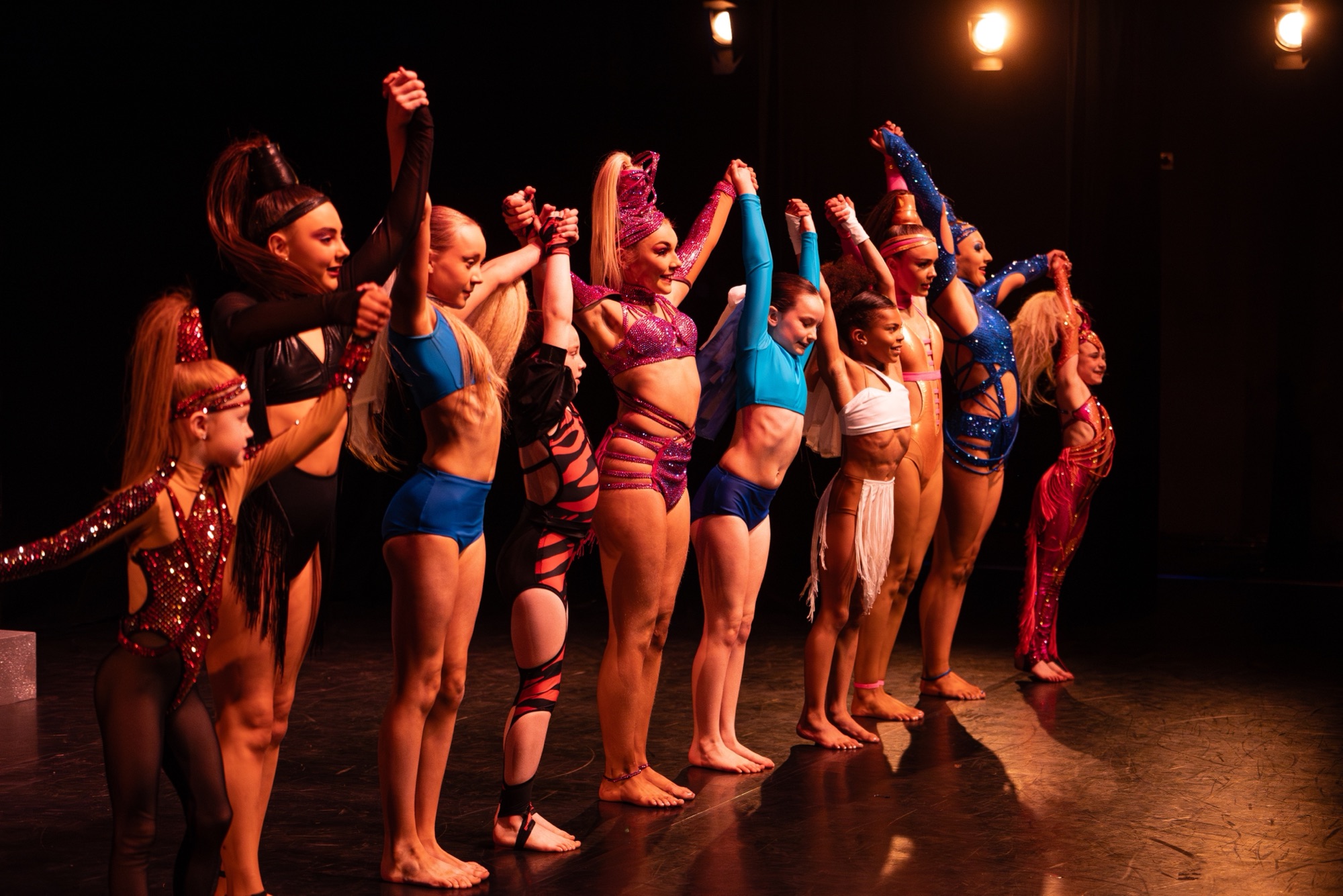
Somewhere in a village or church hall in a UK town, there are a group of young women at a disco freestyle dance class, perfecting their technique or being coached on a solo for a competition at the weekend.
At the competition, alongside other dancers, they will don the sparkliest of bespoke costumes to spin, flip and leap in-front of judges, to get the chance to win medals and massive trophies.
It’s a reality that independent artist, Ella Tighe, experienced growing up in her working-class Bradford home as a disco freestyle dancer. A version of her story, blended with more contemporary accounts from young women, is captured in her new hour-long piece Disco Queen that comes to The Place this month (a huge ‘pinch-me’ moment for Ella, as she said to me).
What started as a seed of an idea when Ella got DYCP funding, and then support from The Place’s Choreodrome in 2023, has developed into a full-length work bringing audiences into the intense world of disco freestyle dance culture. Created by the godmother of disco freestyle dance Anna Jones in the 80s, the dance form is characterised by high-speed flips, kicks, jumps, all danced to pop music with a happy hardcore beat.
“Disco Queen is a mix, really, between freestyle, contemporary film and sound,” begins Ella, “not to mention hearing from the lived experiences of dancers from working-class communities in the disco freestyle world.”
Ella started taking classes when she was six years old. “I saw older girls doing classes and competitions and I wanted to try it. I convinced my mum that it would be a good way to spend our time, and it very much quickly became my life.”
Ella’s love for disco freestyle opened her up to other possibilities at school. When taking her GCSEs and A-levels in dance, she was made aware of another side of the dance world that wasn’t necessarily about competitions and ‘how high your leg could go’.
It feels important in this interview to add a necessary side note about dance in schools. Recent news has sadly highlighted that an increasing number of schools are not offering dance on the curriculum, which is a huge disservice for working-class young people in particular. Growing up without access to dance and the wider art world means that GCSEs and A-levels are a crucial access point for many. The fact this is slowly being erased poses a huge problem in terms of getting the working-class into the arts and enabling them to remain in the industry.
Thanks to a solid dance offering at school however, Ella learnt about possibilities such as choreography and dance teaching. She then pursued a BA in dance at Coventry University and an MA at ArtEz in the Netherlands, further opening her mind to more conceptual dance work.
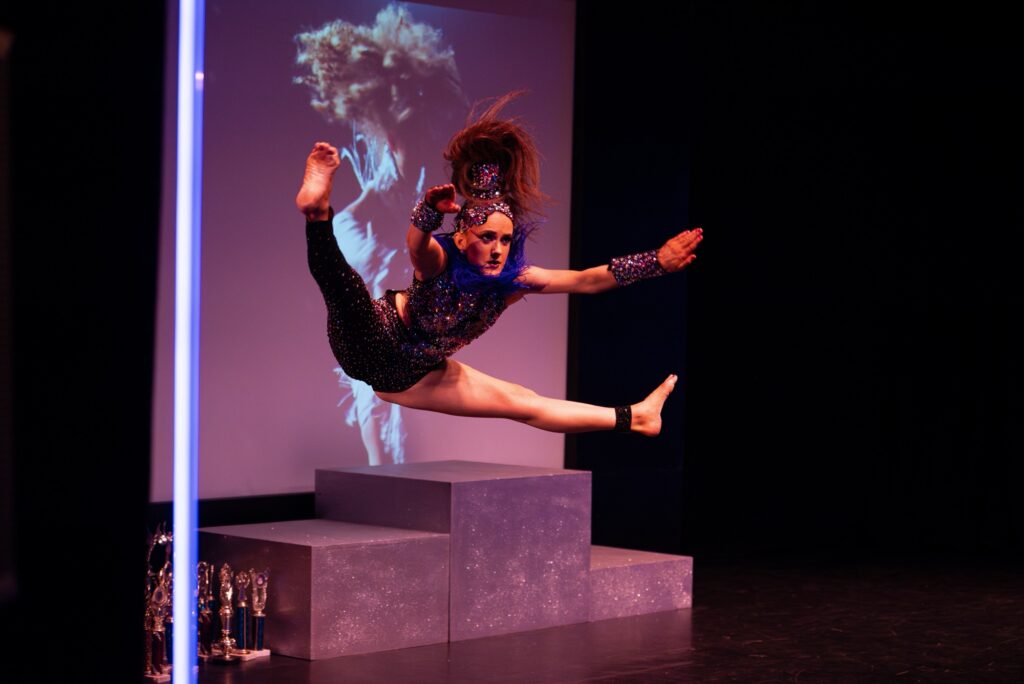
After experimenting with different approaches and dance forms, Ella found herself coming back to her roots in disco freestyle dance; a decision fuelled by her return to her home city, Bradford.
“When I moved back to Bradford, I recognised a disconnect between the conceptual work that I had learnt at university and the audience here. I noticed this, and it opened the door to Disco Queen.”
“I’d already been asking these questions to myself as a dancer from a working-class background in middle-class spaces,” Ella continues. “I could never get rid of this physicality in my body and I started to ask questions around what that meant. Although I felt very welcome in these spaces and enjoyed being in them, I did always feel like I didn’t quite fit. I’d go to classes, and I’d be kicking my legs and wanting to do a backward-walk-over. Although I was never made to feel that way at all, I did feel like I had to suppress that side of me in those spaces.”
There are lots of negative stereotypes and problematic misconceptions around disco freestyle dancing, not just in terms of who participates but how the form is recognised within the dance industry and beyond. These stereotypes are at true odds with the rigour of the dance form and the young women’s skills and dedication, as Ella highlights. “At a competition you have 40 seconds in your age and experience category (Beginners up to Premier Champs) to impress the judges, whilst there could be up to X dancers on the floor at the same time. During the week, that looks like four hours of training several nights a week and usually a Saturday with a comp on a Sunday. It takes skill, hours of intense training and technique to be a disco freestyle dancer. Despite the stereotype, the form is rooted in technique.”
“I feel passionately about how the form is looked at and the respect it gets. I’d love disco freestyle to be acknowledged as a technical dance form. After all, you have to spin at a certain speed and jump a certain way – these are clear principles of a technique! My hope is that it can be appreciated in this way. And for more young people to see Disco Queen and see that they can use dance and their experiences to make work or teach and not only think they need to be ‘the best’.
With audience and community engagement pivotal to Disco Queen, how did Ella invite other dancers into the work, to go beyond her own experience? What was it like working with the young women on the disco freestyle scene right now?
“From the beginning, I wanted to make a narrative-driven work that resonated with people now, not just showcasing my experience in the noughties,” says Ella.“Part of the research for me was seeing what had changed and stayed the same. The form has evolved, the costumes have evolved, but the underlying politics and culture are the same.”
“I got such a lot out of trying to capture what these young women love about disco freestyle because it is such an intense thing to be involved in. It’s your life. It’s your mum’s life too as she gets your costumes, helps you with your make-up and takes you to your classes – which are very accessible at around £3 a class! And then a lot of the young women get to 18 years old and just completely drop dance, mostly because the access and opportunities to work in the industry hadn’t been there for them.”
What has she learnt from working on Disco Queen? “There are so many learnings from the project in terms of ensuring the community engagement work we did with the disco freestyle community was led by them, and understanding how their world operates. It’s why it is really important that I have lived experience. During the three year research process, we we were going to competitions, we were having stalls, we were talking to people. We were really showing up and kept knocking at the doors, even when it felt like they didn’t understand what we were doing at all.”
“With that in mind, it was not always easy to make the connections with the disco freestyle community. It was hard to reach them and I really had to push for it. This a world in and of itself, which is amazing, but it could learn so much from contemporary dance – and vice versa. The form also rests a lot on the celebritisation of certain dance figures, and this turns attention to the different value systems of private dance schools and public funded dance. And this is where I was sitting in the middle to encourage conversations between both, and this is hard to do. But I have started this exchange, and this feels really positive.”
Disco Queen is at The Place on 17 September. Book here: https://theplace.org.uk/events/autumn-25-ella-tighe-disco-queen