Words by Paula Catalina Riofrio.
Whilst an art form like dance is edgeless and connective, artists from all over the world have to deal with the shame of bureaucratic borders to perform or extend their practices. Since February 2020, the Global Talent Visa has offered a streamlined route for leaders in the Arts and Culture to live and work in the UK. On paper it doesn’t appear daunting. Yet the endorsement criteria grapples with a question humanity has pondered since the Renaissance: what does it entail being an artist?
It is nearly painful to think that the word bound relates to both a sense of destiny and the state of being restricted. If all borders were open, where would a dancer go?
This question has been rewritten more times than I can count, as have UK migration policies, so I’ll promptly tell you what it is all about on this article before another sudden change arises. As an independent dancer not native to the UK, there are so many life choices to navigate after graduating from a degree or study programme in London. There is possibility but also the real, tangible threat of needing to leave.
Over the years, I’ve explored numerous ways to remain in the UK, working as an independent artists. I remember just before a concert at Wigmore Hall, my former partner arrived and so I told him about my confident plan to get a Global Talent Visa. He asked, cheerfully and genuinely unaware of the complexities of visas in general: “Where does that visa get you?” Only the UK, I replied.
Visa Routes: Life Paths
Applicants for the Global Talent Visa must carefully prepare a dossier showcasing proof of appearances and media recognition of their work, along with three letters of support from people who know them and have worked with them directly. The standards are reasonable for artists already working in the UK, but present a high barrier for emerging artists or recent graduates who often work in collaborative spaces outside mainstream institutions.
An acquaintance of mine — a voice actress who completed her Master’s degree in the UK — revealed the reasons that led her to leave the country. Holding Australian and US citizenship, she considered that the Graduate Route didn’t provide enough time to build a portfolio that would meet the criteria. Bearing in mind the risk of not being able to remain, she decided to ground her career in the US, where she required no proof of her worth as a professional artist. The Global Talent Visa would have offered her five years of residency, with a pathway to permanent residence — but migration policies, as she well knew, tend to change unexpectedly.
Fe, a sound artist from China who completed a Master’s in London before moving to Berlin, describes watching fellow graduates from her course in search for opportunities that never quite materialised. She too, found herself unable to see a clear path for herself in the UK, but she heard about Catalyst Berlin, an Institute for Creative Arts and Technology. She applied and got in. Now in Berlin, on a student permit, she describes her year there as “50/50” — half learning, half simply having a place and a community from which to do her own practice.
For Fe, dealing with borders and visas is simply part of life. “It’s like if you want to eat your meal, you have to cook your food. If I want to go somewhere, I need to get my visa.” She describes the particular anxiety shared by many international artists — a noisy uncertainty that never fully resolves, even after years in a place. “You wanted to call this place your second home, but you just have to be afraid that you need to leave.” At the same time, she credits the pressure itself with sharpening her commitment: “Dealing with all of these restrictions has helped me strengthen my commitment to my own practice. My work has no boundary, in a way, because it’s all the combination of what I do and how I came here and why I stay here.”
A Moving Target
In May 2025, the UK launched the Immigration White Paper, a plan to redesign the immigration system. The most significant shift raised the permanent residency requirement from five years to ten. For artists whose contracts vary from a year-long company position to a three-month project or a six-week residency, this is not just unsettling — it is structurally incompatible with how a contemporary dance career works. Visa grants fell significantly, down by over 100,000 in the first half of 2025.
Just recently, the permanent residency waiting time was reduced to three years for migrants on the Global Talent route — though the conditions for this reduction remain undefined, and so does the factual date for the implementation of this new law. The uncertainty is the constant. Current migration routes all over the world support residency status when it is profitable in measurable terms: lately, prioritising AI researchers and digital nomads with disregard to the most human aspect of migration, culture. Countries like Ireland remain exceptions, recognising the cultural profit that art brings to the wellbeing of a nation and the urgency of addressing it.
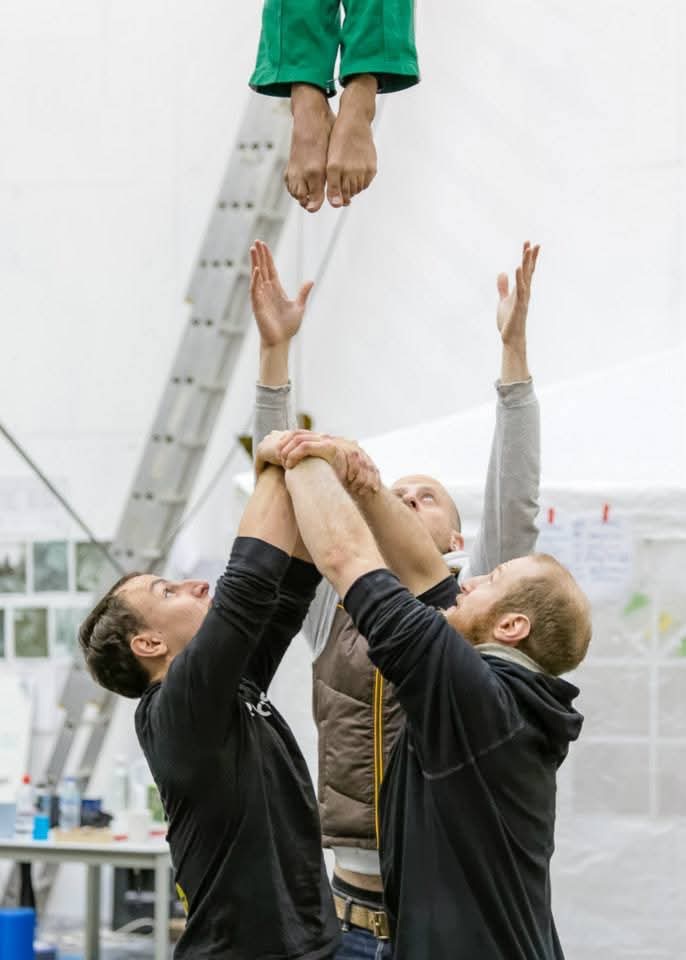
Tim Lenkiewicz, a British circus director who has worked extensively in Europe, and East Asia, reflects on how much has changed since the relative freedom of the pre-Brexit era. Until about a year ago, he could work as a freelancer across Europe for up to 180 days a year without a visa — a flexibility that enabled him to build long-term international collaborations over years. “I think we should have free movement for artists,” he says. “It would be great if you could just go wherever you want to do the work that you want to do.” He draws a practical distinction between artists at the beginning of their careers — where the economic activity is small and the cultural exchange is vital — and those whose work generates significant revenue. “There should be some acknowledgement that artists can travel and collaborate in a much simpler way when the amounts of money involved are much less. That creates opportunities for the biggest stuff to happen later.”
Lenkiewicz traces the current difficulties of two converging forces in the UK: the defunding of Arts Council England, which significantly reduced the quantity of companies supported, and the “climate of hostility” — an immigration policy explicitly designed to discourage arrivals. “Those two things have been really detrimental to the whole scene in Britain”.
The Ebb and Flow of the Thames
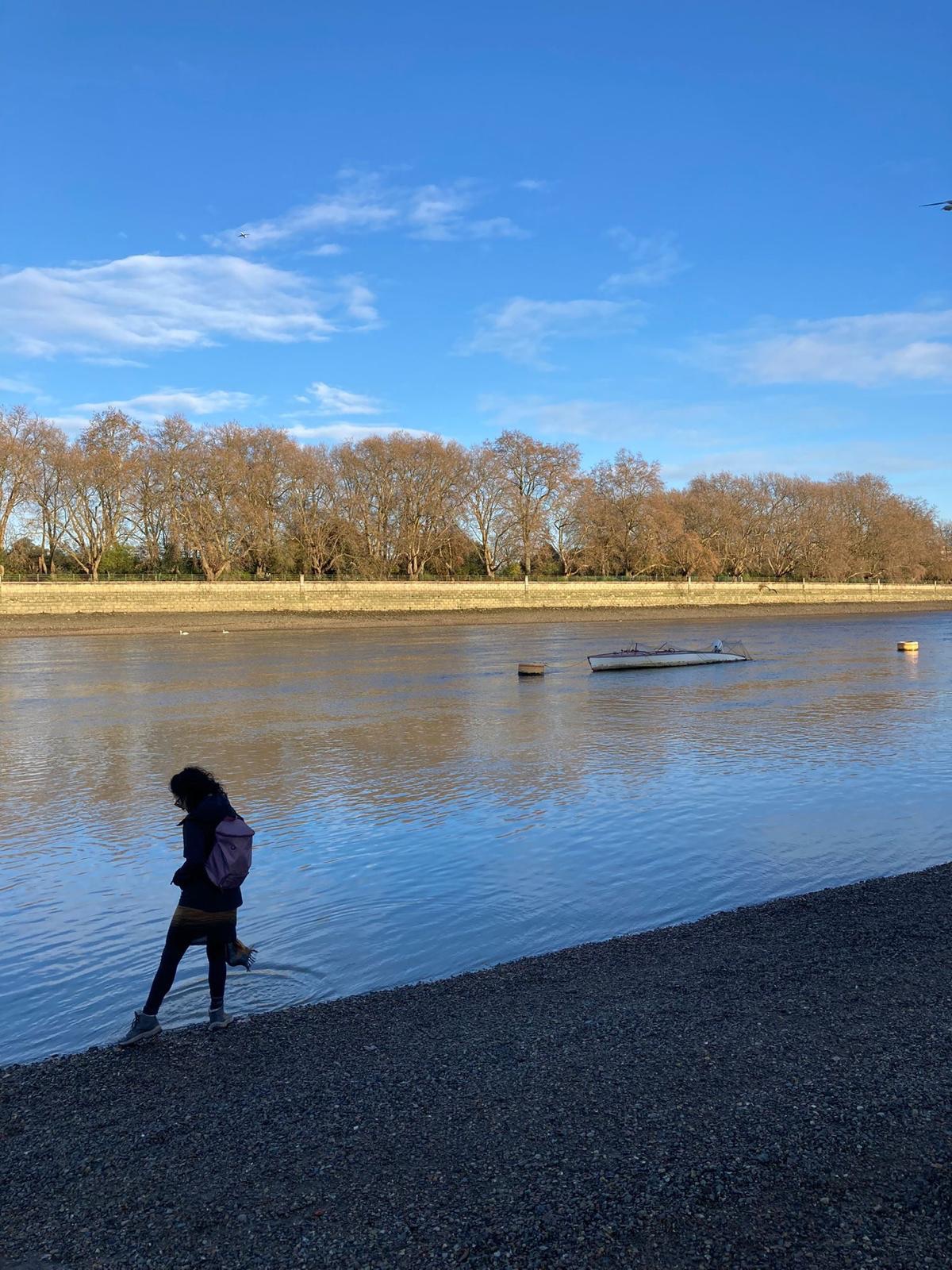
I arrived in London on a Student Visa and met the Thames on an autumn afternoon at Putney Riverside. I had brought a stone from Ecuador. I threw it into the water. I want to grow as an artist here — I murmured, childlike, to both the stone and the river.
Seasons passed. I graduated from an MA in Dance Philosophy. Yet, Zarathustra, an Iranian prophet, was never included on the syllabus, nor ancient rites from Greece; I never told them about the spiral lines of movement in South America (Abya Yala). But I kept on going, I found a magazine that cared about dance research, and they were glad to have a writer from the Global South. The Graduate Route Visa allowed me to stay for two more years: and the process was for once, short and easy.
My first on-site assignment at dance art journal was Dance by Lucinda Childs and Philip Glass — the royalty of modern and experimental performance. I have beautiful memories of that day. I thought the greatest achievement of dance writing was the reflective exchange of ideas; promoting choreographers’ work was a way of sustaining that aim. I also wrote for small collectives and independent dancers. In fact, when it was my time to leap toward the Global Talent Visa, I reached out to a colleague — a dance writer from South Africa. She shared her endorsement portfolio with me. I found a couple of my reviews there.
On the 6th of March, an email from ACE arrived. They informed me of several reasons why my portfolio was refused, but the one I kept thinking of was “we are unable to verify that this is a professional orchestra rather than a community orchestra”. When I started working with Orchestra New I did have the feeling of it being a community, a community of artists. Some of them were already retired, well placed musicians, regular performers at Café Oto, the Horse Hospital, International Festivals. Some others were younger in age, PhD students, graduates, internationals, freelancers, cutting edge artists known to the local music scene, and active leaders of the dance community. While one of the objectives of the Arts Council is to “strengthen communities”, their focus seems to value solely monetary income.
Implications when working as an artist in another country
Another email from a dance graduate landed in my inbox, asking me to write about their work to fulfil the criteria for the Global Talent Visa. It made me contemplate the role and power of the independent press. It is not only about promoting work or the reflective exchange of ideas; for some time now, it has helped artists maintain their legal residency status. Proof of one’s work and trajectory are not only required by independent artists. On a short visit to Berlin, I came to understand that dance venues supported by government funding also need a certain amount of media recognition to sustain their income. Press and media for the arts feed a balance that protects the whole ecosystem — from the solo dancer applying for a visa to the institution applying for its next share of funding.
I interviewed Maggie Kelly, the graduate who had reached out, who is now a Global Emerging Talent endorsed by ACE. She shared the questions that accompanied her throughout the process: “How much do I want this? And even more importantly, why do I want this? It’s very confronting. You are putting yourself, voluntarily, through a highly stressful, time-consuming, expensive and unpredictable process. The only reason to do something like that is for something you love.” And then she added: “I’d never before felt such a desire to prove myself. And having that seal of approval from such an official and highly regarded source felt like the vote of confidence I needed.”
Tim Lenkiewicz knows a version of this constraint from the production side. When his circus company was hiring; he had to turn away US artists — not for artistic reasons, but because he wanted to prioritise fair payment for artists rather than expanding his administrative costs. A decision that reflects values, but also a reality: the paperwork of international collaboration is itself a resource, unevenly distributed. His company could welcome artists from Hong Kong, given the historical ties of a former British colony and from across the EU — until Brexit made that freedom disappear. What about artists from South America and Africa? As you know, the geometry of who can work with whom has always been influenced by history and politics rather than a desire for diversity.
The Ongoing Move
In late April 2025, when I had to leave London, the magnolia trees had started to bloom unusually early. Green was appearing everywhere. I left my job at City Lit as Language and Culture Tutor, called off my autumn and summer commitments, stopped my independent teaching at Siobhan Davies Studios, dragged my luggage to Heathrow, took two planes, and returned to Ecuador.
The day after I landed I saw a carton print of Daniel Noboa —U.S. born Ecuadorian president. The cartons were carried by several different people in the street, others were placed in windows. It seemed surreal to me. Noboa had slowly handed the democracy of the country into Trump’s hands. I find it immensely disgraceful to hold a passport from a country currently governed by a cocaine exporter. I wish nationality could be a selective thing, as friends are. To freely choose a country because I agree with its politics. For a long time I have wanted to be Colombian. I admire Petro’s policies regarding culture and the environment. It is a shame that Abelardo de la Espriella, a far-right politician, is taking over. I fear for the future of Abya Yala.
By New Year’s Eve 2025 the same carton was burnt in several homes, as Ecuadorian New Year tradition of burning those things we seek to get rid of by the next year. Me? I figured stopping dancing was not a solution to anything.
After some time back, I picked up work at the Contemporary National Dance Company for a two-month project. I found myself collaborating with a dancer from the Czech Republic who happened to be in Ecuador. You can always be the community you seek to find. At the minute, the Ecuadorian Army is occupying indigenous lands in order to look after the extractivist foreign and national companies that illegally acquired protected areas. I have lost count of activists murdered, but I need to recall some of their names: Monika Silva Koniuszek, Eduardo Mendúa, Alberto Quiñónez and Didson de la Cruz Quiñónez, María Chóez, José Isidro Tendetza Antún.
Being an activist in South America is not as safe as being one in Europe, where you will just be imprisoned, not killed. It is hard to navigate an artist with ethical awareness, yet devoid of rights. Every time I eat a banana here in Europe I think of corruption. How else are we able to have imported fruit at such cheap prices? The little I can do is not buy Bonita Bananas, Noboa’s inherited corporation. I am soon going back to Ecuador, hoping not to be killed, one way or another, by a casual robber or the government.

However, I find Tim Lenkiewicz’s conclusion not delusional. He imagines a world where artists at the beginning of their careers can move and collaborate freely — where the economic activity is small enough that states have little reason to intervene, and the cultural exchange is large enough to matter.
Migration is a bird’s phenomenon, a whale’s navigation path, the Earth’s rite. Humans are the only species on the planet criminalising free movement — while capitalising goods across the globe — and we do this so selectively, based on the accident of where we were born. The hurdles faced by international artists are not just bureaucratic. They are existential, deontological.
Spells of boundness can be broken — I hold the hope. The stone I threw into the Thames remains under the water, sensing the river flow.
Header image by Maxine Flasher-Duzgunes.