Words by Qiao Lin Tan.
Almost like a lecture demonstration, No.60 is a thesis and it’s structured like one. The piece starts off with a slideshow showing the 59 fundamental poses in the Thai classical dance of Khon, called the Mae Bot Yai – this is the literature review. The findings? The screen onstage tells us that Circle and Curves is one of the elements of Thai classical dance. Two dancers come onstage and demonstrate a movement exploration of the idea as the screen behind flashes a moving diagram of the concept. Then on to the next concept and the next and the next, until all six fundamental elements of Thai dance have been presented.
The argument? They next perform the different Mae Bot Yai poses in the classical way, and then contrast it with the Mae Bot Yai poses done through their practice of deconstruction. Named No.60, this movement practice is choreographer and performer Pichet Klunchun’s proposed 60th addition to the Thai canon of 59 positions which, instead of a set movement, is a practice that plays with six elements of Thai dance.
The findings? A proposal for what Thai dance can look like beyond the rigid structures of its classicism. As Klunchun said in my interview with him, these six elements are to Thai classical dance as ingredients like lemongrass and fish sauce are to Thai cooking – when you put them together, they give you the right flavour and the right feeling that, no matter what you’re cooking up, yes, this is Thai. This deconstruction and reinterpretation of the classical results is a completely different way of moving, but the bones of Thai classical dance still shines through.
There’s a mathematical, scientific slant to the practice of No.60, with the diagrams resembling Da Vinci’s Vitruvian Man, the breaking down of the practice into six fundamental elements, and then a further breakdown of characteristics within each element. There’s labeling, categorisation and characterisation at every level. In our interview, Klunchun said, “It’s a remapping of the old tradition. And the map is important because you never get lost. When you work in the contemporary way and you run out of the tradition, you can still have the map in your mind. You can return back to first position again.” The order, structure and clarity of the practice goes a way towards making sure one can always start again from the basics.
There are moments of connection in the piece where I feel like the work went beyond an explanation of a thesis, and I see little stories emerging between the two dancers – a hand on a head, the grasping of a wrist, a sense of mediation and power play between two people – but it largely fades quite quickly in service of the Big Thesis.
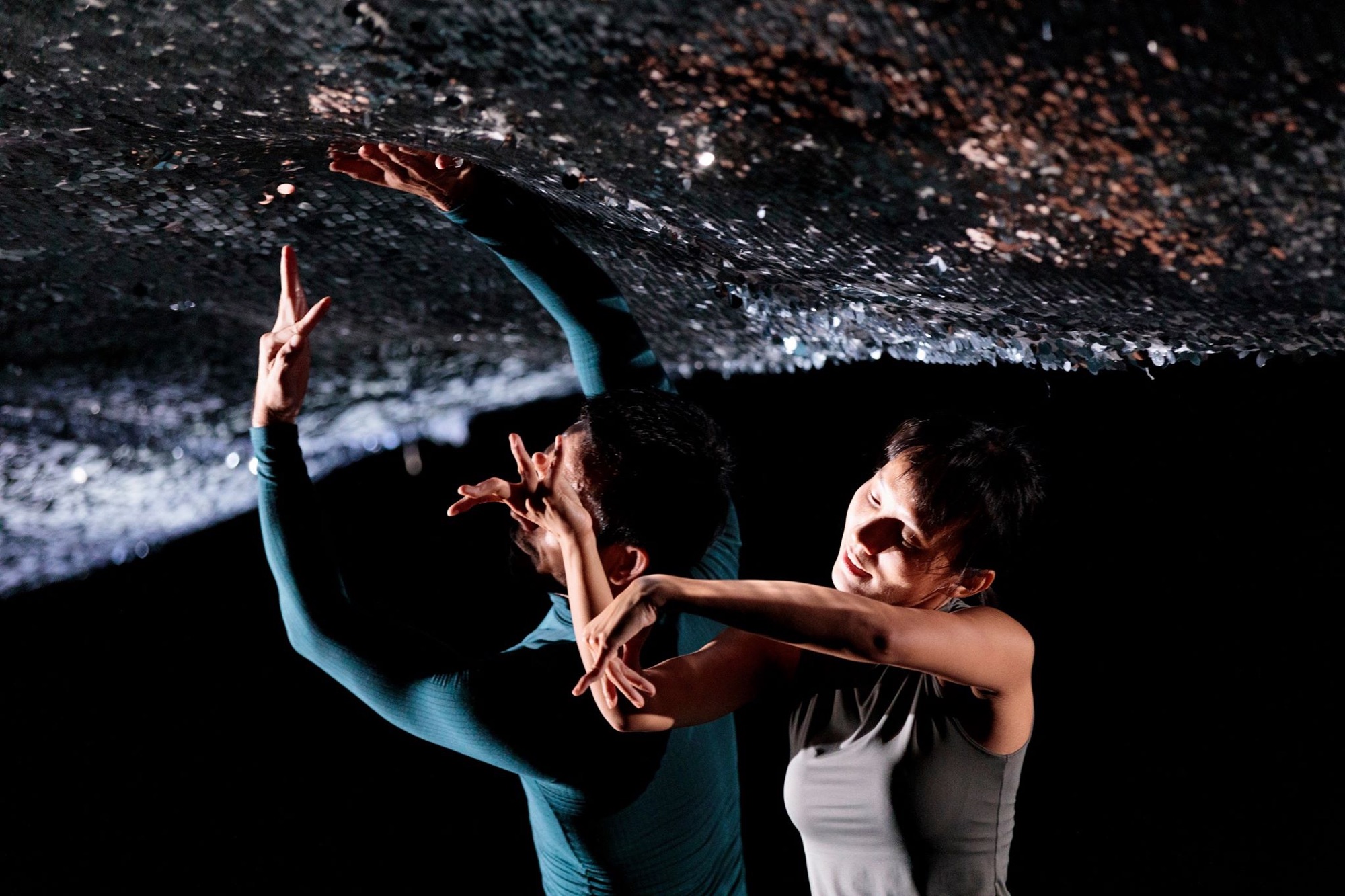
The use case for this practice of No.60 appears towards the last 15 minutes of the work. The set, a shimmery silver cloth hung from a rig descends upon the stage and the space is transformed into a glittery landscape for the dancers to explore. Set to a pulsing electronic beat, the two dancers and the musician dash across the stage shouting unintelligibly into megaphones as sirens wail loudly in the background. The dancers are performing the No.60 practice amongst the set of silver cloth; at times they are at the front of the stage, body fully visible, and other times they are amongst the cloth with their top halves obscured and only their feet visible. As the music gets more intense, the dancers collapse to the ground and tremble as flashing lights go off. There’s a sense of riot, rebellion, protest.
The work ends on a single person dancing onstage, and the diagrams we’ve seen previously flicker on and off on the ground amongst her feet, as if she’s going through all of them, holding all of them in her body, all at once. One can only break things down when you know what it is you’re breaking. That’s how deconstruction works. The final image is a silhouette of the dancer performing one of the traditional Mae Bot Yai poses, an image of the Thai dancing body.
Image by Hideto Maezawa.