Words by Josephine Leask.
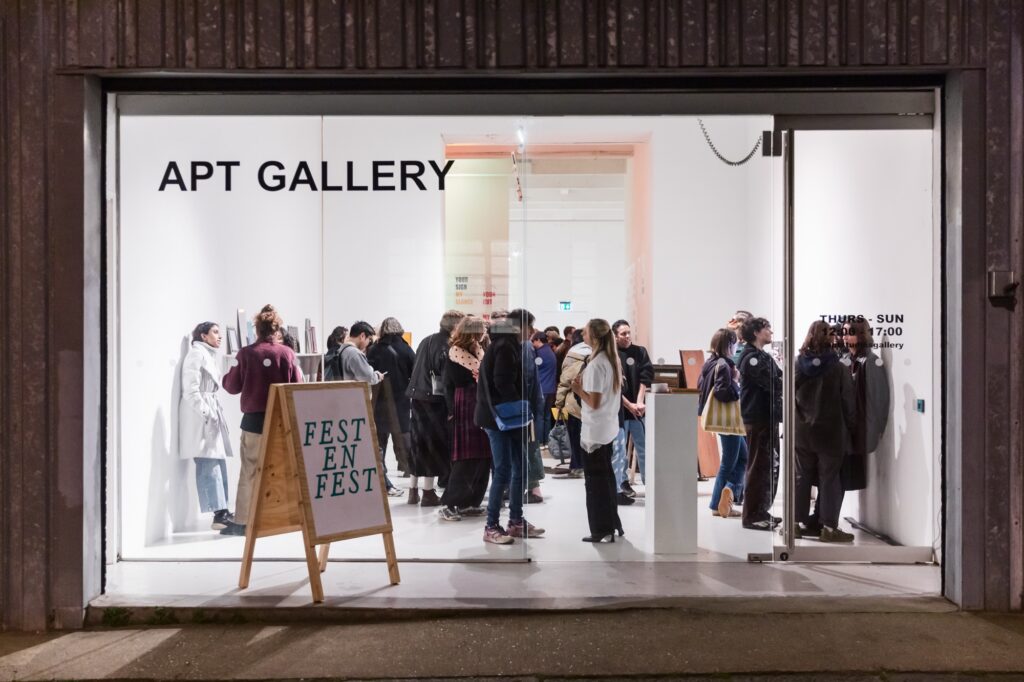
On a dark, damp March evening, the APT gallery in Deptford radiated light and energy for Fest En Fest’s opening night, marking the beginning of H2DANCE’s (Heidi Rustgaard and Hanna Gilgrin) international festival for expanded choreography.
The programme included two live performances and several artworks, all exploring connections between body, objects, sound, text, film, and installation. Each work cultivated intimacy and stirred strong emotions, blurring the boundaries between them. The evening underscored why we need festivals like this: to create more space and opportunity for artists to push dance beyond fixed forms and gender stereotypes.
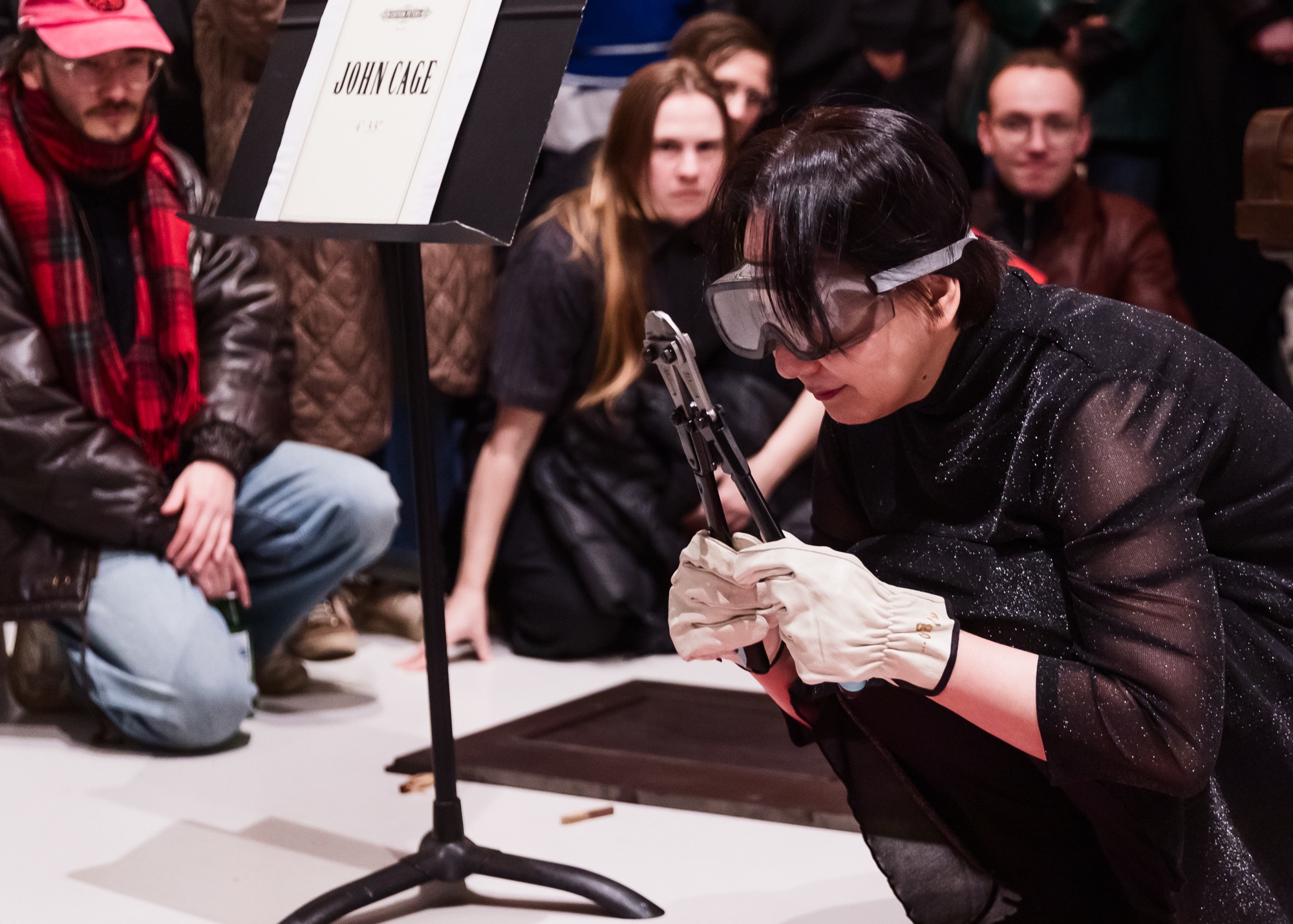
Chisato Minamimura, a Japanese performance artist and choreographer based in London, explores sound as she methodically takes apart an upright piano. Inspired by her own deafness and John Cage’s three-movement composition 4’33’’ (1952)—in which the musicians remain mostly silent and attention shifts to the surrounding environment—Minamimura invites the audience to experience both silence and the sounds she produces as she dismantles the instrument. In each of three short, formulaic sections (performed every 30 minutes), she neatly lays out her tools (hammer, pliers, saw, and screwdriver), bows to the audience, and gets to work.
She taps and strikes the keys, plucks the wire strings, and finally wrenches out the felt-covered hammers and rips up the piano’s fabric lining. Her actions are sometimes forceful, but always careful and curious. You can see her considering the sound each gesture might create, and how it resonates with us. She experiments by gently sliding a saw along the strings, tapping keys with a hammer, or suddenly striking the strings with pliers.
It is both riveting and unsettling to watch and listen to this deconstruction, which simultaneously builds a score of discordant sound and silence. Even more intriguing is the manner of her dismantling: with concentration and determination, as if performing surgery. Her unemotional presence is occasionally interrupted by flickers of frustration when her tools fail, or satisfaction when she succeeds.
It is fascinating to see the hidden anatomy of the piano exposed, yet painful to witness the extraction of strings and the breaking of keys as she exercises artistic licence, finding another purpose for the instrument. In a moment that feels triumphantly taboo, she scatters the delicate felt keypads at our feet like plucked flowers. When the disassembly is complete, she bows with dignity and walks away, leaving the demolished remains—and the sound of silence—for further contemplation.
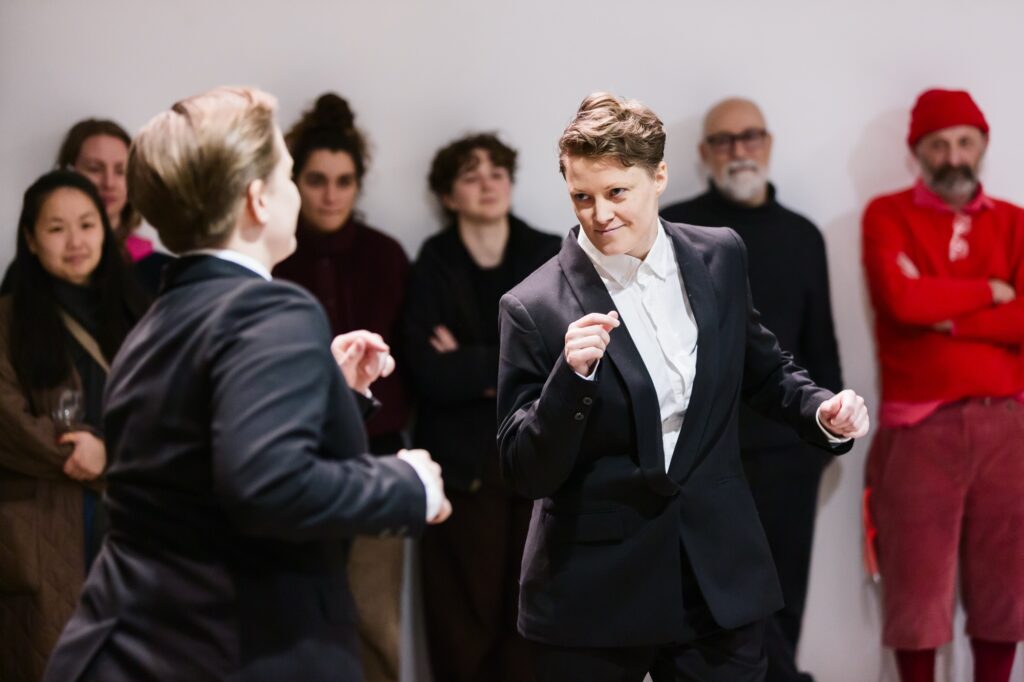
In Flirt, Norwegian dance artists Marte Sterud and Ann-Christin Kongsness take us on a very differentjourney, inviting us into an exploration of lesbian butch performativity. Wearing sleek black suits with slicked-back hair, they dance opposite each other in a generic “straight-man” mode: contained and repetitive, stepping from side to side with bent arms, clenched hands, and a stiff upper body tipped forward.
As they settle further into the groove—air-guitaring and air-drumming, biting their lower lips, pumping their arms—they reclaim these coded moves and shape a distinctive presence of female masculinity. Moving towards members of the surrounding audience, they seek attention and become flirtations—meeting our gazes, scanning our bodies—not in a predatory way, but with charm and inquisitiveness.
They take control while keeping a balance of power within the reciprocal acts of looking, desiring, and inviting our gaze. Gradually, they retreat into private fantasies and leave us with ours, melting to the floor and writhing with pleasure. I realise how rarely queer, butch female representation appears in dance. Sterud and Kongsness address this absence with a nuanced, intriguingly erotic performance of what butch can do—dismissing rigid categories.
Sterud and Kongsness continue their exploration of sexuality in their film Handy, which plays on a loop throughout the evening. The camera zooms in on a performer’s hand as it hovers above and around the groin/upper thigh.
In this minimal hand choreography, inspired by Yvonne Rainer’s Hand Movie (1966), the hand searches: enacting tiny finger gestures, lightly touching the surface it meets, then shifting into fuller patting and rubbing motions. Through repetition—and a varied palette of subtle and more expansive hand movement focused on the waist and thighs—this choreography brings elements of auto-eroticism and desire into play.
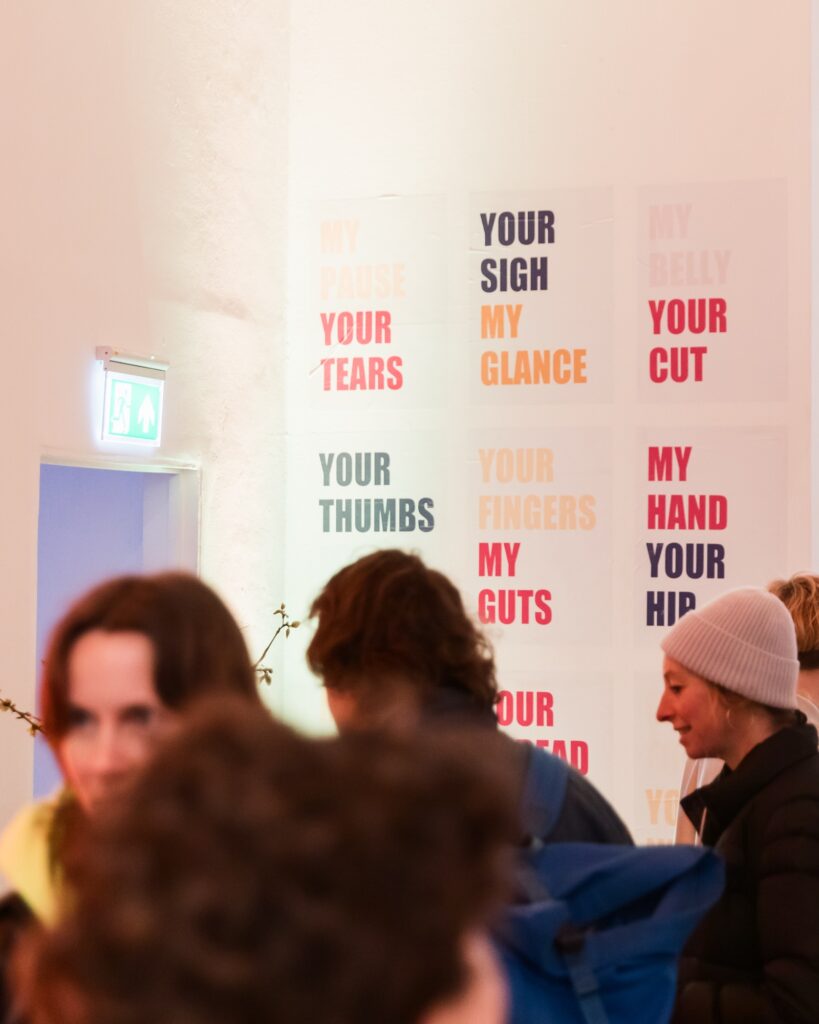
Less subtle, but similarly provocative, Salameche’s Public Intimacies covers the wall with posters juxtaposing two different parts of “my” and “your” body in bold, colourful lettering—phrases such as “My Limp Your Lips” and “Your Nose My Knee”.The score, or map, feels like a set of choreographic prompts: challenging and disorientating, as it stages collisions between bodies that might occur in either intimate or public space.
Images by Henri T.