Words by Nadia Khayrallah.
Every year, contemporary dancers from around the world flock to Israel for summer, winter, and year-round training programs, chasing cutting-edge aesthetics or an artistic awakening. Similar to how Birthright trips court Jewish young adults with a fantasy of Israel, these dance programs are invested in the potential that new generations of dancers will see Israel as a progressive arts haven rather than an ethnostate.
The Palestinian Academic and Cultural Boycott of Israel (PACBI), part of the Boycott, Divestment, and Sanctions (BDS) movement, calls for a boycott of Israeli academic and cultural institutions based on their complicity in implementing, whitewashing, or justifying the grave human rights violations perpetrated by Israel. This includes each of the institutions that offer study abroad dance programs, whether they are explicitly tied to the Israeli government or more implicitly promote Israeli cultural dominance.
Many alumni of these dance programs remain enthusiastic proponents of Israeli dance, with apolitical, centrist, or pro-Israel leanings. But a growing number of dancers who once attended these programs now support Palestinian liberation and PACBI/BDS. I interviewed four of them:
- Dr. Megan Curet – a Puerto Rican dance artist, doula, researcher, and decolonial educator from the Bronx
Lived in Tel Aviv, taking Gaga classes and intensives at Suzanne Dellal Dance Centre in 2014 at age 24
- Zoe W. – a Jewish, queer, trans dancer, arts administrator, and occupational therapy student from North Carolina
Attended Dance Jerusalem, a joint program between Jerusalem Academy of Music and Dance and the Hebrew University of Jerusalem, in 2018 during college
- Nash Wong – a Chinese-Canadian, queer, trans, and disabled interdisciplinary artist
Attended the Gaga Summer Intensive in Tel Aviv in 2017 at age 18
- lily bo shapiro – an Ashkenazi and Chinese dance artist, educator, theater technician, fundraiser, and care worker from NYC
Attended Vertigo Dance Company’s study abroad program in Jerusalem, with support from Masa Israel Journey, in 2013 at age 22
During the years of these study trips, the Israeli military continued its blockade of Gaza and occupation of the West Bank, limiting Palestinians’ freedom of movement and access to food, water, and electricity. It supported the expansion of illegal Israeli settlements in the West Bank, killed over 2000 Palestinians during the 2014 war on Gaza, and shot over 200 protesters across the border in Gaza during the 2018-2019 March of Return demonstrations. But these dancers, like most of their peers, were not initially attuned to Palestinians’ daily realities.

Some began their political awakenings during the trip and others years later. They each offer unique insights into why dance-tourism as propaganda is compelling, and why they ultimately saw through it.
Why They Went
Each dancer mentioned that the increasing popularity of Gaga drew them to explore dance in Israel. Gaga is the improvisation-based “movement language” developed by Batsheva Dance Company’s Ohad Naharin, which gained international traction in the 2010s and is now offered in 20 countries.
Zoe had watched the Ohad Naharin documentary “Mr. Gaga,” which made Gaga seem fun, inviting, and accessible to all movers. Nash, who encountered Gaga at a summer intensive in high school, felt “liberated” by Gaga’s internal focus, emphasis on pleasure, and absence of a strict structure, in contrast to their ballet-based contemporary training. Megan was drawn to Gaga as a more physically sustainable way to move, as opposed to the harshness of her Graham technique training. lily bo heard messaging that there was something “more real or raw about the dancing coming out of Israel–that there’s nothing like what comes out of a major conflict zone.”
These dancers embarked on their study abroad trips without established politics around Zionism, though lily bo wondered if they would feel a “sense of home and connection” related to their Jewish identity. Most held myths that the “conflict,” was too complicated to understand, eternal, or unfixable. Zoe was a bit more politically primed, having heard from friends who were critical of Israel, but they remained “undecided” and hoped that studying abroad would inform their perspective.
Brand Israel and Tel Aviv Dance Tourism
Politically disengaged North Americans are the prime target for Israel’s 21st century “national branding” strategy, called Brand Israel. In contrast to older strategies focused on spreading pro-Israel political arguments, this new approach relies on art, culture, tourism, and business to give international audiences positive emotional associations with Israel that distract from politics. The combination of pleasure-driven contemporary dance and tourism fits perfectly into this model, creating emotional appeal with little politically explicit content.
Students are particularly likely to have a positive and apolitical experience in Tel Aviv, a trendy, beachside city with few Palestinians. Nash describes their time in Tel Aviv as “carefree,” “taking Gaga classes, going to the beach, eating falafel and hummus every day,” and having their first nightlife experiences. Similarly, Megan describes how she initially romanticized Tel Aviv, thinking “I get to do this beautiful movement in a place where a lot of dancers from around the world are heading; I get to live in this place that’s so cool and so safe.”

Mixed Feelings in Jerusalem
The “tourism propaganda,” as Megan calls it, faces more interruptions in Jerusalem, a multiethnic city with visible signs of apartheid and militarism. Zoe remembers the militarized campus security, the visible wall separating Jerusalem from the West Bank, and warnings to stay out of Arab areas of town. lily bo recalls sharing housing with “loan soldiers” (foreign soldiers serving in the Israeli military) and seeing teenagers carrying guns in public.
For lily bo, Jerusalem felt “heavy and thick” with the sense of “weight and history and gravity.” In contrast, their decidedly apolitical training with Vertigo felt “detached from anything else.” They left the program early, unsure of why they were there, but compelled to learn more intellectually and politically.
Zoe didn’t quite process their observations at the time, but they suspect that their disillusionment with the Israeli dance scene helped them begin to deromanticize their surroundings. Initially enamored by the beauty and proclaimed inclusivity of Gaga, they eventually realized that its professional standards were the same as American standards, “still prioritizing skinny, white, able-bodied people.” In contrast, they noticed that classmates who were favored within this aesthetic were less critical, remaining apolitical or shifting further toward Zionism after the program.
Breaking the Fantasy
For Megan, the fantasy broke during the 2014 War on Gaza with the realization that “the people around you can justify the murder of so many civilians.” Her own experiences with racism helped her see through common arguments talking points that blamed Palestinians for the violence against them or insisted that the land was uninhabited and uncultivated before Israeli presence. “I’m grateful for being Black, and I’m grateful for being Latina, because at some point, when you listen to it enough, you start to say, ‘hold on, a lot of this sounds familiar.’”
This recognition prompted Megan to visit the West Bank and engage with Palestinian dancers. Still, for years, she remained illusioned about the surface liberalism of the Israeli dance scene and the potential of artistic collaboration alone to create peace. But by 2017, after several trips to the West Bank and harrowing conversations with liberal Zionist colleagues, she concluded that “there was no way out of this that involves normalization with Zionism” and began supporting the cultural boycott.
For others, social media videos shifted their awareness. For Zoe, it was a video of settlers in the West Bank taking over a Palestinian family’s house in 2020. For Nash, it was Israeli police storming the Al-Aqsa Mosque in Jerusalem in 2021. For both, these videos prompted a deeper engagement with Palestinian history and activism. Nash credits their developing political consciousness around other issues of racism and colonialism, sparked by the resurgence of Black Lives Matter in 2020, for helping them recognize colonialism in the Palestinian context.
Words of Advice
Even though some dancers found their way to the Palestinian liberation movement obliquely through studying abroad in Israel, they don’t recommend taking the same path. Zoe says “For people who are considering studying abroad [in Israel], I want them to know that there are ways to learn and grow as a dancer and in your political perspective without having to feed into the propaganda machine. And if you did, it’s okay to learn and grow after.”
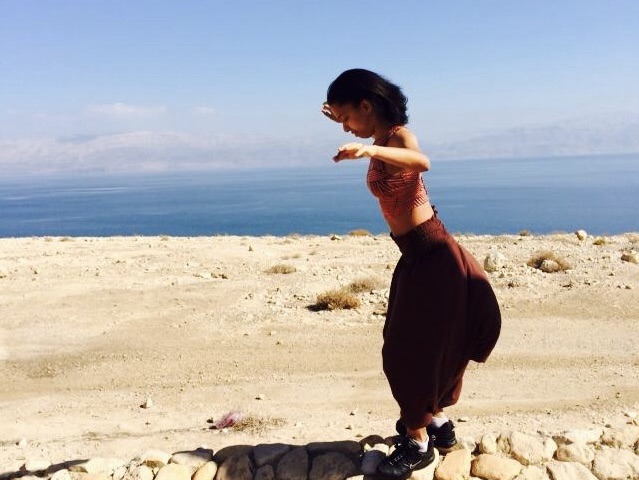
Header image is Dr Megan Curet at the Dead Sea.